First-Party Data: The Future of Attribution Models for US Brands in 2026

The Future of Attribution Models in 2026: Understanding the Impact of First-Party Data for US Brands (INSIDER KNOWLEDGE)
The digital marketing landscape is in a constant state of flux, but few shifts have been as profound or as rapid as the move towards a privacy-first world. As we hurtle towards 2026, US brands are grappling with the imminent obsolescence of third-party cookies and the increasing regulatory scrutiny around data privacy. This paradigm shift isn’t just a challenge; it’s a monumental opportunity for those who strategically embrace First-Party Data Attribution. This comprehensive guide offers an insider’s look into how first-party data will redefine attribution models, empower more precise marketing, and drive sustainable growth for US brands in the coming years.
The Erosion of Third-Party Cookies: A Catalyst for Change
For years, third-party cookies have been the bedrock of digital advertising, enabling cross-site tracking, audience segmentation, and multi-touch attribution. However, their reign is rapidly coming to an end. Major browsers like Safari and Firefox have already blocked them, and Google Chrome’s planned deprecation, now scheduled for late 2024, signals the definitive end of an era. This isn’t merely a technical update; it’s a fundamental reshaping of how marketers understand customer journeys and attribute value across touchpoints.
The implications for US brands are vast. Traditional attribution models, heavily reliant on third-party data for a holistic view of customer interactions, will become increasingly ineffective. Marketers will lose visibility into certain customer behaviors, making it harder to connect the dots between ad impressions, website visits, and conversions. The ability to retarget audiences and personalize experiences will also be significantly hampered. This necessitates a proactive and strategic pivot towards alternative data sources, with First-Party Data Attribution emerging as the undisputed champion.
What is First-Party Data and Why is it Gold?
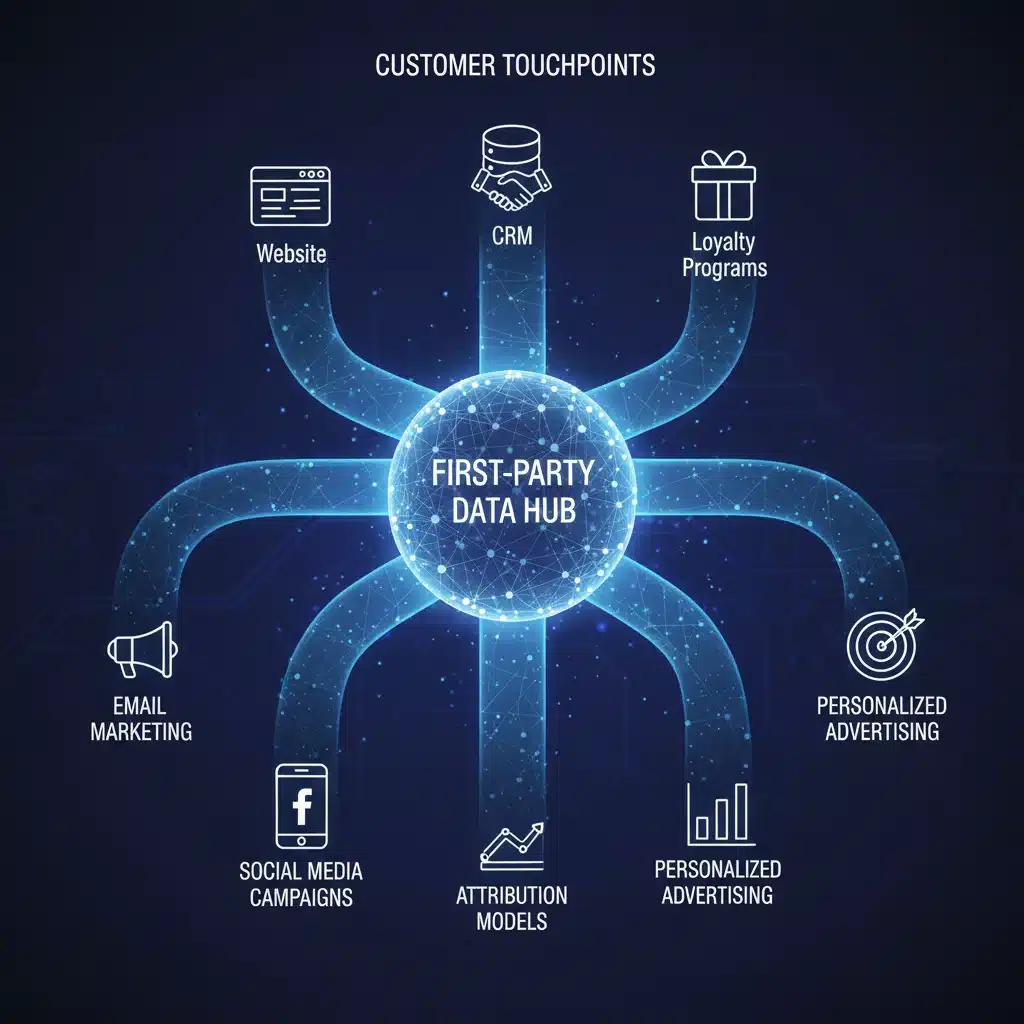
First-party data is information that a company collects directly from its customers or audience. This can include data from:
- Website and App Interactions: Page views, clicks, time spent, search queries, downloads, items added to cart, purchase history.
- CRM Systems: Customer contact information, demographics, purchase history, service interactions.
- Subscription and Loyalty Programs: Preferences, engagement levels, redemption history.
- Email and SMS Marketing: Open rates, click-through rates, subscription preferences.
- Surveys and Feedback Forms: Direct customer opinions, needs, and preferences.
- Offline Interactions: In-store purchases, call center data.
Unlike third-party data, which is collected by an entity that doesn’t have a direct relationship with the user, first-party data is proprietary, consent-based (ideally), and inherently more reliable. It represents direct signals of customer intent and behavior, offering unparalleled insights into their journey with your brand. This direct relationship fosters trust and provides a solid foundation for ethical and effective marketing strategies.
The Inherent Advantages of First-Party Data:
- Accuracy and Reliability: It’s your data, collected directly, ensuring higher fidelity than aggregated or inferred third-party data.
- Relevance: It directly reflects interactions with your brand, making it highly relevant for understanding your specific customer base.
- Exclusivity: It’s unique to your business, providing a competitive advantage that cannot be replicated by competitors.
- Cost-Effectiveness: While there are costs associated with collection and management, you’re not paying a premium to acquire it from external sources.
- Privacy Compliance: When collected with proper consent and transparency, first-party data aligns better with evolving privacy regulations like GDPR and CCPA, mitigating compliance risks.
Redefining Attribution Models with First-Party Data by 2026
The shift to First-Party Data Attribution isn’t just about replacing lost data; it’s about building more robust, insightful, and privacy-centric attribution models. By 2026, US brands will move beyond simplistic last-click or even linear models, embracing more sophisticated approaches powered by their own customer insights.
1. Enhanced Probabilistic and Algorithmic Models:
Without deterministic third-party cookies, probabilistic models will gain prominence. These models use statistical analysis and machine learning to infer user journeys based on patterns within first-party data (e.g., IP addresses, device types, operating systems, login data). With a rich repository of first-party data, these models can become incredibly accurate, predicting the likelihood of conversion based on various touchpoints and sequences.
2. Customer Journey Mapping with Greater Granularity:
First-Party Data Attribution allows brands to stitch together a more complete picture of the customer journey across their own properties. By tracking user behavior on their website, mobile app, email interactions, and even offline purchases, brands can map out complex paths to conversion. This granularity helps identify critical touchpoints, bottlenecks, and the true impact of different marketing efforts.
3. Identity Resolution Powered by First-Party Identifiers:
The ability to unify customer identities across various internal systems will be paramount. This involves creating a persistent, privacy-compliant ID for each customer, often linked to email addresses, loyalty program IDs, or authenticated logins. This unified ID, built on first-party data, becomes the backbone for accurate cross-device and cross-channel attribution, even without third-party cookies.
4. The Rise of Customer Data Platforms (CDPs):
CDPs are becoming indispensable for managing and activating first-party data. They consolidate customer data from disparate sources into a single, unified profile, making it accessible for analytics, segmentation, and activation across various marketing channels. By 2026, a robust CDP will be a non-negotiable tool for any US brand serious about optimizing their First-Party Data Attribution strategy.
5. Leveraging Predictive Analytics and Machine Learning:
With a wealth of historical first-party data, brands can employ machine learning algorithms to predict future customer behavior, identify high-value segments, and optimize budget allocation. Predictive attribution models can forecast the impact of different marketing mixes on future conversions, moving beyond simply reporting past performance to actively shaping future outcomes.
Challenges and Strategic Imperatives for US Brands
While the benefits of First-Party Data Attribution are clear, its implementation is not without its challenges. US brands must strategically navigate these hurdles to fully capitalize on this shift.
Challenge 1: Data Collection and Integration
Many organizations have customer data scattered across various silos – CRM, email platforms, e-commerce systems, customer service databases. The first major hurdle is to consolidate and integrate this data into a unified view. This requires significant investment in data infrastructure and potentially new technologies like CDPs.
Strategic Imperative: Invest in a robust data architecture. Implement a CDP or similar solution to centralize first-party data. Develop a clear data governance strategy to ensure data quality, consistency, and accessibility across the organization.
Challenge 2: Privacy and Consent Management
Collecting first-party data comes with the responsibility of protecting customer privacy. US brands must adhere to evolving regulations like CCPA, CPRA, and a patchwork of state-specific privacy laws. Transparency and explicit consent are paramount.
Strategic Imperative: Implement strong consent management platforms (CMPs) and privacy policies. Clearly communicate to users what data is collected, why it’s collected, and how it’s used. Provide easy-to-use tools for users to manage their data preferences and opt-outs. Build trust through transparent data practices.
Challenge 3: Data Quality and Hygiene
Garbage in, garbage out. The effectiveness of any attribution model, especially one based on first-party data, hinges on the quality of the data. Inaccurate, incomplete, or duplicate data can lead to flawed insights and misguided marketing decisions.
Strategic Imperative: Establish rigorous data quality standards and processes. Regularly audit and cleanse your first-party data. Implement validation rules at the point of data collection. Train staff on data entry best practices.
Challenge 4: Skill Gap and Organizational Silos
Leveraging first-party data effectively requires a blend of technical skills (data engineering, data science) and marketing expertise (analytics, strategy). Many organizations face a skill gap in these areas, and internal silos can prevent the seamless flow of data and insights between departments.
Strategic Imperative: Invest in upskilling existing marketing and data teams. Hire data scientists and analysts with expertise in attribution modeling and machine learning. Foster cross-functional collaboration between marketing, IT, and data teams to break down silos and ensure a unified approach to data utilization.
Challenge 5: Measuring Incrementality
Even with robust First-Party Data Attribution, understanding true incrementality – what would have happened without a particular marketing touchpoint – remains a challenge. Correlation does not equal causation, and isolating the true impact of an intervention is crucial for optimizing spend.
Strategic Imperative: Incorporate experimental design (A/B testing, holdout groups) into your marketing strategies. Utilize advanced statistical methods to measure incrementality, moving beyond observational attribution to controlled experiments. This provides a more accurate understanding of ROI for various marketing activities.
Actionable Steps for US Brands to Prepare for 2026
The time to act is now. US brands that proactively build their first-party data capabilities will be best positioned to thrive in the post-cookie era. Here are concrete steps to take:
1. Audit Your Current Data Landscape:
Understand what first-party data you currently collect, where it resides, and how it’s being used. Identify gaps and opportunities for more comprehensive data collection.
2. Prioritize Data Collection Strategies:
Focus on creating compelling value propositions for customers to share their data. This could include loyalty programs, personalized experiences, exclusive content, or early access to products. Make data collection an integral part of the customer experience.
3. Invest in a CDP or Enhance Existing Data Infrastructure:
A centralized platform is crucial for unifying, managing, and activating first-party data. Evaluate different CDP solutions or explore how existing CRM and data warehouse systems can be enhanced to serve this purpose.
4. Develop a Robust Identity Resolution Strategy:
Implement methods to link disparate customer interactions across devices and channels using privacy-compliant first-party identifiers. This is fundamental for accurate First-Party Data Attribution.
5. Embrace Advanced Analytics and Machine Learning:
Move beyond basic reporting to leverage predictive analytics and machine learning for deeper insights into customer behavior and attribution. This will enable more proactive and adaptive marketing strategies.
6. Strengthen Privacy and Trust:
Ensure your data collection and usage practices are transparent, compliant with all relevant regulations, and focused on building customer trust. Privacy by design should be a core principle.
7. Foster a Data-Driven Culture:
Encourage all departments to understand the value of first-party data and how it contributes to business success. Provide training and resources to empower employees to utilize data effectively.

The Competitive Edge of First-Party Data Attribution
By 2026, US brands that have successfully transitioned to a First-Party Data Attribution model will gain a significant competitive edge. They will be able to:
- Optimize Marketing Spend More Effectively: By accurately attributing conversions to specific touchpoints and campaigns, brands can reallocate budgets to the most impactful channels, maximizing ROI.
- Deliver Hyper-Personalized Customer Experiences: A deep understanding of individual customer preferences and behaviors, derived from first-party data, enables highly relevant messaging and offers, fostering stronger customer relationships and loyalty.
- Improve Customer Lifetime Value (CLTV): By understanding the entire customer journey and identifying factors that drive retention and repeat purchases, brands can implement strategies to increase CLTV.
- Innovate Faster: Rich first-party data provides a fertile ground for product development, service improvements, and new marketing initiatives, all driven by genuine customer needs and insights.
- Build Resilience Against Future Privacy Changes: By owning and controlling their data strategy, brands become less reliant on external data sources and better prepared for future shifts in the regulatory and technological landscape.
Looking Beyond 2026: The Continuous Evolution
The journey towards a first-party data-centric world doesn’t end in 2026; it’s an ongoing evolution. As technology advances and consumer expectations shift, attribution models will continue to adapt. The brands that maintain a culture of continuous learning, data experimentation, and customer-centricity will be the ones that consistently lead the market.
The future of marketing is deeply personal and built on trust. First-Party Data Attribution is not just a technical solution to a privacy challenge; it’s a strategic imperative that empowers US brands to build more meaningful relationships with their customers, drive sustainable growth, and truly understand the value of every interaction. Embracing this change now is not just about survival; it’s about unlocking unprecedented opportunities for innovation and competitive advantage.