From Idea to IPO: A 3-Year Roadmap for U.S. Tech Startups Targeting 2026-2028 Growth

In the dynamic and often exhilarating world of technology, the dream of taking a startup from a nascent idea to a flourishing public company is a powerful motivator. For U.S. tech startups, the period between 2026 and 2028 presents a fascinating window of opportunity for an Initial Public Offering (IPO). This ambitious goal requires meticulous planning, strategic execution, and an unwavering commitment to growth and compliance. This article provides a comprehensive 3-year roadmap, detailing the essential steps and considerations for U.S. tech startups aiming to achieve this significant milestone. Understanding this tech startup IPO roadmap is not just about reaching an endpoint; it’s about building a sustainable, valuable enterprise.
The journey to an IPO is multifaceted, demanding excellence in product development, market penetration, financial management, legal compliance, and team building. It’s a marathon, not a sprint, and every stage requires distinct focuses and objectives. Our roadmap is designed to break down this complex process into manageable phases, ensuring that startups are well-prepared for the scrutiny and demands of the public market. From securing initial capital to navigating regulatory hurdles, each element plays a critical role in the ultimate success of a public offering.
Year 1: Foundation, Validation, and Early Growth (2025-2026)
The first year of our tech startup IPO roadmap is all about laying a solid foundation. This period is crucial for validating your core idea, building a minimum viable product (MVP), securing initial funding, and establishing early market traction. Without a strong foundation, subsequent growth phases will be significantly more challenging.
Phase 1: Idea Validation and Market Fit (Months 1-4)
Before any significant investment in development, thorough idea validation is paramount. This involves extensive market research to identify a clear problem, understand your target audience, and analyze the competitive landscape. What unique value does your solution offer? What unmet need does it address? Conduct surveys, interviews, and focus groups to gather qualitative and quantitative data. This initial validation will inform your product strategy and help refine your unique selling proposition (USP).
Developing a compelling business plan is another critical step. This document should clearly articulate your vision, mission, product/service, market analysis, marketing strategy, management team, and financial projections. It serves as your internal compass and a vital tool for attracting early investors. Simultaneously, focus on assembling a lean, agile founding team with diverse skill sets. The strength and cohesion of your early team are often as important as the idea itself.
Phase 2: Product Development and MVP Launch (Months 5-8)
With a validated idea and a solid team, the focus shifts to product development. The goal here is to build a Minimum Viable Product (MVP) – a version of your product with just enough features to satisfy early customers and provide feedback for future product development. The MVP allows you to test core hypotheses, gather user data, and iterate quickly without over-investing in features that may not resonate with the market.
Agile development methodologies are highly recommended during this phase, enabling rapid iteration and responsiveness to user feedback. Prioritize features that deliver the most value and address the core problem identified in your validation phase. User experience (UX) and user interface (UI) design should be a priority, ensuring your product is intuitive and enjoyable to use. Early customer feedback is invaluable; actively solicit it and use it to refine your product. This iterative process is fundamental to building a product that truly meets market needs.
Phase 3: Seed Funding and Early Traction (Months 9-12)
Securing seed funding is often the first significant financial milestone for a tech startup. This capital typically comes from angel investors, incubators, accelerators, or very early-stage venture capitalists. To attract seed funding, you’ll need to demonstrate a compelling vision, a strong team, a viable MVP, and early signs of market traction. This might include beta users, positive feedback, or early revenue figures.
Alongside fundraising, concentrate on acquiring your first paying customers or a substantial user base. This early traction proves that there’s a demand for your product and that people are willing to use or pay for it. Develop a robust go-to-market strategy, focusing on channels that efficiently reach your target audience. This could involve content marketing, social media, strategic partnerships, or early adopter programs. Establishing key performance indicators (KPIs) and consistently tracking them will be crucial for demonstrating progress and informing future strategies. This initial year sets the stage for the ambitious tech startup IPO roadmap.
Year 2: Scaling, Market Expansion, and Series A/B Funding (2026-2027)
Year two of the tech startup IPO roadmap is characterized by accelerated growth, scaling operations, expanding your market reach, and securing more substantial funding rounds. This is where your business model is truly tested and refined for broader impact.
Phase 1: Product-Market Fit and Growth Hacking (Months 13-18)
Having achieved early traction, the focus shifts to proving definitive product-market fit. This means your product consistently satisfies a strong market demand, and you can demonstrate repeatable, scalable growth. Analyze user data, retention rates, and customer lifetime value (CLTV) to understand the true impact of your product. Continuously iterate on your product based on user feedback and market trends, adding features that enhance value and engagement.
Implement growth hacking strategies to rapidly expand your user base or customer count. This involves creative, data-driven approaches to marketing and product development that aim for maximum impact with minimal resources. Experiment with different channels, A/B test messaging, and leverage viral loops within your product if applicable. The goal is to achieve exponential growth and build a strong, loyal customer base. Scaling your customer support and success teams is also vital during this period to maintain high customer satisfaction as you grow.
Phase 2: Team Expansion and Operational Scaling (Months 19-24)
Rapid growth necessitates significant team expansion. Recruit key talent across various departments, including engineering, sales, marketing, operations, and finance. Focus on building a strong leadership team that can drive the company’s vision and manage growing complexities. Culture fit and alignment with the company’s values are paramount during this hiring spree. Develop robust onboarding processes to integrate new employees effectively and maintain productivity.
Simultaneously, scale your operational infrastructure. This includes upgrading technology, optimizing internal processes, and potentially expanding physical office space or remote work capabilities. Ensure your technical infrastructure can handle increased user load and data volume. Establish clear communication channels and project management systems to maintain efficiency as the team grows. This operational scaling is critical for managing the increased demands that come with preparing for a public offering.
Phase 3: Series A and B Funding Rounds (Months 25-30)
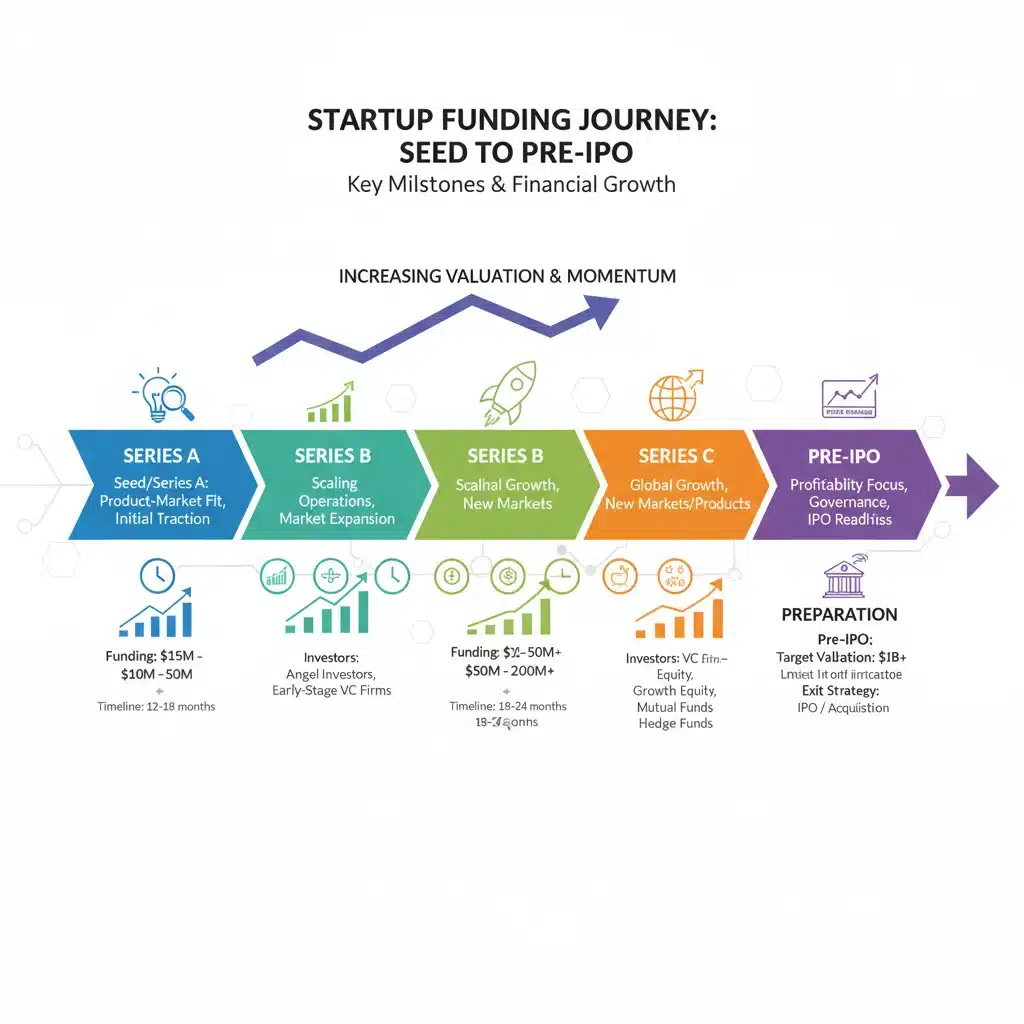
Securing Series A and Series B funding is a major milestone in the tech startup IPO roadmap. Series A typically ranges from $2 million to $15 million and is used to further develop the product, expand the team, and grow the user base. Series B, often between $15 million and $50 million, focuses on scaling the business model, entering new markets, and potentially acquiring smaller companies.
To attract these rounds, you’ll need to demonstrate significant traction, a clear path to profitability, a scalable business model, and a strong leadership team. Prepare detailed financial models, growth projections, and a compelling investor deck. Engage with venture capital firms that specialize in your industry and have a track record of supporting companies through to IPO. Building relationships with these investors early on can be highly beneficial. Due diligence during these rounds will be intense, so ensure your financials, legal documents, and intellectual property are meticulously organized.
Year 3: Pre-IPO Preparation, Governance, and Public Offering (2027-2028)
The final year of our tech startup IPO roadmap is the most intense, focusing entirely on preparing for and executing the Initial Public Offering. This involves stringent financial audits, establishing robust governance, and navigating the complex regulatory landscape.
Phase 1: Financial Readiness and Governance (Months 31-36)
Achieving financial readiness for an IPO is a monumental task. This involves preparing several years of audited financial statements in accordance with GAAP (Generally Accepted Accounting Principles). Engage with a reputable accounting firm specializing in IPOs to ensure all financial records are impeccable and meet public company standards. This also includes establishing robust internal controls and financial reporting systems that can withstand public scrutiny.
Corporate governance becomes paramount. Establish an independent board of directors with a mix of industry experts, financial gurus, and legal professionals. Implement best-in-class governance practices, including audit committees, compensation committees, and clear policies for executive compensation, risk management, and ethical conduct. Transparency and accountability are key. Your legal team will also be busy ensuring all corporate documents, contracts, and intellectual property are in perfect order.
Phase 2: Pre-IPO Fundraising (Series C/D) and Underwriter Selection (Months 37-42)
Leading up to an IPO, many startups opt for a late-stage private funding round, often Series C or D. This capital provides a war chest for IPO expenses, further growth initiatives, and a cushion against market volatility. These rounds typically involve growth equity firms and institutional investors looking for pre-IPO opportunities. The valuation at this stage will be a strong indicator of your potential IPO valuation.
Selecting the right investment bank(s) to act as underwriters is a critical decision. These banks will guide you through the entire IPO process, including valuation, marketing, and distribution of shares. Interview multiple firms, considering their experience in your sector, their research capabilities, and their network of institutional investors. The relationship with your lead underwriter will be one of the most important partnerships during this phase of the tech startup IPO roadmap.
Phase 3: S-1 Filing, Roadshow, and Pricing (Months 43-48)
The formal IPO process begins with the filing of the S-1 registration statement with the U.S. Securities and Exchange Commission (SEC). This comprehensive document provides detailed information about your company’s business, finances, management, and risks. The S-1 filing is a public document and will undergo intense scrutiny from the SEC and potential investors. This is an iterative process, involving multiple rounds of comments and revisions.
Once the S-1 is nearing completion, the company embarks on a ‘roadshow.’ This involves presentations to institutional investors across various cities, pitching your company’s story, growth prospects, and investment thesis. The roadshow is crucial for building investor interest and determining the demand for your shares. Based on investor feedback and market conditions, the underwriters will help you determine the final IPO price and the number of shares to be offered. This delicate balance of valuation and market appetite is key to a successful offering.
Phase 4: IPO Day and Beyond (Months 49-50)
IPO day is the culmination of years of hard work and dedication. Your company’s shares begin trading on a public exchange (e.g., NASDAQ or NYSE). While it’s a moment of celebration, it also marks the beginning of a new chapter as a public company. The demands of public ownership are significant, requiring ongoing transparency, consistent financial reporting, and effective communication with shareholders and the market.
Post-IPO, the focus shifts to maintaining investor confidence, delivering on growth promises, and navigating quarterly earnings calls. The company must adhere to strict regulatory requirements, including Sarbanes-Oxley (SOX) compliance. Continued innovation, strategic acquisitions, and market leadership will be crucial for long-term success and shareholder value creation. The journey doesn’t end with the IPO; it evolves into a new set of challenges and opportunities within the public domain.

Key Considerations and Challenges in the Tech Startup IPO Roadmap
While this tech startup IPO roadmap provides a clear path, several overarching considerations and potential challenges must be addressed throughout the journey.
Market Conditions and Timing
The broader economic and market conditions play a significant role in IPO success. Favorable market sentiment, strong investor appetite for tech stocks, and a stable regulatory environment can greatly enhance the chances of a successful public offering. Conversely, economic downturns or market volatility can delay or derail IPO plans. Timing your IPO correctly requires keen market awareness and flexibility.
Competitive Landscape
The tech industry is notoriously competitive. Startups must continuously differentiate themselves, innovate, and maintain a competitive edge. This involves staying ahead of emerging technologies, understanding competitor strategies, and protecting intellectual property. A strong, defensible position in the market is highly attractive to public investors.
Regulatory Compliance and Legal Hurdles
Navigating the complex web of SEC regulations, state laws, and international compliance requirements can be daunting. From data privacy (e.g., GDPR, CCPA) to industry-specific regulations, ensuring full legal compliance is non-negotiable. Engaging experienced legal counsel early and continuously is essential to avoid costly missteps.
Talent Acquisition and Retention
Attracting and retaining top talent is a perpetual challenge for tech startups. As you scale, the demand for skilled engineers, product managers, sales professionals, and finance experts intensifies. Offering competitive compensation, a compelling company culture, opportunities for growth, and meaningful equity incentives are crucial for building and maintaining a high-performing team capable of executing the tech startup IPO roadmap.
Sustainable Growth and Profitability
While hyper-growth is often celebrated, investors increasingly look for a clear path to sustainable profitability. Balancing growth at all costs with prudent financial management is key. Demonstrating efficient unit economics, strong gross margins, and a viable business model that can generate consistent free cash flow will be critical for attracting and retaining public investors.
Cybersecurity and Data Protection
In an increasingly digital world, robust cybersecurity measures and stringent data protection protocols are not just best practices; they are fundamental requirements. A data breach can have catastrophic consequences, impacting customer trust, brand reputation, and financial stability. Public companies face even greater scrutiny in this regard, making continuous investment in cybersecurity infrastructure and policies paramount.
Conclusion
The journey from a groundbreaking idea to a successful IPO is undoubtedly one of the most challenging yet rewarding endeavors a U.S. tech startup can undertake. This 3-year tech startup IPO roadmap provides a strategic framework for founders and leadership teams aiming for a public offering between 2026 and 2028. It emphasizes the importance of a strong foundation, disciplined growth, meticulous financial preparation, and robust corporate governance.
Success in this ambitious endeavor hinges on a combination of vision, execution, adaptability, and an unwavering commitment to building a company that delivers enduring value to its customers, employees, and, ultimately, its shareholders. By diligently following these steps and proactively addressing potential challenges, U.S. tech startups can significantly increase their chances of navigating the complex path to becoming a publicly traded entity, realizing their full potential, and making a lasting impact on the global technology landscape.