Sustainable Growth: ESG Frameworks for U.S. Startups in 2026

In an increasingly conscious global economy, the traditional metrics of success for startups are evolving. Beyond profit margins and market share, investors, consumers, and employees are scrutinizing a company’s impact on the environment, its social responsibility, and its governance practices. This shift has propelled Environmental, Social, and Governance (ESG) considerations from a niche concern to a mainstream imperative. For U.S. startups aiming for sustained growth and resilience in 2026 and beyond, integrating robust ESG frameworks is no longer optional; it’s a strategic necessity.
The landscape for startups is dynamic, characterized by rapid innovation, intense competition, and a constant need to attract capital. In this environment, demonstrating a commitment to ESG principles can be a powerful differentiator. It signals foresight, responsible management, and an understanding of long-term value creation. Furthermore, regulatory pressures, supply chain demands, and the growing influence of impact investing mean that early adoption of ESG frameworks can provide a significant competitive advantage.
This comprehensive guide delves into four pivotal ESG frameworks that U.S. startups should consider adopting by 2026. We will explore the Global Reporting Initiative (GRI) Standards, the Sustainability Accounting Standards Board (SASB) Standards, the Task Force on Climate-related Financial Disclosures (TCFD), and the B Corp Certification. Each framework offers a unique lens through which to view and manage ESG performance, and understanding their nuances is key to selecting the right fit for your burgeoning enterprise. By proactively aligning with these frameworks, startups can not only mitigate risks and enhance their reputation but also unlock new opportunities for innovation, talent acquisition, and sustainable financial performance.
The Growing Importance of ESG for U.S. Startups
The term ESG encompasses a broad spectrum of non-financial factors that investors use to evaluate a company’s sustainability and ethical impact. Environmental criteria consider a company’s energy use, waste, pollution, natural resource conservation, and treatment of animals. Social criteria examine a company’s business relationships, including its labor practices, diversity and inclusion, human rights, and community engagement. Governance criteria deal with a company’s leadership, executive pay, audits, internal controls, and shareholder rights.
Why ESG is Crucial for Startups in 2026
- Investor Attraction: A significant and growing portion of investment capital is flowing into ESG-aligned funds. Venture capitalists and institutional investors are increasingly incorporating ESG criteria into their due diligence processes. Startups with a clear ESG strategy are more attractive to this capital, potentially leading to better valuations and easier fundraising rounds.
- Enhanced Reputation and Brand Value: Consumers, particularly younger generations, are more likely to support brands that demonstrate social and environmental responsibility. A strong ESG profile can foster customer loyalty, differentiate a startup in a crowded market, and build a positive brand image that resonates with its target audience.
- Risk Management: Proactive identification and management of ESG risks can prevent future liabilities. This includes everything from supply chain disruptions due to climate change, reputational damage from labor disputes, or legal repercussions from data privacy breaches.
- Operational Efficiency and Cost Savings: Implementing sustainable practices, such as energy efficiency or waste reduction, can lead to significant cost savings in the long run. ESG initiatives often drive innovation in processes and products, enhancing overall operational efficiency.
- Talent Acquisition and Retention: Top talent, especially millennials and Gen Z, seek employers whose values align with their own. Startups with strong ESG commitments are better positioned to attract and retain skilled employees, fostering a motivated and productive workforce.
- Regulatory Compliance: While comprehensive federal ESG regulations for private companies are still evolving in the U.S., state-level initiatives and global trends suggest an increasing regulatory environment. Early adoption of frameworks can prepare startups for future compliance requirements.
- Long-Term Value Creation: Integrating ESG into the core business strategy shifts the focus from short-term gains to long-term value creation, building a more resilient, adaptable, and sustainable business model.
The competitive advantage gained by embracing ESG is undeniable. Startups that embed these principles early in their journey are not just doing good; they are building better businesses, poised for sustainable growth and greater success in the coming years.
1. Global Reporting Initiative (GRI) Standards: The Universal Language of Sustainability
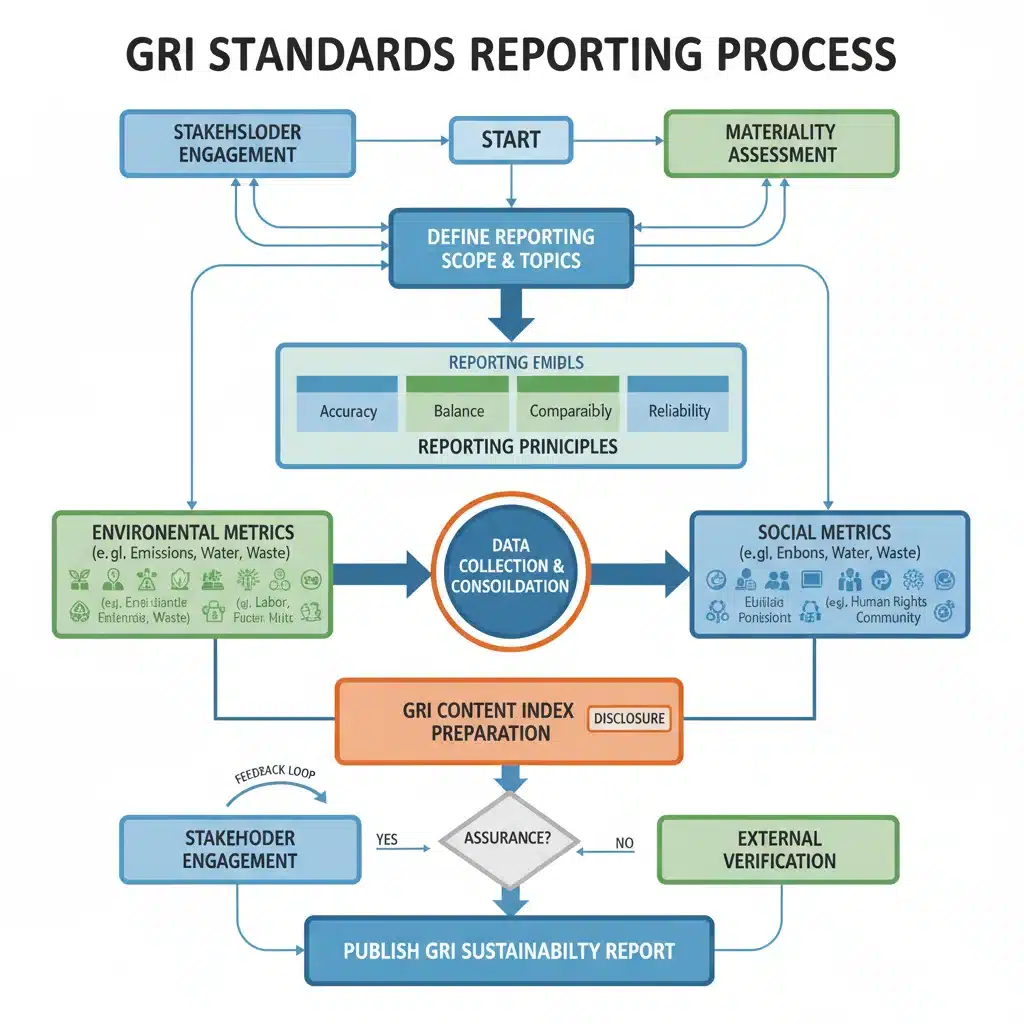
The Global Reporting Initiative (GRI) Standards are among the most widely used and recognized frameworks for sustainability reporting globally. They provide a comprehensive set of standards that allow organizations to report on their economic, environmental, and social impacts. For U.S. startups aiming for transparency and broad stakeholder communication, GRI offers a robust and flexible approach.
Key Aspects of GRI Standards
- Universality: GRI Standards are designed to be applicable to any organization, regardless of size, sector, or location. This makes them highly adaptable for startups across diverse industries.
- Stakeholder Inclusiveness: A core principle of GRI is the identification and engagement of stakeholders. Startups are encouraged to understand the concerns and expectations of their employees, customers, suppliers, investors, and local communities.
- Materiality: GRI emphasizes reporting on topics that are material to the organization and its stakeholders. This means focusing on the most significant economic, environmental, and social impacts. For a startup, this involves a strategic process of identifying key impact areas relevant to its business model and value chain.
- Comprehensive Disclosure: The standards cover a wide range of topics, from greenhouse gas emissions and water usage to labor practices, diversity, anti-corruption, and product responsibility. This allows startups to provide a holistic view of their sustainability performance.
- Modular Structure: GRI Standards are structured as a set of interconnected modular standards. This includes Universal Standards (applicable to all organizations), and Topic-specific Standards (covering economic, environmental, and social topics). This modularity allows startups to tailor their reporting to their specific material issues.
Benefits for U.S. Startups
Adopting GRI Standards can bring several advantages to U.S. startups:
- Enhanced Transparency and Credibility: By providing structured, comprehensive data, startups can demonstrate a genuine commitment to sustainability, building trust with stakeholders.
- Improved Stakeholder Engagement: The process of identifying material topics often involves engaging with various stakeholders, leading to better relationships and a deeper understanding of their concerns.
- Better Internal Management: The reporting process itself can highlight areas for improvement, drive internal efficiencies, and foster a culture of sustainability within the organization.
- Meeting Investor Demands: Many institutional investors and sustainability-focused funds look for GRI-aligned reports as a benchmark for ESG performance.
- Benchmarking: GRI reporting allows startups to benchmark their performance against peers and industry standards, identifying best practices and areas for competitive advantage.
Implementing GRI for Startups in 2026
For startups, full GRI reporting can seem daunting. A phased approach is often most effective:
- Assess Materiality: Begin by identifying your most significant economic, environmental, and social impacts. This involves engaging with key stakeholders and reviewing industry best practices.
- Select Relevant Standards: Based on your materiality assessment, choose the specific GRI Topic Standards that are most relevant to your startup. You don’t need to report on everything at once.
- Data Collection Systems: Establish robust systems for collecting and tracking relevant data. This might involve integrating sustainability metrics into existing operational systems.
- Draft Your First Report: Start with a concise report focusing on your most material topics. As your startup grows and matures, you can expand the scope of your reporting.
- Continuous Improvement: Use the reporting process to identify areas for improvement and set new sustainability goals.
GRI Standards provide a powerful framework for U.S. startups to communicate their sustainability journey effectively, fostering transparency and accountability. By embracing GRI, startups can position themselves as responsible leaders in their respective industries.
2. Sustainability Accounting Standards Board (SASB) Standards: Financial Materiality Focus
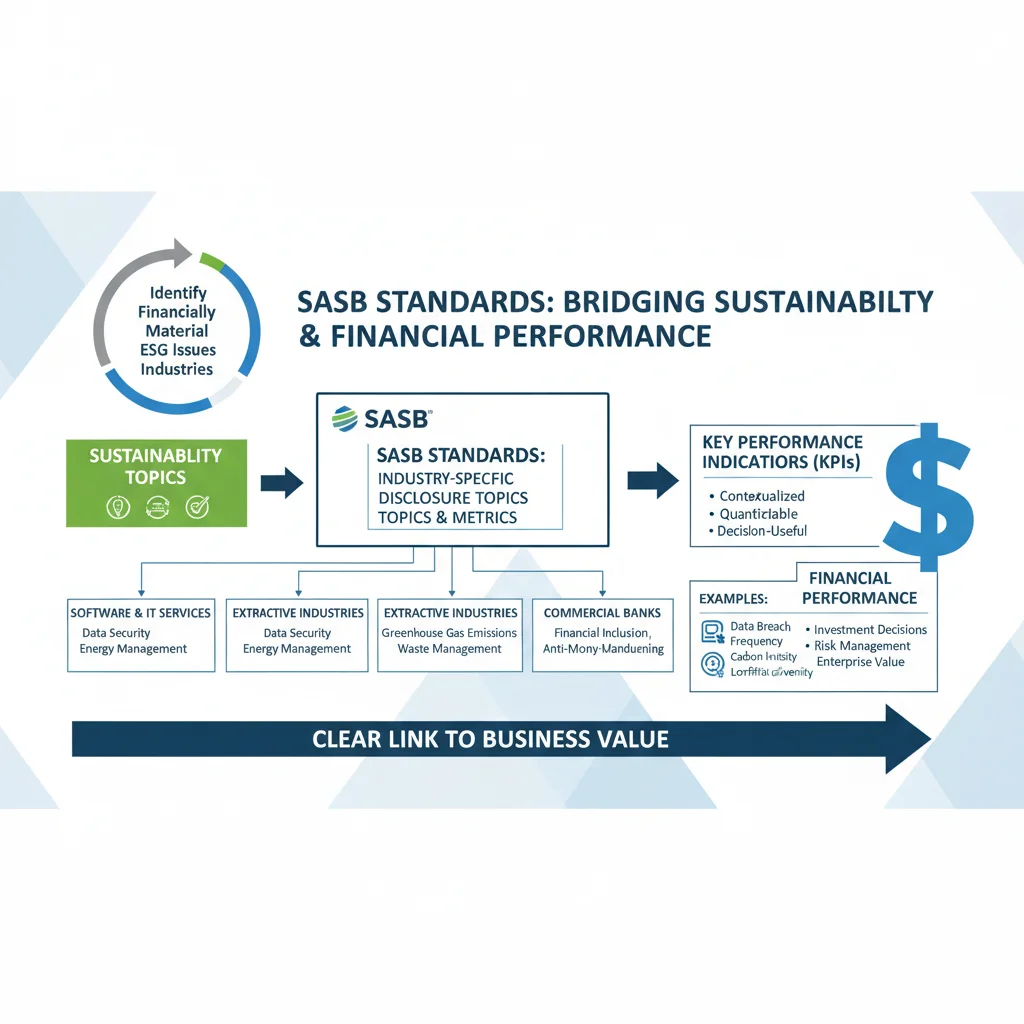
While GRI offers a broad view of sustainability impacts, the Sustainability Accounting Standards Board (SASB) Standards take a more focused approach, emphasizing financially material ESG issues. SASB aims to help companies disclose sustainability information that is relevant to investors, providing a clear link between ESG performance and financial value. For U.S. startups seeking to communicate their ESG impact in financial terms, SASB is an invaluable tool.
Key Aspects of SASB Standards
- Industry-Specific: Unlike GRI’s universal approach, SASB has developed 77 industry-specific standards, covering a wide range of sectors from technology and healthcare to extractives and infrastructure. This ensures that the disclosed information is highly relevant to the specific challenges and opportunities of each industry.
- Financial Materiality: SASB’s core principle is financial materiality. It identifies ESG issues that are reasonably likely to affect the financial condition or operating performance of a company within a particular industry. This focus makes the information highly valuable for investors seeking to assess long-term risks and opportunities.
- Decision-Useful Information: The standards aim to provide investors with comparable, consistent, and decision-useful information that can be integrated into financial analysis. This helps investors make more informed capital allocation decisions.
- Quantitative and Qualitative Metrics: Each industry standard includes a set of disclosure topics and associated metrics, which can be both quantitative (e.g., energy consumption, water withdrawal) and qualitative (e.g., management of supply chain labor risks).
- Integration with Financial Reporting: SASB encourages companies to integrate their sustainability disclosures into mainstream financial filings (e.g., 10-K reports), underscoring the financial relevance of ESG data.
Benefits for U.S. Startups
Adopting SASB Standards can provide several strategic advantages for U.S. startups:
- Investor-Centric Approach: Directly addresses the information needs of investors, making it easier to attract capital from funds focused on financially material ESG issues.
- Streamlined Reporting: By focusing only on financially material issues relevant to their specific industry, startups can avoid reporting on non-essential data, making the process more efficient.
- Clear Link to Financial Performance: Helps startups understand and articulate how their ESG strategies contribute to their financial health and long-term value creation.
- Competitive Intelligence: Provides a standardized way to compare ESG performance within an industry, allowing startups to identify competitive strengths and weaknesses.
- Risk and Opportunity Identification: Forces startups to consider ESG factors that could significantly impact their financial performance, leading to better risk management and identification of new business opportunities.
Implementing SASB for Startups in 2026
For U.S. startups, implementing SASB involves a few key steps:
- Identify Your Industry: Determine which of the 77 SASB industry standards is most relevant to your startup’s core business.
- Review the Standard: Familiarize yourself with the disclosure topics and associated metrics for your chosen industry.
- Assess Materiality: While SASB standards are already designed to be financially material, startups should still conduct their own assessment to confirm the relevance of each topic to their specific operations and business model.
- Data Collection: Establish systems to collect the necessary quantitative and qualitative data for the identified metrics. This may require collaboration across different departments.
- Integrate Disclosure: Consider how to integrate SASB disclosures into your existing financial or annual reports, or create a dedicated sustainability report that aligns with SASB.
By focusing on financially material ESG issues, SASB Standards enable U.S. startups to speak the language of investors, demonstrating how their commitment to sustainability translates into tangible financial value. This makes SASB an indispensable tool for startups seeking to secure funding and build investor confidence.
3. Task Force on Climate-related Financial Disclosures (TCFD): Navigating Climate Risk
Climate change poses significant financial risks and opportunities for businesses across all sectors. The Task Force on Climate-related Financial Disclosures (TCFD), established by the Financial Stability Board (FSB), provides recommendations for companies to disclose climate-related financial information. For U.S. startups, particularly those in climate-sensitive sectors or with complex supply chains, TCFD adoption by 2026 is crucial for demonstrating resilience and forward-thinking risk management.
Key Aspects of TCFD Recommendations
TCFD’s recommendations are structured around four core pillars, providing a framework for disclosing how an organization identifies, assesses, manages, and reports on climate-related risks and opportunities:
- Governance: Disclosures related to the organization’s governance around climate-related risks and opportunities. This includes board oversight and management’s role in assessing and managing these issues.
- Strategy: Disclosures related to the actual and potential impacts of climate-related risks and opportunities on the organization’s businesses, strategy, and financial planning. This often involves scenario analysis to understand resilience under different climate pathways.
- Risk Management: Disclosures related to how the organization identifies, assesses, and manages climate-related risks. This integrates climate risk into existing enterprise-wide risk management processes.
- Metrics and Targets: Disclosures related to the metrics and targets used to assess and manage relevant climate-related risks and opportunities. This includes greenhouse gas (GHG) emissions and other relevant metrics.
Benefits for U.S. Startups
Adopting TCFD recommendations offers several strategic benefits for U.S. startups:
- Enhanced Risk Management: Forces startups to systematically identify, assess, and manage climate-related risks (both physical risks like extreme weather and transition risks like policy changes), leading to greater operational resilience.
- Improved Access to Capital: Investors are increasingly using TCFD disclosures to evaluate companies’ exposure and mitigation strategies for climate risk. Startups aligning with TCFD will be more attractive to climate-conscious investors and lenders.
- Strategic Planning and Innovation: Encourages startups to consider climate change in their long-term strategy, potentially leading to the development of climate-resilient products, services, and business models.
- Increased Transparency: Provides clear and consistent information to stakeholders about how the startup is addressing climate change, enhancing trust and credibility.
- Competitive Advantage: Early adoption can position a startup as a leader in climate risk management, differentiating it from competitors and attracting partners who value climate resilience.
Implementing TCFD for Startups in 2026
Implementing TCFD can be a complex undertaking, but startups can approach it incrementally:
- Understand Your Exposure: Begin by assessing your startup’s direct and indirect exposure to climate-related risks and opportunities. This includes your operations, supply chain, and customer base.
- Integrate into Governance: Ensure that your board or leadership team understands and oversees climate-related issues. Assign clear responsibilities for managing climate risks.
- Scenario Analysis (Simplified): Even for startups, conducting a simplified climate scenario analysis can reveal potential impacts on your business model under different climate futures (e.g., a 2°C warming scenario vs. a 4°C warming scenario).
- Identify Key Metrics: Start by tracking relevant climate-related metrics, such as your carbon footprint (Scope 1, 2, and potentially 3 emissions), energy consumption, and water usage.
- Develop Disclosure: Draft disclosures aligned with the four TCFD pillars. Focus on clear, concise communication about your approach to climate risk and opportunity.
- Continuous Evolution: TCFD is an evolving framework. Startups should aim for continuous improvement in their disclosures and climate resilience strategies.
By proactively addressing climate-related financial disclosures through TCFD, U.S. startups can not only mitigate future risks but also identify significant opportunities for innovation and growth in a world increasingly shaped by climate considerations.
4. B Corp Certification: A Holistic Commitment to Purpose and Profit
Unlike the reporting frameworks of GRI, SASB, and TCFD, B Corp Certification is a holistic standard that assesses a company’s entire social and environmental performance, accountability, and transparency. Administered by B Lab, B Corp status signifies that a business meets high standards of verified performance, accountability, and transparency on factors from employee benefits and charitable giving to supply chain practices and input materials. For U.S. startups aiming to embed purpose and positive impact into their core identity, B Corp offers a powerful and recognizable seal of approval.
Key Aspects of B Corp Certification
- Comprehensive Assessment (B Impact Assessment – BIA): The certification process involves completing the rigorous B Impact Assessment, which evaluates a company’s impact across five key areas: Governance, Workers, Community, Environment, and Customers.
- Legal Accountability: To become a B Corp, companies must amend their legal governing documents to consider the impact of their decisions on all stakeholders, not just shareholders. This demonstrates a long-term commitment to purpose beyond profit.
- Transparency: Certified B Corps are required to publish their B Impact Assessment scores publicly on B Lab’s website, fostering transparency and allowing stakeholders to see their performance.
- Recertification: B Corps must recertify every three years, ensuring ongoing commitment and continuous improvement in their social and environmental performance.
- Global Community: Becoming a B Corp connects startups to a global community of like-minded businesses committed to using business as a force for good.
Benefits for U.S. Startups
Pursuing B Corp Certification can yield significant advantages for U.S. startups:
- Brand Differentiation and Trust: The B Corp logo is a recognizable mark of distinction, signaling to consumers, employees, and investors that a company meets the highest standards of social and environmental performance. This can significantly enhance brand reputation and differentiate a startup in a competitive market.
- Attracting and Retaining Talent: Many individuals, especially in the startup ecosystem, are driven by purpose. B Corp status helps attract mission-aligned talent who are passionate about contributing to a positive impact.
- Investor Appeal: A growing number of impact investors and venture capitalists specifically seek out B Corps or companies with strong ESG credentials, recognizing their resilience and long-term value potential.
- Operational Improvement: The B Impact Assessment provides a valuable framework for identifying areas for improvement across all aspects of a business, driving innovation and operational excellence.
- Community and Collaboration: Joining the B Corp community offers opportunities for networking, collaboration, and learning from other purpose-driven businesses.
- Legal Protection for Mission: The legal requirement to consider all stakeholders provides a framework for protecting a company’s mission through leadership changes or funding rounds.
Implementing B Corp for Startups in 2026
The B Corp journey for startups typically involves:
- Take the B Impact Assessment (BIA): Complete the free online BIA to benchmark your current performance. This provides a baseline score and highlights areas for improvement.
- Meet the Minimum Score: Strive to achieve the minimum verified score of 80 points on the BIA. Startups often need to make operational changes to reach this threshold.
- Fulfill the Legal Requirement: Amend your legal governing documents to incorporate stakeholder governance. This is a critical step that demonstrates a deep commitment to purpose.
- Verification Process: Once the minimum score is met and legal requirements are addressed, submit your assessment for verification by B Lab. This involves providing documentation and engaging in a review process.
- Continuous Improvement: Certification is just the beginning. B Corps are encouraged to continuously improve their impact and will go through recertification every three years.
For U.S. startups that genuinely want to integrate social and environmental good into their DNA, B Corp Certification offers a comprehensive framework and a powerful signal to the world that they are committed to being a force for positive change.
Choosing the Right ESG Frameworks for Your U.S. Startup
With four powerful ESG frameworks at your disposal, how does a U.S. startup decide which one, or which combination, is right for them by 2026? The choice largely depends on your startup’s industry, stage of growth, strategic goals, and target stakeholders.
Considerations for Selection
- Industry Relevance:
- If your startup operates in an industry with significant environmental or social impacts (e.g., manufacturing, energy, agriculture), GRI and SASB will be highly relevant. SASB’s industry-specific standards can be particularly useful here.
- If climate change poses a material risk or opportunity for your business (e.g., renewable energy, sustainable tech, logistics), TCFD should be a priority.
- Stakeholder Focus:
- If your primary goal is broad stakeholder transparency and engagement (employees, customers, community), GRI’s comprehensive approach is excellent.
- If attracting ESG-focused investors is a top priority, SASB’s financially material disclosures will resonate strongly.
- If you aim to attract talent and customers who seek purpose-driven companies, and you want a holistic commitment to social and environmental good, B Corp Certification is ideal.
- Stage of Growth and Resources:
- Early-Stage Startups: May start with a more focused approach. SASB’s industry-specific metrics can be a manageable starting point for investor communications. Alternatively, using the B Impact Assessment (even without full certification) can provide a roadmap for improvement.
- Growth-Stage Startups: As resources grow, integrating more comprehensive reporting like GRI or pursuing B Corp Certification becomes more feasible.
- Mature Startups/Pre-IPO: Preparing for public markets often necessitates robust TCFD disclosures, especially if climate risk is significant.
- Strategic Objectives:
- Risk Mitigation: TCFD for climate risks, and aspects of GRI/SASB for broader environmental and social risks.
- Brand Building & Differentiation: B Corp Certification offers a powerful brand signal.
- Investor Relations: SASB is highly valued by financial analysts. GRI provides comprehensive data for ESG ratings.
- Operational Excellence: The assessment processes for all frameworks can highlight inefficiencies and areas for improvement.
Can Startups Adopt Multiple Frameworks?
Absolutely. In fact, many larger companies use a combination of frameworks to meet different reporting needs. For startups, a phased or integrated approach is often best:
- SASB + TCFD: A strong combination for communicating financially material ESG and climate risks to investors.
- GRI + SASB: GRI provides a broad sustainability context, while SASB offers specific, financially material data. Many organizations use GRI for a full sustainability report and cross-reference SASB for investor-specific disclosures.
- B Corp as an Overarching Strategy: B Corp Certification can serve as a guiding philosophy and framework, with elements of GRI, SASB, or TCFD used to support specific reporting needs or enhance certain aspects of performance. The B Impact Assessment often touches upon areas covered by other frameworks.
The key is to start somewhere. Even small steps towards integrating ESG principles and adopting a relevant framework can set your startup on a path to sustainable success. By 2026, the expectation for U.S. startups to demonstrate their commitment to ESG will only intensify, making proactive engagement with these frameworks a critical element of long-term strategy.
The Road Ahead: Integrating ESG for Future Success
The imperative for U.S. startups to embrace ESG frameworks by 2026 is clear. The global business landscape is shifting, and sustainability is no longer a peripheral concern but a core driver of value. By strategically adopting frameworks like GRI, SASB, TCFD, and pursuing B Corp Certification, startups can build resilient, responsible, and highly attractive enterprises.
The journey to full ESG integration may seem challenging, especially for resource-constrained startups. However, the benefits far outweigh the initial investment. Enhanced investor appeal, a stronger brand, a more engaged workforce, improved risk management, and operational efficiencies are just some of the tangible returns. More profoundly, aligning with ESG principles ensures that your startup is contributing positively to society and the planet, building a legacy that extends beyond financial statements.
Start today by understanding your startup’s unique impacts and identifying the framework that best aligns with your mission and strategic goals. Whether it’s transparent reporting with GRI, investor-focused disclosures with SASB, climate risk management with TCFD, or a holistic commitment to purpose with B Corp, taking action now will position your startup for sustained success in 2026 and for decades to come. The future of business is sustainable, and your startup has the power to lead the way.