Predictive Analytics vs. Traditional Forecasting: Boosting 2026 Sales Accuracy
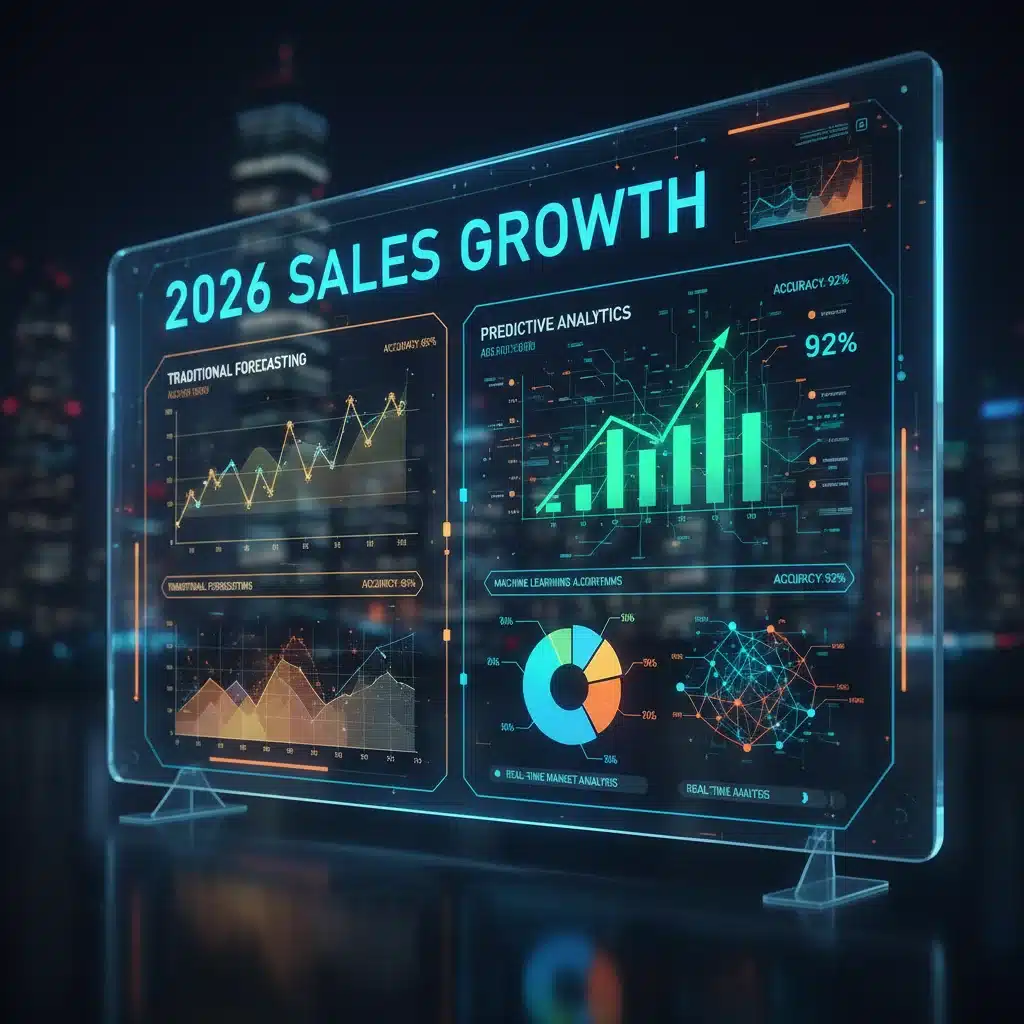
Predictive Analytics vs. Traditional Forecasting for 2026 Sales Growth: Which Delivers 30% More Accuracy?
In the rapidly evolving landscape of global commerce, the ability to accurately forecast future sales is not just an advantage; it’s a necessity. Businesses worldwide are grappling with increased market volatility, shifting consumer behaviors, and an ever-growing mountain of data. The question for 2026 and beyond isn’t whether to forecast, but how to do it with the highest possible accuracy. This article delves deep into a critical comparison: Predictive Sales Forecasting powered by advanced analytics versus the time-honored, traditional forecasting methods. We will explore which approach is poised to deliver significantly more accuracy, potentially boosting your 2026 sales growth by a remarkable 30% or more.
For decades, traditional forecasting methods served as the backbone of business planning. These techniques, often relying on historical sales data, expert judgment, and simple statistical models, provided a foundational understanding of future trends. However, as markets became more complex and data exploded in volume and variety, the limitations of these methods became increasingly apparent. Enter Predictive Sales Forecasting – a paradigm shift enabled by artificial intelligence, machine learning, and big data analytics. This modern approach promises not just better predictions, but a fundamentally different way of understanding and influencing future sales outcomes.
The Foundation of Sales Forecasting: Traditional Methods Revisited
Before we fully immerse ourselves in the world of Predictive Sales Forecasting, it’s crucial to understand the bedrock upon which all forecasting was built. Traditional sales forecasting methods, while sometimes seen as outdated, still hold value and form the theoretical basis for many modern techniques. These methods typically fall into a few key categories:
Historical Data Analysis: The Simplest Approach
Many businesses start with simply looking at past sales. Methods like moving averages, exponential smoothing, and linear regression analyze past performance to project future trends. For instance, a company might average its sales over the last three months to predict the next month’s sales, or identify a consistent growth rate over several years and extrapolate it forward. While straightforward, this approach assumes that past patterns will continue into the future, an assumption that frequently breaks down in dynamic markets.
Qualitative Forecasting: Expert Judgment and Surveys
When historical data is scarce, or when significant market shifts are anticipated, qualitative methods come into play. These include:
- Expert Opinion: Gathering insights from sales managers, industry experts, and senior leadership.
- Delphi Method: A structured communication technique, originally developed as a systematic, interactive forecasting method which relies on a panel of experts. The experts answer questionnaires in two or more rounds. After each round, a facilitator provides an anonymous summary of the experts’ forecasts and their reasons for the forecasts. Experts are then encouraged to revise their earlier answers in light of the replies of other members of their panel.
- Sales Force Composite: Aggregating individual salespersons’ estimates of future sales in their respective territories.
- Customer Surveys: Asking customers about their purchasing intentions.
These methods can capture nuances and intangible factors that quantitative data might miss. However, they are inherently subjective and prone to biases, which can significantly impact accuracy.
Time Series Analysis: Identifying Patterns
More sophisticated traditional methods involve time series analysis, which seeks to identify patterns such as trends, seasonality, and cyclical variations in historical data. Techniques like ARIMA (AutoRegressive Integrated Moving Average) models are used to decompose time series data into its component parts and then project these components into the future. While more robust than simple averages, these models still struggle with sudden, unpredictable events or complex, non-linear relationships within the data.
Limitations of Traditional Forecasting in the Modern Era
The primary drawback of traditional forecasting methods is their reactive nature. They are excellent at explaining what happened and projecting it forward, but less effective at predicting what will happen when conditions change significantly. In today’s fast-paced, interconnected world, several factors expose these limitations:
- Data Volume and Velocity: Traditional methods are not designed to process the sheer volume and speed of modern data (e.g., social media trends, real-time market sentiment, web analytics).
- Complexity of Influencing Factors: Sales are influenced by a multitude of interconnected variables – economic indicators, competitor actions, marketing campaigns, supply chain disruptions, weather events, political shifts, and more. Traditional models often oversimplify these relationships.
- Lack of Granularity: They often provide high-level forecasts, making it difficult to drill down into specific products, customer segments, or geographic regions with precision.
- Inability to Learn: Once a traditional model is built, it typically doesn’t automatically adapt or improve without manual intervention.
- Bias and Subjectivity: Qualitative methods, while valuable, introduce human bias, which can lead to optimistic or pessimistic projections that don’t align with reality.
These limitations highlight the urgent need for a more dynamic, data-driven approach – one that truly embraces the power of modern technology to deliver superior accuracy for Predictive Sales Forecasting.
The Rise of Predictive Analytics: A New Era for Sales Forecasting
Predictive Sales Forecasting leverages advanced statistical algorithms, machine learning (ML), and artificial intelligence (AI) to analyze vast datasets and identify complex patterns that are invisible to traditional methods. Instead of merely extrapolating past trends, predictive analytics aims to understand the underlying drivers of sales and forecast future outcomes based on these insights. The core idea is to move from ‘what happened’ to ‘what will happen’ and ‘why it will happen’.
Key Components of Predictive Sales Forecasting
At its heart, Predictive Sales Forecasting involves several sophisticated components:
- Big Data Integration: Combining internal sales data (CRM, ERP, POS) with external data sources (economic indicators, social media trends, competitor pricing, weather patterns, demographic shifts, news events).
- Machine Learning Algorithms: Employing a variety of algorithms such as regression models (linear, logistic, polynomial), decision trees, random forests, gradient boosting machines (XGBoost, LightGBM), neural networks, and support vector machines. These algorithms learn from historical data to build models that predict future sales.
- Feature Engineering: The process of transforming raw data into features that better represent the underlying problem to the predictive models, enhancing their accuracy. This could involve creating new variables from existing ones (e.g., calculating customer lifetime value, segmenting customers by behavior).
- Ensemble Modeling: Combining multiple machine learning models to improve overall prediction accuracy and robustness.
- Real-time Data Processing: The ability to continuously ingest and analyze new data, allowing for dynamic, up-to-the-minute forecasts.

How Predictive Analytics Delivers Higher Accuracy
The superior accuracy of Predictive Sales Forecasting stems from its ability to:
- Identify Non-Linear Relationships: Machine learning models can uncover subtle, non-linear relationships between various influencing factors and sales outcomes that traditional linear models would miss. For example, a specific marketing campaign might have a delayed, non-linear impact on sales that traditional methods wouldn’t easily capture.
- Incorporate More Variables: Predictive models can handle hundreds, even thousands, of variables simultaneously, allowing for a much more comprehensive understanding of sales drivers. This includes internal factors like product features, pricing, promotions, and sales team performance, as well as external factors like economic growth, competitor activities, and seasonal weather changes.
- Adapt and Learn: ML models can continuously learn from new data, automatically refining their predictions as market conditions change. This self-correction mechanism is a significant advantage over static traditional models.
- Quantify Uncertainty: Advanced models can provide not just a single forecast number, but also a range of probable outcomes and associated confidence intervals, giving businesses a clearer picture of potential risks and opportunities.
- Segment and Personalize: Predictive analytics can forecast sales at a highly granular level – by individual customer, product SKU, geographic region, or even specific sales representative – enabling targeted strategies and resource allocation.
This comprehensive and adaptive approach is what allows Predictive Sales Forecasting to offer a significant leap in accuracy, potentially exceeding traditional methods by 30% or more, especially when forecasting for complex periods like 2026.
Comparing Accuracy: Predictive Analytics vs. Traditional for 2026 Sales
Let’s directly compare the two approaches with a focus on preparing for 2026 sales growth.
Traditional Forecasting for 2026
If a business uses traditional methods to forecast for 2026, they might:
- Look at 2023-2025 sales trends and extrapolate.
- Factor in known marketing campaigns or product launches.
- Adjust based on senior management’s expectations for market growth.
While this provides a baseline, it struggles with:
- Unforeseen Economic Shifts: A sudden recession or boom in 2026 would render historical extrapolations inaccurate.
- Emerging Competitors/Technologies: New market entrants or disruptive technologies could drastically alter demand, which traditional models can’t easily foresee.
- Complex Customer Behavior: The increasing fragmentation of customer segments and personalized buying journeys are difficult to model with simple statistics.
Predictive Sales Forecasting for 2026
A business employing Predictive Sales Forecasting for 2026 would take a much more nuanced approach:
- Dynamic Data Inputs: Continuously feed in real-time economic indicators, social media sentiment, competitor pricing changes, global supply chain health, and even weather patterns relevant to their product.
- Advanced Modeling: Utilize algorithms that can detect subtle shifts in consumer preferences based on web browsing data, purchase history, and demographic information.
- Scenario Planning: Run multiple simulations based on different economic forecasts (optimistic, pessimistic, moderate) and market interventions (e.g., impact of a new product launch with varying marketing spend).
- Granular Predictions: Forecast sales not just for the entire company, but for specific product lines, regions, or even individual customer segments, allowing for highly targeted sales strategies.
- Early Warning Systems: Identify potential drops in sales or emerging opportunities months in advance, allowing for proactive adjustments to strategy.
The ability of predictive analytics to integrate diverse data, identify complex relationships, and continuously adapt makes its forecasts significantly more robust and accurate, especially for a future-facing horizon like 2026. Studies and real-world implementations consistently show that companies leveraging advanced analytics can achieve forecast accuracy improvements of 20-30% or more compared to those relying solely on traditional methods. This directly translates into better inventory management, optimized marketing spend, improved resource allocation, and ultimately, higher sales growth.
Implementing Predictive Sales Forecasting: Challenges and Best Practices
While the benefits of Predictive Sales Forecasting are clear, its implementation is not without challenges. Businesses need to consider several factors to ensure a successful transition.
Common Challenges
- Data Quality and Availability: Dirty, incomplete, or siloed data is the biggest hurdle. Predictive models are only as good as the data they are fed.
- Talent Gap: A shortage of data scientists, machine learning engineers, and analysts with the skills to build, deploy, and maintain these sophisticated models.
- Integration Complexity: Integrating various data sources and predictive platforms with existing CRM, ERP, and marketing automation systems can be complex.
- Cost: Initial investment in technology, software, and skilled personnel can be substantial.
- Change Management: Overcoming resistance from teams accustomed to traditional methods and fostering a data-driven culture.
Best Practices for Successful Implementation
To overcome these challenges and maximize the benefits of Predictive Sales Forecasting, consider these best practices:
- Start Small, Scale Up: Begin with a pilot project in a specific area or product line to demonstrate value and build internal confidence before a full-scale rollout.
- Focus on Data Governance: Prioritize data cleaning, standardization, and integration. Invest in data warehousing and ETL (Extract, Transform, Load) processes.
- Invest in Talent and Training: Either hire skilled professionals or upskill existing employees. Provide training for sales and marketing teams on how to interpret and act on predictive insights.
- Choose the Right Technology: Select predictive analytics platforms that are scalable, user-friendly, and integrate well with your existing tech stack. Consider cloud-based solutions for flexibility.
- Foster Collaboration: Encourage collaboration between data science, sales, marketing, and finance teams. Predictive analytics is most effective when insights are shared and acted upon across the organization.
- Continuous Monitoring and Refinement: Predictive models are not ‘set it and forget it.’ Regularly monitor their performance, retrain them with new data, and refine algorithms to maintain accuracy.
- Define Clear Objectives: Clearly articulate what you aim to achieve with predictive forecasting (e.g., 30% increase in accuracy, 15% reduction in inventory, 20% improvement in lead conversion).

The Tangible Benefits of Enhanced Predictive Sales Forecasting for 2026
Achieving a 30% or greater improvement in forecast accuracy through Predictive Sales Forecasting has profound implications for a business’s bottom line and strategic positioning. The benefits extend far beyond just knowing future sales numbers:
- Optimized Inventory Management: More accurate forecasts mean less excess inventory (reducing carrying costs) and fewer stockouts (preventing lost sales), leading to significant cost savings and improved customer satisfaction.
- Smarter Marketing and Sales Strategies: By understanding which products will sell to whom and when, marketing campaigns can be highly targeted and personalized, maximizing ROI. Sales teams can focus their efforts on high-potential leads and opportunities.
- Improved Resource Allocation: Better predictions allow for more efficient allocation of resources, including staffing levels, production capacity, and budget distribution across departments.
- Enhanced Financial Planning: Finance departments can create more reliable budgets, cash flow projections, and investment plans, reducing financial risks and enabling more strategic capital deployment.
- Proactive Risk Management: Early identification of potential sales downturns or market shifts allows businesses to develop contingency plans and mitigate risks before they escalate.
- Competitive Advantage: Companies that can consistently predict market trends and customer demand with higher accuracy gain a significant edge over competitors still relying on less sophisticated methods.
- Better Customer Experience: Meeting customer demand consistently and offering relevant products at the right time leads to increased customer loyalty and satisfaction.
For businesses looking ahead to 2026, these benefits are not merely theoretical. They represent concrete pathways to increased profitability, operational efficiency, and sustainable growth in an increasingly competitive global marketplace.
Conclusion: Embracing the Future of Sales with Predictive Analytics
The comparison between traditional forecasting and Predictive Sales Forecasting for 2026 sales growth reveals a clear winner in terms of accuracy, depth of insight, and strategic value. While traditional methods offer a foundational understanding, their limitations in handling the complexity and volume of modern data are undeniable. Predictive analytics, powered by AI and machine learning, offers a transformative approach, capable of delivering forecasts that are not only more accurate – potentially by 30% or more – but also more granular, dynamic, and actionable.
Embracing Predictive Sales Forecasting is no longer a luxury but a strategic imperative for businesses aiming to thrive in 2026 and beyond. It requires investment in technology, data infrastructure, and human talent, but the returns in terms of optimized operations, reduced risks, and significantly enhanced sales performance are substantial. The future of sales is data-driven, intelligent, and predictive. By adopting these advanced capabilities, companies can move from merely reacting to market changes to proactively shaping their success, ensuring robust growth and a strong competitive position in the years to come.