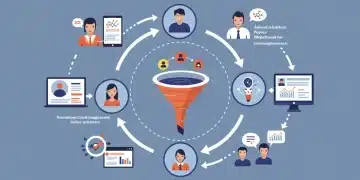
Maximize Cross-Sell & Up-Sell: Boost CLV by 18% in 2025
Maximizing cross-sell and up-sell opportunities is essential for sustainable business growth, directly impacting customer lifetime value and revenue. This guide outlines a 6-step framework to achieve an 18% increase in CLV by 2025 through strategic implementation.
In today’s competitive landscape, businesses constantly seek innovative ways to drive revenue and foster customer loyalty. One of the most potent yet often underutilized strategies is maximizing cross-sell and up-sell opportunities. By strategically encouraging existing customers to purchase complementary products or upgrade their current services, companies can significantly increase their customer lifetime value (CLV) and achieve substantial financial growth. This comprehensive guide will walk you through a 6-step framework designed to boost your CLV by an impressive 18% by 2025, providing practical solutions and detailing the profound financial impact.
Understanding Cross-Sell and Up-Sell Fundamentals
Before diving into advanced strategies, it’s crucial to grasp the core concepts of cross-selling and up-selling. While often grouped, they represent distinct approaches to increasing customer spending. Both aim to enhance customer value and loyalty, but through different mechanisms that require tailored execution.
Defining Cross-Selling
Cross-selling involves encouraging customers to buy related or complementary products alongside their initial purchase. Think of it as suggesting items that naturally go together, enriching the customer’s overall experience and solving additional needs they might have. This approach leverages an existing relationship to expand the scope of products or services a customer uses.
- Example: A customer buying a new smartphone is offered a protective case, screen protector, or wireless earbuds.
- Benefit: Increases average order value and deepens customer engagement with your brand’s ecosystem.
- Strategy: Identify logical product pairings based on customer purchase history and product usage patterns.
Defining Up-Selling
Up-selling, on the other hand, persuades customers to purchase a more expensive, upgraded, or premium version of an item they are already considering or using. The goal is to provide a superior solution that offers more features, better performance, or enhanced benefits, thereby increasing the transaction value. This strategy often focuses on illustrating the additional value an upgrade provides.
- Example: A customer looking at a basic software subscription is shown the benefits of a premium plan with advanced features.
- Benefit: Boosts revenue per customer and enhances customer satisfaction by offering better solutions.
- Strategy: Highlight the comparative advantages and long-term value of higher-tier products or services.
Both cross-selling and up-selling are powerful tools for revenue generation, but their effectiveness hinges on understanding customer needs and preferences. A successful strategy integrates both, creating a seamless and valuable experience for the customer, rather than merely pushing more products. When executed thoughtfully, these techniques don’t feel like sales tactics; they feel like helpful recommendations.
Step 1: Deep Customer Segmentation and Persona Development
The foundation of any successful cross-sell and up-sell strategy lies in a profound understanding of your customer base. Generic approaches rarely yield optimal results. Instead, businesses must invest in deep customer segmentation and the development of detailed buyer personas to tailor their offerings effectively. This initial step ensures that subsequent efforts are precise and relevant, resonating with individual customer needs and preferences.
Leveraging Data for Segmentation
Effective segmentation goes beyond basic demographics. It involves analyzing purchase history, browsing behavior, engagement levels, and even psychographic data to group customers with similar characteristics and needs. Data analytics tools are indispensable here, uncovering patterns that might otherwise remain hidden. Predictive analytics can even forecast future needs, enabling proactive recommendations.
- Purchase History: What have they bought previously? What was the order value?
- Behavioral Data: Which products did they view? What content did they engage with?
- Demographic & Psychographic Data: Age, location, interests, lifestyle, values.
Crafting Detailed Buyer Personas
Once segments are identified, creating detailed buyer personas brings them to life. A persona is a semi-fictional representation of your ideal customer based on market research and real data about your existing customers. These personas should include their goals, challenges, motivations, and preferred channels of communication. This humanizes your data, making it easier for your sales and marketing teams to empathize and strategize.
For instance, a persona for a B2B software company might include ‘Sarah, the Small Business Owner,’ who seeks efficiency and cost-effectiveness, or ‘Michael, the Enterprise IT Manager,’ who prioritizes scalability and robust security. Understanding these nuanced needs allows for highly targeted cross-sell and up-sell proposals. This detailed understanding ensures that every recommendation feels personal and valuable to the customer, rather than an arbitrary suggestion.
Step 2: Personalized Product and Service Recommendations
With robust customer segmentation in place, the next critical step is to leverage this insight for personalized recommendations. Generic product suggestions are largely ignored in today’s digital age. Customers expect and respond to offers that are specifically tailored to their inferred needs, past behaviors, and expressed preferences. Personalization transforms a sales pitch into a helpful suggestion, significantly increasing conversion rates for both cross-selling and up-selling efforts.
Utilizing AI and Machine Learning
Modern technology, particularly artificial intelligence (AI) and machine learning (ML), plays a pivotal role in delivering hyper-personalized recommendations at scale. These technologies can analyze vast amounts of customer data in real-time, identifying complex correlations and predicting optimal product pairings or upgrade paths. Recommendation engines, powered by AI, can suggest items a customer is highly likely to purchase, based on their own history and the behavior of similar customers.
- Collaborative Filtering: Recommends products based on what similar users have liked or purchased.
- Content-Based Filtering: Suggests items similar to those a user has previously shown interest in.
- Hybrid Systems: Combine both approaches for more accurate and diverse recommendations.
The implementation of such systems requires investment but offers a significant return by boosting sales efficiency and customer satisfaction. The goal is to make the customer feel understood and valued, rather than simply targeted. This approach shifts the dynamic from transactional to relational, fostering long-term loyalty.
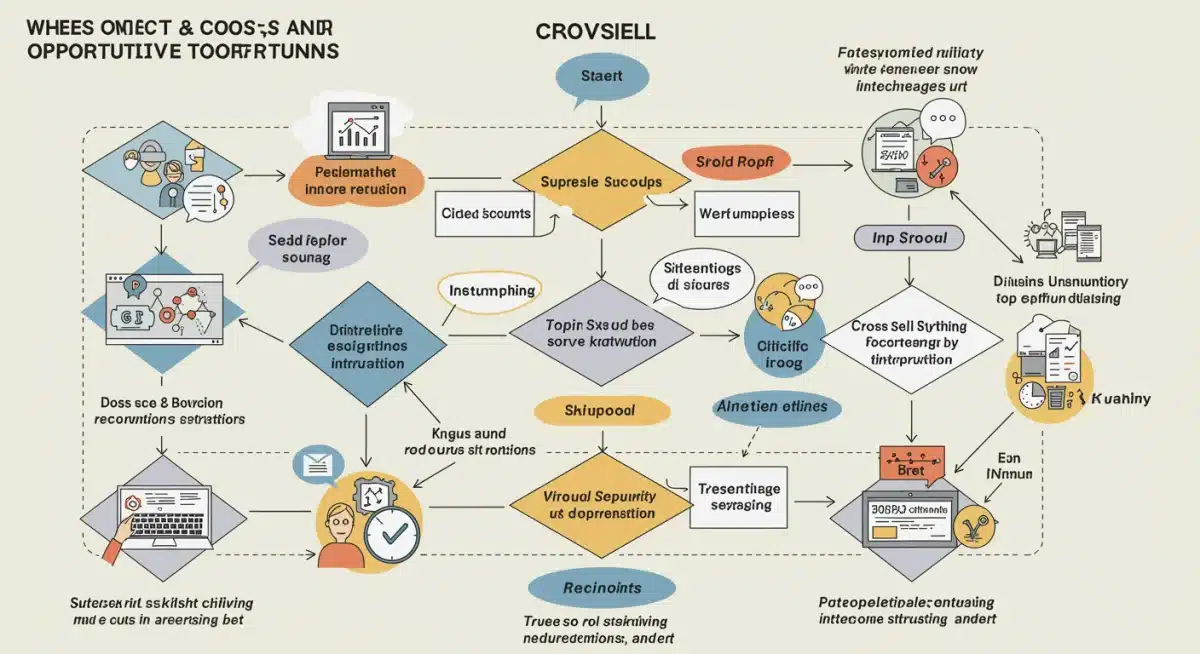
Beyond automated systems, human touchpoints remain crucial. Sales representatives, armed with customer insights, can offer personalized advice during interactions, enhancing the perceived value of recommendations. Training sales teams to actively listen and propose solutions that genuinely benefit the customer is key to successful personalization.
Step 3: Strategic Timing and Placement of Offers
Even the most personalized offer can fall flat if presented at the wrong time or in an inconvenient location. Strategic timing and placement are crucial for maximizing the effectiveness of cross-sell and up-sell initiatives. The goal is to integrate these offers seamlessly into the customer journey, making them appear as a logical extension of their current needs or interests, rather than an intrusive interruption.
Optimizing Touchpoints in the Customer Journey
Identify key touchpoints where customers are most receptive to additional offers. This could be at the point of sale, immediately after a purchase confirmation, during customer service interactions, or even within product usage. For cross-selling, relevant moments often occur during the initial purchase process or shortly thereafter, when the customer is still engaged with their new product. For up-selling, the ideal time might be when a customer is nearing the limits of their current service plan or expressing satisfaction with a basic version of a product.
- Checkout Page: Suggest complementary items before the transaction is finalized.
- Post-Purchase Emails: Offer related products or service upgrades as follow-ups.
- Customer Support: Train agents to identify opportunities for up-selling or cross-selling relevant solutions.
- In-App Notifications: For software or subscription services, prompt users with upgrade options when they encounter feature limitations.
Contextual Relevance and Non-Intrusiveness
The placement of offers should always be contextually relevant and non-intrusive. Avoid bombarding customers with too many options or presenting irrelevant suggestions. A well-placed offer feels like a helpful suggestion, while a poorly placed one can feel aggressive and deter the customer. Experiment with different channels—website banners, email campaigns, in-app messages, or direct sales interactions—to find what resonates best with your segmented audience.
For example, a customer who just bought a new coffee machine might appreciate an email suggesting gourmet coffee beans a few days later, but not an immediate pop-up advertising another coffee machine. Similarly, a user of a free software tier might be more open to an upgrade offer after experiencing the limitations of the free version, rather than upon initial sign-up. This thoughtful approach ensures that offers enhance the customer experience rather than detract from it.
Step 4: Value-Based Communication and Benefits Articulation
Successful cross-selling and up-selling are not about pushing products; they are about communicating value. Customers are more likely to consider additional purchases or upgrades if they clearly understand the benefits these offers provide. This step focuses on articulating how a cross-sell item enhances their primary purchase or how an up-sell improves their current experience, focusing on solutions rather than just features.
Highlighting Solutions, Not Just Features
When presenting cross-sell or up-sell opportunities, shift the focus from a list of features to the tangible benefits and solutions they offer. How will this product or service solve a problem, save time, enhance convenience, or improve performance for the customer? For instance, instead of saying a premium software plan has ‘more storage,’ emphasize that it allows them to ‘collaborate seamlessly on larger projects without worrying about space limitations.’
- Cross-Sell Benefit: A camera bag protects the new camera and makes it easier to carry, solving portability and safety concerns.
- Up-Sell Benefit: A faster internet plan ensures smoother streaming and gaming, eliminating frustrating lag and buffering.
Crafting Compelling Value Propositions
Each cross-sell or up-sell offer should come with a clear and compelling value proposition. This statement should succinctly explain why the offer is relevant and beneficial to the customer. Use language that resonates with their needs and aspirations, as identified during the segmentation and persona development phase. Test different messaging and calls to action to see what performs best with various customer segments.
Moreover, consider framing offers as opportunities to unlock greater potential or prevent future inconveniences. For example, offering extended warranties or maintenance plans can be positioned as peace of mind, protecting their investment. This approach builds trust and positions your brand as a helpful partner, rather than just a vendor. By focusing on the customer’s perspective and demonstrating a clear understanding of their needs, businesses can significantly increase the acceptance rate of these additional offers.
Step 5: Training Sales and Customer Service Teams
Even the most sophisticated algorithms and data-driven insights are only as effective as the people implementing them. Your sales and customer service teams are on the front lines, interacting directly with customers. Equipping them with the right training, tools, and incentives is paramount to successfully maximizing cross-sell and up-sell opportunities. They need to understand not just what to offer, but how and why.
Empowering Teams with Knowledge and Skills
Comprehensive training programs should cover product knowledge, customer segmentation insights, and effective communication techniques. Sales teams need to understand the full product ecosystem and how different offerings complement each other. Customer service representatives should be trained to identify implicit needs during support interactions and gently guide customers towards relevant solutions, without being overtly pushy.
- Product Knowledge: Deep understanding of features, benefits, and use cases for all products.
- Objection Handling: Training on how to address customer concerns and highlight value effectively.
- Active Listening: Developing skills to uncover customer needs and pain points during conversations.
Incentivizing and Measuring Performance
Beyond training, motivating your teams through appropriate incentives is crucial. This could include commission structures tied to cross-sell and up-sell conversions, bonuses for achieving specific targets, or recognition programs for exceptional performance. Regularly track and analyze individual and team performance metrics related to these initiatives. This data provides valuable feedback, allowing for continuous improvement in training and strategy.
It’s also important to foster a culture where cross-selling and up-selling are viewed as part of providing excellent customer service, rather than just a sales quota. When employees genuinely believe they are helping customers by offering additional value, their approach becomes more authentic and effective. This holistic approach ensures that every customer interaction becomes a potential opportunity to enhance their experience and increase CLV.
Step 6: Continuous Optimization and A/B Testing
The business landscape is constantly evolving, as are customer preferences. What works today might not be as effective tomorrow. Therefore, the final, yet ongoing, step in maximizing cross-sell and up-sell opportunities is continuous optimization through rigorous testing and analysis. This iterative process ensures that strategies remain relevant, effective, and continuously improve performance over time.
Implementing A/B Testing
A/B testing is a powerful method for comparing two versions of a marketing element to see which one performs better. Apply A/B testing to various aspects of your cross-sell and up-sell campaigns:
- Offer Messaging: Test different headlines, calls to action, and benefit statements.
- Placement and Timing: Experiment with where and when offers are presented on your website, in emails, or during customer interactions.
- Product Bundles: Test different combinations of cross-sell products to see which bundles resonate most with specific segments.
- Pricing Strategies: Evaluate the impact of different pricing tiers or discounts on up-sell conversions.
Analyze the results of these tests to identify winning variations and implement them on a larger scale. The insights gained from A/B testing are invaluable for refining your approach and optimizing conversion rates. This data-driven methodology removes guesswork and replaces it with actionable evidence, ensuring your efforts are always moving in the right direction.
Monitoring Key Performance Indicators (KPIs)
Regularly monitor a set of key performance indicators (KPIs) to track the success of your cross-sell and up-sell efforts. These metrics provide a clear picture of what’s working and where adjustments are needed. Important KPIs include:
- Customer Lifetime Value (CLV): The ultimate measure of long-term customer profitability.
- Average Order Value (AOV): Indicates the average amount spent per transaction.
- Conversion Rates: The percentage of customers who accept cross-sell or up-sell offers.
- Customer Retention Rate: How many customers you keep over time, often improved by enhanced value.
- Churn Rate: The rate at which customers discontinue their service, which can be reduced by effective up-selling.
By consistently monitoring these KPIs and using A/B testing to refine your strategies, you can ensure your cross-sell and up-sell programs are not only effective but also continuously improving. This commitment to ongoing optimization is what will ultimately drive the sustained 18% increase in CLV by 2025 and beyond, solidifying your brand’s market position.
| Key Strategy | Brief Description |
|---|---|
| Deep Segmentation | Understand customer needs through data and detailed personas for targeted offers. |
| Personalized Recommendations | Utilize AI to suggest relevant products or upgrades based on individual behavior. |
| Strategic Timing | Present offers at optimal points in the customer journey for maximum receptivity. |
| Value-Based Communication | Articulate clear benefits and solutions, rather than just listing product features. |
Frequently Asked Questions About Cross-Sell and Up-Sell
Cross-selling involves suggesting complementary products or services that enhance an existing purchase. Up-selling, conversely, encourages customers to buy a more premium, expensive, or upgraded version of what they are already considering or using, providing more features or better performance.
Customer segmentation allows businesses to group customers with similar needs and behaviors. This enables highly targeted and personalized offers, making recommendations more relevant and valuable to the individual, significantly increasing the likelihood of conversion compared to generic approaches.
AI and machine learning analyze vast amounts of customer data to identify patterns and predict future needs. This powers recommendation engines that suggest optimal product pairings or upgrade paths in real-time, delivering hyper-personalized offers at scale, enhancing both efficiency and customer satisfaction.
The best time depends on the customer journey. Cross-sell offers often work well during the initial purchase or immediately after. Up-sell opportunities are ideal when a customer shows satisfaction with a basic product or approaches service limitations, indicating readiness for an upgrade.
Continuous optimization, primarily through A/B testing and KPI monitoring, ensures that cross-sell and up-sell strategies remain effective and adapt to changing market conditions and customer preferences. It allows businesses to refine their approach, maximize conversion rates, and sustain long-term growth.
Conclusion
Achieving an 18% increase in customer lifetime value by 2025 through maximizing cross-sell and up-sell opportunities is an ambitious yet entirely attainable goal for businesses committed to a customer-centric approach. By meticulously following the 6-step framework—deep segmentation, personalized recommendations, strategic timing, value-based communication, robust team training, and continuous optimization—companies can transform their sales processes. These strategies not only drive significant revenue growth but also foster deeper customer relationships, turning one-time buyers into loyal, high-value advocates. The financial impact of these efforts extends far beyond immediate sales, building a resilient and profitable business foundation for years to come.