Predictive Analytics for Marketing: 10% ROI Boost in 3 Months

Implementing predictive analytics in marketing campaigns can yield a significant 10% ROI improvement within three months by enabling data-driven decision-making and optimizing resource allocation.
Are you ready to transform your marketing efforts and see tangible results quickly? Predictive analytics marketing ROI is not just a buzzword; it’s a strategic imperative that offers a clear path to boosting your marketing return on investment by a verifiable 10% in as little as three months. This guide delves into the practical solutions and insider knowledge you need to achieve this ambitious goal, moving beyond theoretical discussions to actionable strategies.
The foundational shift: understanding predictive analytics in marketing
Predictive analytics represents a fundamental evolution in how marketing decisions are made. Instead of simply reacting to past performance, businesses can now anticipate future customer behaviors, market trends, and campaign outcomes with remarkable accuracy. This proactive approach empowers marketers to allocate resources more effectively, personalize communications, and ultimately drive higher engagement and conversions.
At its core, predictive analytics utilizes historical data, statistical algorithms, and machine learning techniques to identify the likelihood of future outcomes. For marketing, this means forecasting which customers are most likely to convert, churn, or respond to a specific offer. Understanding these probabilities allows for highly targeted and optimized campaigns, moving away from broad, often inefficient, marketing tactics.
Beyond historical data: foresight in action
- Customer behavior prediction: Identify individuals most likely to purchase, subscribe, or engage with content.
- Churn prevention: Pinpoint customers at risk of leaving and implement retention strategies.
- Lifetime value forecasting: Estimate the long-term revenue potential of individual customers.
- Campaign optimization: Predict which campaign elements (offers, channels, timing) will yield the best results.
The transition to a predictive model requires a shift in mindset, from descriptive reporting to forward-looking analysis. By embracing this change, marketing teams can move from simply understanding ‘what happened’ to confidently predicting ‘what will happen,’ enabling them to shape future outcomes rather than merely observing them. This strategic advantage is crucial for staying competitive in today’s dynamic market.
Building your predictive analytics framework: essential components
Establishing a robust predictive analytics framework involves several key components, each playing a vital role in data collection, processing, and actionable insights generation. It begins with data, the lifeblood of any analytical endeavor, and extends to the tools and talent necessary to interpret and apply that data effectively. A well-structured framework ensures that your predictive models are accurate, reliable, and scalable.
The first step is identifying and consolidating relevant data sources. This includes customer relationship management (CRM) systems, marketing automation platforms, website analytics, social media data, and external market research. The quality and breadth of your data directly impact the accuracy of your predictions. Data hygiene and integration are paramount to avoid the ‘garbage in, garbage out’ pitfall.
Key pillars of a successful framework
- Data infrastructure: Robust systems for collecting, storing, and managing large datasets.
- Analytical tools: Machine learning platforms, statistical software, and business intelligence (BI) tools.
- Skilled personnel: Data scientists, analysts, and marketing strategists capable of interpreting and acting on insights.
Once data is consolidated, it needs to be cleaned, transformed, and prepared for modeling. This often involves feature engineering – selecting and creating variables that are most relevant to the prediction task. The selection of appropriate algorithms, such as regression models, classification trees, or neural networks, depends on the specific marketing problem you’re trying to solve. Finally, continuous monitoring and refinement of models are essential to maintain their accuracy as market conditions and customer behaviors evolve. A strong framework is the backbone of achieving that 10% ROI improvement.
Actionable strategies for a 10% ROI improvement in 3 months
Achieving a 10% ROI improvement within three months through predictive analytics is an ambitious yet entirely attainable goal with focused, actionable strategies. The key lies in identifying high-impact areas where predictive insights can be immediately applied to optimize campaign performance and customer engagement. This rapid turnaround requires a clear understanding of your current marketing funnel and where predictive models can provide the most significant uplift.
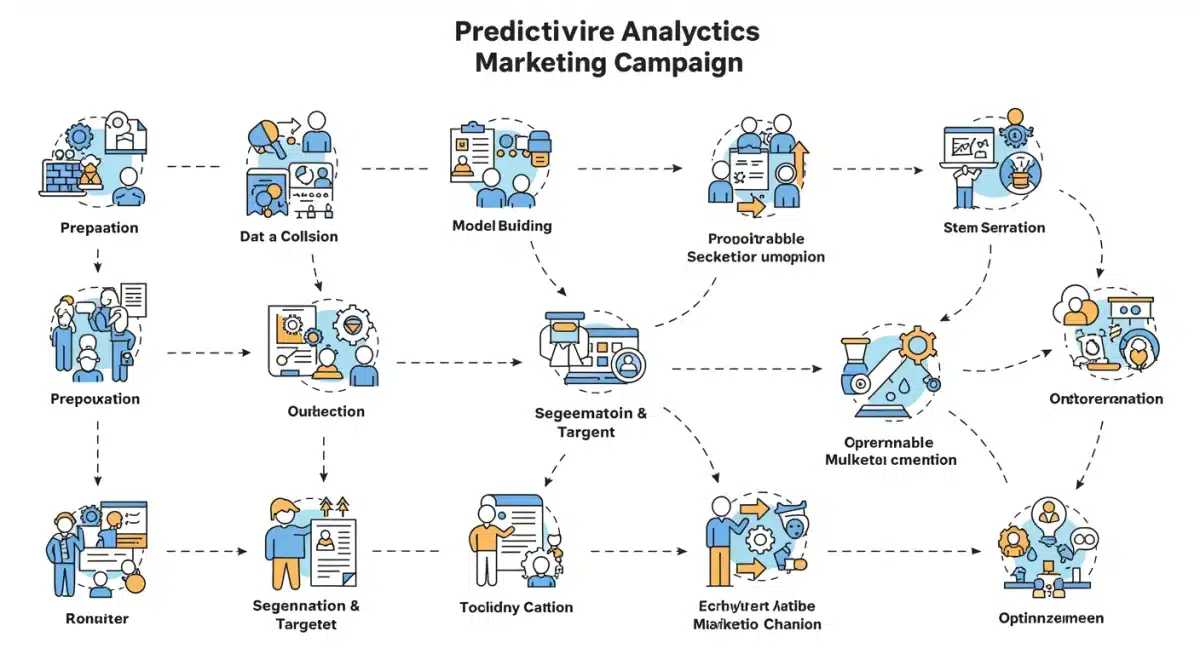
One of the most effective strategies is hyper-segmentation. Instead of broad customer segments, predictive analytics allows for the creation of micro-segments based on predicted behaviors, preferences, and value. For example, you can identify customers with a high propensity to purchase a specific product or those likely to respond to a particular discount. This precision targeting significantly reduces wasted ad spend and increases conversion rates.
High-impact predictive applications
- Personalized product recommendations: Leverage past behavior and predictive models to suggest relevant products, increasing average order value.
- Optimized channel selection: Predict which channels (email, social, direct mail) are most effective for specific customer segments, improving reach and response rates.
- Dynamic pricing strategies: Adjust pricing in real-time based on predicted demand and customer willingness to pay, maximizing revenue without sacrificing volume.
- A/B testing with predictive insights: Use predictive models to inform which variations to test and on which segments, accelerating learning and optimization.
Another crucial strategy involves optimizing your customer journey. Predictive models can identify potential drop-off points or opportunities for upselling and cross-selling. By proactively addressing these moments with targeted interventions, you can guide customers more smoothly through the funnel, improving conversion rates at each stage. Regularly testing and refining your predictive models based on real-world campaign performance is essential for continuous improvement and sustaining that 10% ROI growth.
Overcoming common challenges in predictive analytics implementation
While the promise of predictive analytics is compelling, its implementation often comes with a unique set of challenges. Recognizing and proactively addressing these hurdles is crucial for a smooth transition and successful integration into your marketing operations. From data quality issues to organizational resistance, anticipating these obstacles can significantly streamline your path to achieving a 10% ROI improvement.
A primary challenge frequently encountered is data quality and accessibility. Disparate data sources, inconsistent formatting, and missing information can severely hamper the accuracy and reliability of predictive models. Investing in robust data governance practices and data integration tools is essential to ensure that your analytical engine is fed with clean, comprehensive data. Without high-quality data, even the most sophisticated algorithms will struggle to produce meaningful insights.
Addressing typical roadblocks
- Data silos: Integrate data from various departments and platforms into a centralized repository.
- Lack of skilled talent: Invest in training existing staff or hiring data scientists with marketing domain expertise.
- Resistance to change: Champion the benefits of data-driven marketing across the organization to foster adoption.
- Model complexity: Start with simpler models and gradually increase sophistication as your team gains experience.
Another significant hurdle can be the cultural shift required within an organization. Moving from intuition-based decisions to data-driven strategies can meet with resistance from marketing teams accustomed to traditional methods. Effective change management, including clear communication of the benefits, training, and demonstrating early successes, is vital. It’s important to frame predictive analytics not as a replacement for human creativity but as a powerful tool that augments it, allowing marketers to focus on strategic thinking rather than guesswork.
Measuring impact and sustaining your ROI gains
Implementing predictive analytics is only half the battle; accurately measuring its impact and establishing mechanisms to sustain ROI gains are equally critical for long-term success. Without clear metrics and a continuous optimization loop, the initial improvements can quickly diminish. A robust measurement framework ensures that your predictive models remain effective and continue to deliver value over time, solidifying that 10% ROI improvement and beyond.
Key performance indicators (KPIs) directly linked to your marketing objectives must be established before implementation. These might include conversion rates, customer acquisition cost (CAC), customer lifetime value (CLTV), churn rate, and campaign ROI. By tracking these metrics rigorously, you can quantify the precise impact of your predictive analytics initiatives and demonstrate their value to stakeholders. A/B testing is also invaluable for comparing the performance of predictive models against traditional approaches.
Ensuring continuous improvement
- Regular model validation: Periodically re-evaluate and update your predictive models with new data to maintain accuracy.
- Feedback loops: Integrate campaign performance data back into your models for continuous learning and refinement.
- Iterative testing: Continuously experiment with different strategies informed by predictive insights to discover new optimization opportunities.
- Performance dashboards: Create accessible dashboards that visualize key metrics and model performance for all relevant teams.
Sustaining ROI gains requires a commitment to continuous learning and adaptation. Market dynamics, customer preferences, and competitive landscapes are constantly evolving. Therefore, your predictive models must also evolve. Regular model retraining, incorporating new data sources, and exploring advanced algorithms are essential practices. Establishing a culture of data-driven experimentation and optimization ensures that your marketing efforts remain at the forefront, consistently delivering superior results and solidifying the ongoing value of predictive analytics.
The future of marketing: integrating AI and machine learning for deeper insights
The journey with predictive analytics doesn’t end with initial ROI improvements; it’s a stepping stone towards a more sophisticated future where artificial intelligence (AI) and machine learning (ML) are deeply integrated into every facet of marketing. These advanced technologies promise even deeper insights, greater automation, and unprecedented levels of personalization, propelling marketing effectiveness far beyond what traditional methods can achieve. Embracing this evolution is key to maintaining a competitive edge and unlocking new growth avenues.
AI and ML algorithms can process vast amounts of complex data at speeds impossible for humans, uncovering subtle patterns and correlations that might otherwise remain hidden. This capability allows for more nuanced customer segmentation, real-time personalization of content and offers, and dynamic optimization of campaign parameters. Imagine an AI-powered system that automatically adjusts ad bids, creative elements, and targeting parameters based on live performance data and predicted outcomes, all without human intervention.
Next-gen marketing capabilities
- Generative AI for content creation: Automatically generate personalized ad copy, email subject lines, and even blog posts.
- Reinforcement learning for strategy: AI systems learn optimal marketing strategies through trial and error, dynamically adapting to market responses.
- Advanced anomaly detection: Instantly identify unusual patterns in customer behavior or campaign performance, allowing for rapid intervention.
- Hyper-personalization at scale: Deliver unique, individualized experiences to millions of customers simultaneously across all touchpoints.
The integration of AI and ML will transform marketing from a series of discrete campaigns into a continuous, intelligent system that learns and adapts in real-time. This future promises not just a 10% ROI increase, but potentially exponential growth as marketing becomes truly predictive, proactive, and personalized. Businesses that invest in these capabilities now will be best positioned to dominate the markets of tomorrow, leveraging cutting-edge technology to foster deeper customer relationships and drive unparalleled business success.
| Key Aspect | Brief Description |
|---|---|
| Predictive Analytics Basics | Utilizes data and algorithms to forecast future customer behavior and market trends. |
| Framework Components | Requires robust data infrastructure, analytical tools, and skilled personnel for effective insights. |
| ROI Improvement Strategy | Focus on hyper-segmentation, personalized recommendations, and channel optimization for rapid gains. |
| Overcoming Challenges | Address data quality, talent gaps, and organizational resistance through strategic planning and training. |
Frequently Asked Questions about Predictive Analytics in Marketing
Predictive analytics in marketing uses historical data, statistical algorithms, and machine learning to forecast future customer behavior and campaign outcomes. This allows marketers to anticipate trends, personalize strategies, and optimize resource allocation for better results.
With focused implementation and strategic application, businesses can realistically expect to see a 10% ROI improvement within three months. This rapid gain comes from optimizing targeting, personalization, and resource allocation based on data-driven insights.
Effective predictive analytics requires comprehensive data from various sources, including CRM systems, marketing automation platforms, website analytics, and social media. Data quality, integration, and hygiene are crucial for accurate predictions.
Common challenges include poor data quality, fragmented data sources, a shortage of skilled data scientists, and organizational resistance to new technologies. Overcoming these requires strategic planning, investment in tools, and cultural shifts.
Sustaining ROI gains involves continuous monitoring, regular model validation, and iterative testing. Establishing feedback loops where campaign performance data refines predictive models ensures ongoing accuracy and optimal results in a dynamic market.
Conclusion
The journey to leveraging predictive analytics for marketing campaigns is not merely about adopting new technology; it’s about fundamentally transforming your approach to customer engagement and business growth. By embracing data-driven foresight, marketers can move beyond reactive strategies to proactive, highly optimized campaigns that deliver measurable results. The promise of a 10% ROI improvement within three months is a testament to the power of these tools when implemented with strategic intent and a commitment to continuous refinement. As we look to the future, the integration of AI and machine learning will only amplify these capabilities, making predictive analytics an indispensable cornerstone of successful marketing in an increasingly competitive landscape. The time to act is now, setting the stage for sustained growth and unparalleled market advantage.