AI-Driven Content Optimization for SEO: Top 3 Rankings 2026

Achieving top 3 search engine rankings by 2026 will demand advanced AI content optimization SEO, utilizing new platform features to precisely align content with evolving user intent and algorithm complexities.
Are you ready to redefine your SEO strategy? The landscape of search engine optimization is rapidly transforming, making traditional methods increasingly insufficient. By 2026, securing a coveted top 3 ranking will demand a sophisticated approach, one deeply rooted in AI-driven content optimization for SEO. This isn’t just about keywords anymore; it’s about intelligent content creation and adaptation that speaks directly to both algorithms and human users.
The Evolution of SEO: Beyond Keywords to AI Understanding
The journey of SEO has been a dynamic one, shifting from keyword stuffing to semantic understanding and now, to an era where artificial intelligence is the driving force. In 2026, search engines will possess an even deeper comprehension of user intent, context, and content quality. This evolution necessitates a fundamental change in how we approach content creation and optimization.
Understanding Google’s AI-Powered Algorithms
Google’s algorithms, like RankBrain, BERT, and MUM, have already demonstrated a significant leap in understanding natural language and complex queries. By 2026, these systems will be further refined, capable of inferring nuanced meanings and cross-referencing information across vast datasets. This means content must not only be relevant but also authoritative, comprehensive, and contextually rich.
- Semantic Search Mastery: AI helps identify related topics and entities, ensuring your content covers the full breadth of a user’s potential query.
- User Intent Prediction: Advanced algorithms anticipate what users truly seek, even if their initial query is ambiguous.
- Content Quality Assessment: AI evaluates readability, factual accuracy, and overall value, pushing high-quality content to the forefront.
The days of simply scattering keywords are long gone. Success now hinges on creating content that AI can easily interpret as the most valuable resource for a given search query, a task made significantly easier and more effective with intelligent optimization tools.
To truly excel, marketers must embrace tools that can analyze content from an AI perspective, identifying gaps, improving clarity, and enhancing relevance in ways human analysis alone cannot. This proactive approach to content development is what will distinguish top performers in the competitive digital landscape of 2026.
Leveraging Predictive Analytics for Content Strategy in 2026
In the coming years, simply reacting to current search trends will no longer suffice. Achieving top rankings will require foresight, and that’s where predictive analytics powered by AI becomes indispensable. This technology allows marketers to anticipate future search queries, emerging topics, and shifts in consumer behavior before they become mainstream.
Anticipating Market Shifts with AI
AI-driven predictive analytics can process historical data, real-time trends, and external factors to forecast what content will resonate with audiences months in advance. This capability provides a significant competitive edge, enabling brands to create content that meets demand precisely when it peaks, rather than playing catch-up.
- Trend Forecasting: Identify nascent trends and prepare content strategies to capitalize on them early.
- Seasonal Demand Prediction: Optimize content for seasonal peaks and troughs with greater accuracy.
- Competitor Analysis: Predict competitor moves and identify opportunities for differentiation in content offerings.
Imagine knowing six months ahead of time that a particular sub-niche is about to explode in popularity. With AI predictive analytics, this becomes a reality, allowing for strategic content planning that positions your brand as a thought leader and primary information source.
By integrating these predictive insights into your content calendar, you can move beyond reactive content creation to a proactive, forward-thinking strategy. This ensures your content isn’t just optimized for today, but for the search landscape of tomorrow, securing your dominance in relevant search results.
Personalized Content Scaling with AI
The modern consumer expects personalized experiences. In 2026, this expectation will extend deeply into search results and the content they consume. AI-driven content optimization platforms will be crucial for delivering highly personalized content at scale, without compromising efficiency or quality.
Tailoring Content to Individual User Journeys
AI can analyze individual user behavior, preferences, and demographic data to generate or adapt content that is uniquely relevant to each person. This level of personalization moves beyond basic segmentation, offering a truly bespoke content experience that significantly boosts engagement and conversion rates.
- Dynamic Content Generation: AI can modify existing content or generate new variations to match specific user profiles or search contexts.
- Audience Segmentation Refinement: Gain deeper insights into micro-segments, allowing for hyper-targeted content strategies.
- Behavioral Content Adaptation: Content adjusts in real-time based on a user’s interactions and journey on your site.
Consider a scenario where a user searching for ‘best running shoes’ receives content tailored to their specific running style, past purchases, and even local weather conditions. This level of precision is only achievable through advanced AI integration.
The ability to scale personalized content effectively is a game-changer. It ensures that every piece of content published serves a specific purpose for a specific audience segment, maximizing its impact and contributing directly to higher search rankings through improved user signals like dwell time and lower bounce rates.
New Platform Features for Advanced SEO Performance
The tools and platforms available for SEO are evolving at an unprecedented pace. By 2026, new features will empower marketers with capabilities that were once the realm of science fiction, making AI content optimization SEO more accessible and powerful than ever before.
Integrated AI Content Suites
Expect to see comprehensive platforms that integrate AI across the entire content lifecycle – from ideation and creation to optimization and performance analysis. These suites will offer seamless workflows, reducing manual effort and increasing the accuracy of SEO efforts.
- Automated Content Audits: AI can rapidly identify content gaps, outdated information, and optimization opportunities across your entire website.
- Real-time Optimization Suggestions: As content is being drafted, AI provides instant feedback on readability, SEO score, and semantic completeness.
- Performance Prediction: Before publishing, AI can estimate the potential ranking and traffic impact of a piece of content.
These platforms will act as an intelligent co-pilot for content strategists, offering guidance and automation that significantly streamlines the optimization process. This allows teams to focus on creativity and strategic thinking, while AI handles the intricate details of algorithm alignment.
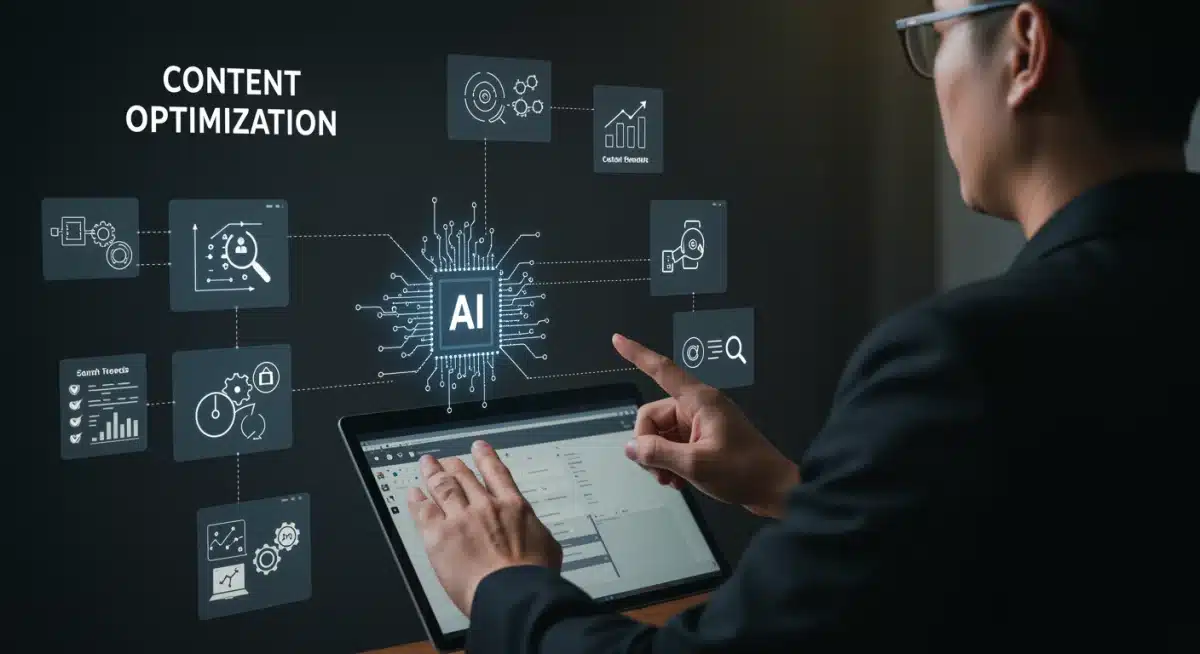
The integration of these advanced features will democratize sophisticated SEO, making it possible for businesses of all sizes to compete for top rankings. Staying abreast of these technological advancements and adopting them early will be key to maintaining a competitive edge.
Measuring Success: AI-Driven Analytics and Reporting
Knowing whether your optimization efforts are working is paramount. In 2026, AI-driven analytics will move beyond simple data aggregation to offer deep, actionable insights into content performance, allowing for continuous refinement and improvement.
Beyond Traditional Metrics: Understanding Impact
AI will provide a more holistic view of content performance, correlating various metrics to reveal true impact on user engagement, conversions, and ultimately, revenue. This goes beyond just traffic or keyword rankings, delving into the qualitative aspects of how content influences business outcomes.
- Attribution Modeling: Understand the true contribution of each piece of content across the customer journey using advanced AI models.
- Sentiment Analysis: Gauge audience perception and emotional response to your content, identifying areas for improvement in tone and messaging.
- Competitive Benchmarking: AI automatically compares your content performance against competitors, highlighting strengths and weaknesses.
Imagine receiving a report that not only tells you which content ranks highest but also explains why, linking specific optimization choices to measurable user behavior and business results. This level of insight empowers data-driven decision-making.
These advanced analytics capabilities will transform how marketers evaluate their SEO strategies. Instead of relying on guesswork, they will have precise, AI-backed data to guide their content optimization efforts, ensuring every adjustment leads to tangible improvements in ranking and ROI.
The Human Element: Guiding AI for Optimal Results
While AI will play an increasingly dominant role in content optimization, the human element remains irreplaceable. The most successful strategies in 2026 will be those that effectively blend AI’s analytical power with human creativity, intuition, and ethical oversight.
Strategic Oversight and Creative Direction
AI excels at data processing, pattern recognition, and optimization based on predefined rules. However, it lacks the nuanced understanding of human emotion, cultural context, and the ability to generate truly innovative, paradigm-shifting content. Human strategists will be responsible for guiding AI, setting objectives, and injecting the creative spark that differentiates content.
- Ethical Content Creation: Humans ensure AI-generated or optimized content adheres to ethical guidelines and brand values.
- Creative Storytelling: AI can optimize structure, but human writers craft compelling narratives that resonate deeply.
- Strategic Vision: Marketers define the overarching content strategy and how AI tools fit into achieving those goals.
The future of SEO isn’t about replacing humans with AI; it’s about augmenting human capabilities with powerful AI tools. This synergy allows for content that is not only algorithmically optimized but also genuinely engaging and impactful for human readers.
Therefore, investing in skills that complement AI – such as critical thinking, creative writing, and strategic planning – will be crucial for marketing professionals. The combination of intelligent technology and human ingenuity will be the ultimate formula for achieving and sustaining top 3 rankings in 2026.
| Key Aspect | Description for 2026 SEO |
|---|---|
| AI Algorithm Shift | Google’s AI will deeply understand user intent and content quality, demanding comprehensive, contextually rich content. |
| Predictive Analytics | AI will forecast search trends and consumer behavior, enabling proactive content strategy and early market capitalization. |
| Personalized Content | AI will scale highly personalized content delivery based on individual user behavior, enhancing engagement and conversions. |
| Human-AI Synergy | Human creativity and strategic oversight will remain crucial, guiding AI for ethical, innovative, and impactful content. |
Frequently Asked Questions About AI-Driven SEO
AI-driven content optimization for SEO involves using artificial intelligence tools to analyze, create, and refine content. It focuses on understanding user intent, predicting trends, and ensuring content aligns with complex search engine algorithms for better visibility and higher rankings.
By 2026, AI will deepen search engine understanding of content context and quality, making traditional keyword strategies less effective. SEO will shift towards semantic relevance, personalized content delivery, and proactive trend prediction, requiring more sophisticated AI-powered tools.
No, AI is not expected to fully replace human content creators. While AI excels at data analysis and optimization, human creativity, strategic thinking, emotional intelligence, and ethical oversight remain vital for crafting compelling narratives and guiding AI effectively for optimal, impactful results.
Future SEO platforms will feature integrated AI content suites offering automated audits, real-time optimization suggestions during content creation, and performance prediction. Expect advanced analytics for attribution modeling, sentiment analysis, and competitive benchmarking to measure true content impact.
Begin by researching and adopting AI-powered SEO tools for keyword research, content generation, and performance analysis. Focus on understanding user intent, investing in predictive analytics, and training your team to work collaboratively with AI to enhance existing content and create future-proof strategies.
Conclusion
The path to achieving top 3 search engine rankings by 2026 is unequivocally paved with AI-driven content optimization. As search algorithms grow more sophisticated, understanding user intent and delivering highly relevant, personalized content at scale will be non-negotiable. Embracing new platform features, leveraging predictive analytics, and strategically integrating AI into every facet of your content strategy will be crucial. Remember, the most successful approach will be a synergistic one, combining the unparalleled analytical power of AI with the indispensable creativity and strategic vision of human marketers. The future of SEO is intelligent, dynamic, and within reach for those who are prepared to adapt and innovate.