Mastering Upselling & Cross-Selling: Boost Customer Lifetime Value by 30% Annually by 2026

In the fiercely competitive landscape of modern business, simply acquiring new customers is no longer sufficient for sustainable growth. The true differentiator, the bedrock of long-term profitability, lies in maximizing the value of your existing customer base. This is where a robust Upselling Cross-Selling Strategy becomes not just beneficial, but absolutely critical. By 2026, businesses that master the art and science of upselling and cross-selling will be those that witness an impressive 30% annual increase in Customer Lifetime Value (CLV), leaving competitors scrambling to catch up.
This comprehensive guide delves into the strategic imperatives and tactical executions required to transform your approach to customer engagement, turning every interaction into an opportunity for mutual value creation. We’ll explore the psychological underpinnings, technological enablers, and data-driven methodologies that will define success in the coming years. Prepare to revolutionize your understanding of customer relationships and unlock unprecedented growth.
The Pivotal Role of Upselling Cross-Selling Strategy in 2026
Before we dive into the ‘how,’ let’s firmly establish the ‘why.’ Why is an effective Upselling Cross-Selling Strategy more important now than ever before? The answer lies in several converging market forces:
Escalating Customer Acquisition Costs (CAC)
Acquiring a new customer can be five to 25 times more expensive than retaining an existing one. As advertising costs soar and competition intensifies across all sectors, businesses are feeling the pinch of rising CAC. This makes extracting more value from each acquired customer an economic imperative. Upselling and cross-selling directly address this by increasing the revenue generated per customer without incurring significant additional acquisition costs.
The Power of Customer Loyalty and Trust
Existing customers already trust your brand, understand your offerings, and have a relationship with you. This pre-existing trust significantly lowers the barrier to purchase for additional products or services. A well-executed Upselling Cross-Selling Strategy reinforces this loyalty, making customers feel understood and valued, rather than just targeted for more sales. When customers perceive that recommendations are genuinely beneficial, their loyalty deepens, leading to repeat purchases and positive word-of-mouth.
Data-Driven Personalization Expectations
Customers in 2026 expect personalized experiences. They are accustomed to streaming services recommending movies, e-commerce sites suggesting related products, and social media platforms tailoring content. Generic, one-size-fits-all sales approaches are increasingly ineffective. An advanced Upselling Cross-Selling Strategy leverages data to provide highly relevant, timely, and personalized recommendations, meeting these evolving customer expectations and enhancing satisfaction.
Increased Customer Lifetime Value (CLV)
At its core, the goal of upselling and cross-selling is to increase CLV. By encouraging customers to purchase higher-value products (upselling) or complementary items (cross-selling), businesses directly boost the total revenue generated from each customer over their entire relationship. A higher CLV translates into greater profitability, more resources for innovation, and a stronger competitive position.
Competitive Differentiation
In a crowded marketplace, superior customer experience is a key differentiator. Businesses that excel at understanding customer needs and proactively offering solutions through thoughtful upselling and cross-selling stand out. This strategic approach moves beyond transactional selling to relationship-centric growth, fostering a deeper connection with customers that competitors find hard to replicate.
Understanding the Nuances: Upselling vs. Cross-Selling
While often used interchangeably, upselling and cross-selling are distinct strategies with different objectives and approaches within a broader Upselling Cross-Selling Strategy. Understanding this distinction is crucial for effective implementation.
Upselling: Enhancing the Current Purchase
Upselling involves encouraging customers to purchase a more expensive, upgraded, or premium version of a product or service they are already interested in or have previously bought. The aim is to increase the immediate transaction value by offering a ‘better’ option. Examples include:
- Suggesting a larger size of a product.
- Offering a premium subscription tier with more features.
- Recommending a newer model with enhanced capabilities.
- Proposing an extended warranty or service plan.
The key here is to demonstrate the added value and benefits that justify the higher price point, making the upgrade a compelling choice for the customer.
Cross-Selling: Complementing the Purchase
Cross-selling focuses on recommending complementary products or services that enhance the customer’s experience with their primary purchase. The goal is to solve additional needs or provide a more complete solution. Examples include:
- Suggesting batteries when a customer buys a remote-controlled toy.
- Offering a protective case when a new smartphone is purchased.
- Recommending training courses when someone buys new software.
- Proposing a matching accessory to an apparel item.
Cross-selling aims to broaden the customer’s engagement with your brand by meeting related needs they might not have initially considered.
Building a Future-Proof Upselling Cross-Selling Strategy for 2026
Achieving a 30% annual increase in CLV by 2026 requires a sophisticated, multi-faceted Upselling Cross-Selling Strategy. Here are the core pillars:
1. Deep Customer Understanding and Segmentation
The foundation of any successful upselling and cross-selling effort is an intimate understanding of your customers. This goes beyond basic demographics and delves into behavioral data, purchase history, preferences, and even psychographics. Advanced segmentation allows you to group customers based on shared characteristics and predict their needs more accurately.
- Behavioral Data: Analyze past purchases, browsing history, abandoned carts, product views, and engagement with marketing materials.
- Demographic and Psychographic Data: Understand who your customers are and what motivates them.
- Feedback and Surveys: Directly ask customers about their needs, pain points, and preferences.
- Customer Journey Mapping: Identify key touchpoints where upselling and cross-selling opportunities naturally arise.
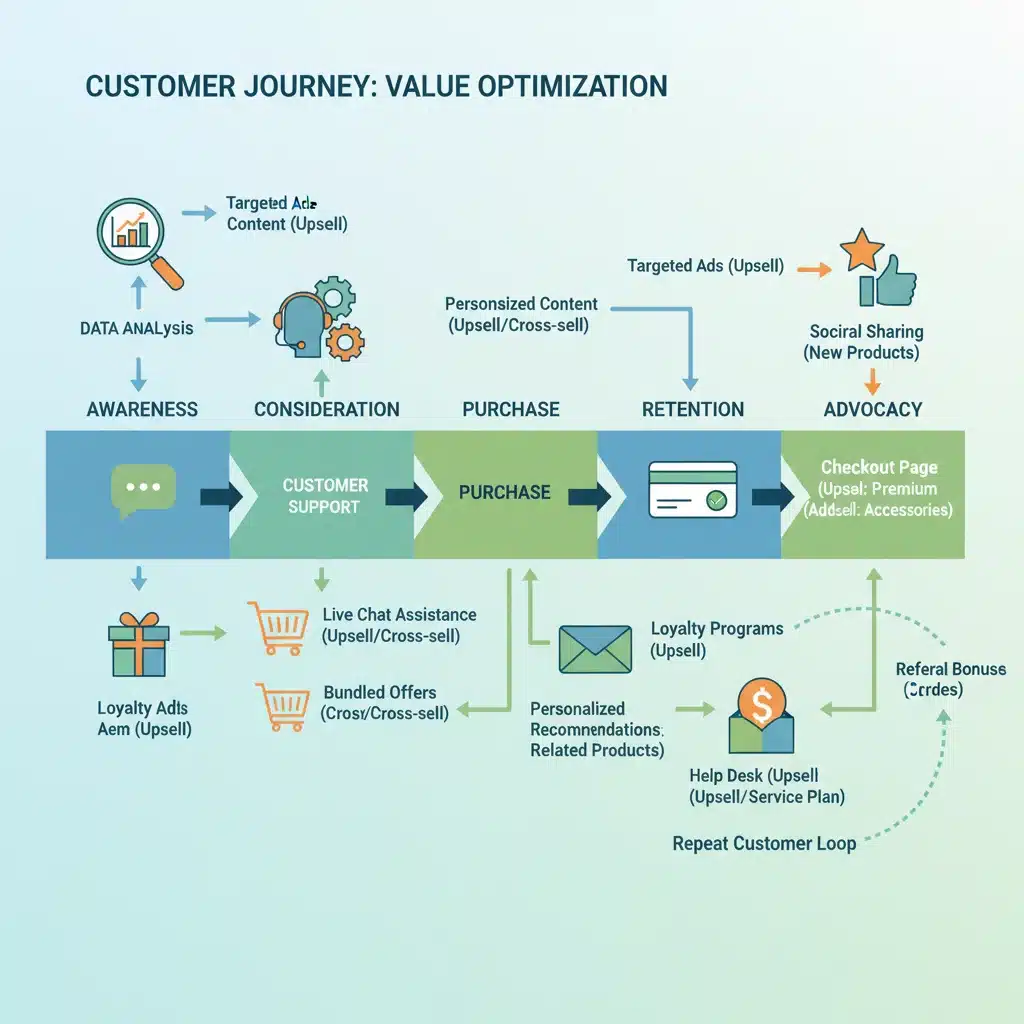
By understanding different customer segments, you can tailor your Upselling Cross-Selling Strategy to be highly relevant and persuasive.
2. Data-Driven Personalization and AI
In 2026, personalization is no longer a luxury; it’s an expectation. Leveraging Artificial Intelligence (AI) and Machine Learning (ML) is paramount for delivering highly relevant upselling and cross-selling recommendations at scale.
- Recommendation Engines: Implement AI-powered recommendation engines that analyze vast amounts of data to suggest products or upgrades customers are most likely to want. These engines can learn over time, becoming more accurate with each interaction.
- Predictive Analytics: Use ML algorithms to predict future customer needs, potential churn risks, and optimal times for offering specific products. For instance, if a customer regularly repurchases a product every three months, predict their next purchase and offer a related item just before.
- Dynamic Pricing and Bundling: AI can help optimize pricing for upsells and develop attractive product bundles based on customer segment and historical purchasing patterns.
The goal is to move beyond generic ‘customers also bought’ suggestions to truly intelligent, context-aware recommendations that feel like a helpful assistant, not a pushy salesperson.
3. Seamless Integration Across All Touchpoints
An effective Upselling Cross-Selling Strategy must be omnichannel. Recommendations should be consistent and integrated across your website, mobile app, email campaigns, in-store experiences, and customer service interactions.
- Website and App: Implement prominent ‘recommended for you,’ ‘upgrade options,’ and ‘complete your look’ sections. Use exit-intent pop-ups with relevant offers.
- Email Marketing: Send personalized follow-up emails post-purchase with complementary product suggestions or information about higher-tier services.
- Customer Service: Empower customer service representatives with tools that provide context-aware suggestions based on the customer’s query or history. They can naturally recommend solutions that involve an upsell or cross-sell.
- Sales Teams: Provide sales teams with comprehensive customer profiles and recommended next best actions to guide their conversations.
Consistency across channels ensures a cohesive and positive customer experience, reinforcing the value of your Upselling Cross-Selling Strategy.
4. Value-Driven Communication and Education
The most common mistake in upselling and cross-selling is making it sound like a mere sales pitch. Instead, focus on demonstrating the tangible value and benefits to the customer. Educate them on how the upgrade or complementary product will solve a problem, enhance their experience, save them time, or provide a better outcome.
- Highlight Benefits, Not Just Features: Explain what the product does for the customer, not just what it is.
- Use Social Proof: Incorporate testimonials, reviews, and case studies of other customers who benefited from the upsell or cross-sell.
- Content Marketing: Create blog posts, videos, and guides that naturally introduce and explain the value of complementary products or higher-tier services. For example, a blog about ‘maximizing your new camera’ could cross-sell lenses, tripods, and editing software.
- Transparent Pricing: Clearly articulate the cost and the value proposition.
When customers understand how an offer genuinely improves their situation, they are far more likely to embrace it.
5. Timing and Context are Everything
The effectiveness of your Upselling Cross-Selling Strategy heavily relies on timing and context. Offering a product at the wrong time or in an irrelevant context can be intrusive and counterproductive.
- Post-Purchase Nurturing: After a customer makes a purchase, there’s a window of opportunity to cross-sell complementary items or offer an upgrade to a related service once they’ve experienced the initial product.
- During Lifecycle Milestones: Identify points in the customer lifecycle where needs might evolve. For example, a subscription service might offer an upgrade when a customer approaches their current plan’s limits.
- Based on Usage Patterns: For software or service providers, analyze how customers use your product. If they frequently use a certain feature, offer an upgrade that enhances that feature or a complementary tool that integrates with it.
- Event-Triggered Offers: Send personalized offers based on specific events, such as an anniversary of their first purchase, a birthday, or a recent positive review.
Sophisticated analytics tools can help pinpoint these optimal moments, making your recommendations feel timely and helpful.
6. Employee Training and Empowerment
Your employees, especially those in sales, customer service, and support roles, are critical touchpoints for your Upselling Cross-Selling Strategy. They need to be well-trained, knowledgeable, and empowered to make relevant recommendations.
- Product Knowledge: Ensure all customer-facing staff have a deep understanding of your entire product and service catalog, including the benefits and use cases for each.
- Active Listening Skills: Train employees to listen for customer pain points and unspoken needs that an upsell or cross-sell could address.
- Solution-Oriented Approach: Emphasize solving customer problems rather than just pushing products.
- Incentivization: Consider incorporating upselling and cross-selling metrics into performance reviews and incentive programs to motivate employees.
When employees are confident and well-equipped, they become powerful advocates for your Upselling Cross-Selling Strategy.

7. Testing, Optimization, and Iteration
No Upselling Cross-Selling Strategy is perfect from the outset. Continuous testing, analysis, and refinement are essential for long-term success. A/B testing different offers, messaging, placements, and timing will provide invaluable insights.
- A/B Testing: Test various headlines, call-to-actions, product images, and recommendation algorithms to see what resonates best with different customer segments.
- Key Performance Indicators (KPIs): Track metrics such as conversion rates on upsell/cross-sell offers, average order value (AOV), CLV, customer churn rate, and customer satisfaction scores.
- Feedback Loops: Establish mechanisms to gather customer feedback on your recommendations. Are they perceived as helpful or intrusive?
- Iterative Improvement: Use the data and feedback to continually refine your strategies and algorithms. The market and customer preferences are constantly evolving, and your strategy must evolve with them.
This iterative process ensures your Upselling Cross-Selling Strategy remains agile, effective, and optimized for maximum CLV growth.
Ethical Considerations and Best Practices
While the goal is to increase revenue, it’s paramount that your Upselling Cross-Selling Strategy remains ethical and customer-centric. Aggressive or irrelevant tactics can backfire, damaging customer trust and leading to churn.
- Focus on Customer Value: Only recommend products or services that genuinely benefit the customer and enhance their experience.
- Transparency: Be clear about what you are offering and why. Avoid deceptive practices or hidden costs.
- Respect Customer Choices: If a customer declines an offer, respect their decision and avoid excessive follow-ups on the same offer.
- Avoid Overwhelm: Don’t bombard customers with too many recommendations at once. Quality over quantity.
- Data Privacy: Handle customer data responsibly and in compliance with all relevant privacy regulations (e.g., GDPR, CCPA).
An ethical Upselling Cross-Selling Strategy builds long-term relationships and fosters brand advocacy, which are far more valuable than short-term gains from aggressive tactics.
The Future of Upselling Cross-Selling Strategy: 2026 and Beyond
Looking ahead to 2026, several trends will further shape the evolution of upselling and cross-selling:
- Hyper-Personalization at Scale: Advancements in AI and data processing will enable even more granular and predictive personalization, making recommendations virtually indistinguishable from genuine helpful advice.
- Conversational AI and Voice Commerce: Chatbots and voice assistants will play a larger role in identifying customer needs and suggesting relevant upsells or cross-sells in a natural, conversational manner.
- Immersive Experiences (VR/AR): Virtual and augmented reality could create new avenues for product discovery and visualization, where customers can ‘try on’ or ‘experience’ an upsell or cross-sell before purchasing.
- Subscription Economy Growth: As more businesses shift to subscription models, upselling to higher tiers and cross-selling complementary subscription services will become even more critical for recurring revenue growth.
- Ecosystem Integration: Businesses will increasingly collaborate to offer integrated solutions, leading to cross-selling opportunities across different but complementary brands.
The businesses that embrace these emerging technologies and adapt their Upselling Cross-Selling Strategy will be the ones that thrive in the future, achieving and even surpassing the goal of a 30% annual CLV increase.
Conclusion
In conclusion, a sophisticated and customer-centric Upselling Cross-Selling Strategy is not merely a sales tactic; it is a fundamental pillar of sustainable business growth in 2026 and beyond. By prioritizing deep customer understanding, leveraging the power of AI and personalization, ensuring seamless integration across touchpoints, and communicating value effectively, businesses can transform their customer relationships into powerful engines of growth.
The goal of a 30% annual increase in Customer Lifetime Value is ambitious but entirely achievable for organizations willing to invest in the right strategies, technologies, and talent. By continuously testing, optimizing, and adapting their approach, companies can build lasting customer loyalty, significantly boost profitability, and secure a leading position in their respective markets. Start refining your Upselling Cross-Selling Strategy today to unlock the immense potential within your existing customer base.