Voice Search Optimization Tools 2026: Capture 50 Million US Queries

In the rapidly evolving landscape of digital search, a seismic shift is underway. Voice search, once a novelty, is now a dominant force, fundamentally altering how users interact with information. As we approach 2026, the imperative for businesses to master voice search optimization has never been more critical. Projections indicate that the United States alone is poised to generate an additional 50 million voice queries, presenting both an immense opportunity and a significant challenge for marketers and SEO professionals.
The transition from typed queries to spoken commands is not merely a change in input method; it represents a deeper evolution in user behavior, expectations, and the very nature of search intent. Users are seeking faster, more convenient, and increasingly conversational interactions with search engines and smart devices. This paradigm shift demands a proactive and sophisticated approach to SEO, one that moves beyond traditional keyword stuffing and embraces natural language processing, semantic understanding, and user context.
This comprehensive guide delves into the cutting-edge voice search optimization tools and strategies that will be indispensable for capturing this burgeoning market in 2026. We will explore how to adapt your content, technical SEO, and overall digital strategy to resonate with voice-activated assistants like Google Assistant, Amazon Alexa, Apple Siri, and others. From understanding conversational keywords to implementing advanced schema markup, and from optimizing for local voice searches to leveraging AI-powered analytics, we aim to provide a roadmap for success in this time-sensitive and highly competitive domain.
Ignoring the ascent of voice search is no longer an option. Businesses that fail to adapt risk becoming invisible in a world where answers are spoken, not typed. Join us as we unpack the critical components of voice search optimization and equip you with the knowledge to not only survive but thrive in the voice-first era.
The Rise of Voice Search: A Statistical Imperative for 2026
The statistics surrounding voice search are compelling and paint a clear picture of its escalating importance. By 2026, experts predict that a substantial percentage of all internet searches will be conducted via voice. This isn’t just a trend; it’s a fundamental shift in user interaction that has profound implications for how businesses are discovered online.
Key Drivers of Voice Search Adoption:
- Convenience and Speed: Speaking is generally faster than typing, especially on mobile devices. Users appreciate the hands-free, eyes-free convenience.
- Smart Device Proliferation: The widespread adoption of smart speakers (Google Home, Amazon Echo), smart displays, and voice-enabled smartphones has made voice interaction a daily norm for millions.
- Improved Accuracy: Advancements in Natural Language Processing (NLP) and Artificial Intelligence (AI) have significantly enhanced the accuracy and understanding of voice assistants, leading to a more satisfying user experience.
- Multitasking: Voice search allows users to perform queries while driving, cooking, exercising, or engaging in other activities that make typing impractical.
- Accessibility: Voice search offers a more accessible way for individuals with certain disabilities to interact with technology.
The projected increase of 50 million additional US queries by 2026 is a conservative estimate, highlighting the urgency for businesses to refine their voice search optimization strategies. This growth isn’t uniform; it disproportionately affects certain industries and types of queries, particularly local searches, informational queries, and transactional queries for quick purchases.
For businesses, this means that if your content isn’t optimized for how people speak, you’re missing out on a rapidly expanding audience. Traditional SEO, while still vital, must be augmented with a voice-first approach that considers the nuances of conversational language and direct answers. The goal of voice search optimization is to ensure that when a user asks a question, your business provides the most relevant, concise, and authoritative answer.
Understanding Conversational Keywords and Natural Language Processing (NLP)
The cornerstone of effective voice search optimization lies in a deep understanding of conversational language and how search engines process it through Natural Language Processing (NLP). Unlike typed queries, which are often short, keyword-focused, and staccato, voice queries tend to be longer, more natural, and question-based.
Key Differences Between Typed and Voice Queries:
- Length: Voice queries are typically 3-5 times longer than typed queries.
- Question Format: Voice searches often take the form of questions (Who, What, When, Where, Why, How).
- Conversational Tone: Users speak to voice assistants as they would to another person, using more natural phrasing and complete sentences.
- Contextual Nuance: Voice queries often carry implied context that NLP systems are becoming increasingly adept at understanding.
To succeed in voice search optimization, marketers must shift their keyword research strategy. Instead of focusing solely on short-tail and exact-match keywords, the emphasis must move towards long-tail, question-based phrases and semantic keyword clusters that reflect natural speech patterns.
Strategies for Conversational Keyword Research:
- "People Also Ask" Sections: Google’s "People Also Ask" (PAA) boxes are a goldmine for understanding common questions related to your target keywords.
- Answer the Public: Tools like Answer the Public visualize questions, prepositions, comparisons, and alphabetical searches related to a topic, providing invaluable insights into conversational queries.
- Keyword Tools with Question Filters: Many advanced keyword research tools now offer filters to identify question-based queries.
- Customer Service Logs & FAQs: Analyze your customer service logs, support tickets, and existing FAQ sections to identify common questions your audience asks.
- Voice Search Simulations: Use voice assistants yourself to understand how they interpret queries and what kind of answers they provide.
NLP is the technology that allows voice assistants to comprehend the intent behind a spoken query. It goes beyond simply matching keywords to understanding the meaning, context, and sentiment of the language. Optimizing for NLP means creating content that is clear, concise, and directly answers potential questions, mimicking human conversation.
Essential Voice Search Optimization Tools for 2026
To effectively implement a voice search optimization strategy, businesses need a robust toolkit. The following categories of tools will be crucial for capturing those 50 million additional US queries by 2026:
1. Advanced Keyword Research Tools:
- Semrush & Ahrefs: While traditional SEO powerhouses, both platforms have evolved to offer sophisticated keyword research capabilities, including question-based keyword identification, long-tail keyword analysis, and competitive insights that are invaluable for voice search. Their content gap analysis can reveal opportunities where your competitors are answering voice queries that you are not.
- AnswerThePublic: Specialized in visualizing questions, prepositions, comparisons, and alphabetical searches around a topic, making it an excellent resource for understanding conversational queries.
- Google Keyword Planner: Still a foundational tool for understanding search volume and identifying related long-tail keywords, though it requires more manual effort to uncover question-based queries.
2. Schema Markup & Structured Data Generators:
- Schema.org: The universal vocabulary for structured data. Understanding and implementing the correct schema types (e.g., FAQPage, HowTo, LocalBusiness, Product, Review) is paramount for voice search, as it helps search engines understand your content’s context and deliver direct answers.
- Google’s Structured Data Markup Helper: A free tool that helps you tag elements on your web page with schema.org properties without needing to write code from scratch.
- Schema Markup Generators (e.g., TechnicalSEO.com Schema Markup Generator): These tools simplify the process of creating JSON-LD schema, which is the preferred format for Google.
3. Local SEO Tools:
- Google Business Profile (formerly Google My Business): Absolutely non-negotiable. Optimizing your GBP listing with accurate, up-to-date information (address, phone, hours, categories, services, reviews) is critical for "near me" voice searches.
- Yext & BrightLocal: These platforms help manage and synchronize your business listings across multiple directories, ensuring consistency and accuracy, which are vital for local voice search rankings.
- Reputation Management Tools: Tools that monitor and help manage online reviews (e.g., Birdeye, Podium) are essential, as voice assistants often prioritize businesses with high ratings and positive feedback.

4. Content Optimization & NLP Tools:
- Surfer SEO & Clearscope: These AI-powered content optimization tools analyze top-ranking content for your target keywords and suggest relevant terms, entities, and questions to include. They are invaluable for creating comprehensive, semantically rich content that aligns with NLP expectations.
- Google Search Console: Provides insights into how Google sees your site, including search queries, impressions, and clicks. While not voice-specific, it helps monitor content performance and identify opportunities.
- Yoast SEO & Rank Math (for WordPress): These plugins help with on-page SEO best practices, including readability, meta descriptions, and schema implementation, all of which indirectly support voice search.
5. Mobile-First Optimization Tools:
- Google’s Mobile-Friendly Test: Essential for ensuring your website provides a seamless experience on mobile devices, which is where a significant portion of voice searches originate.
- Google PageSpeed Insights: Measures your website’s performance on both mobile and desktop, providing recommendations for improving loading speed, a crucial factor for user experience and search engine rankings.
- AMP (Accelerated Mobile Pages): While not a tool, implementing AMP can drastically improve mobile page load times, making your content more accessible to voice search users.
6. Analytics & Tracking:
- Google Analytics 4 (GA4): While direct voice search tracking is still evolving, GA4’s event-based model can help you track user behavior on pages that are likely to be targeted by voice queries, such as FAQs or "How-to" guides.
- Custom Dashboards: Building custom dashboards to monitor organic traffic to question-based content, featured snippets, and local pack rankings can provide insights into your voice search optimization performance.
Strategies for Optimizing Content for Voice Search
Beyond tools, a strategic approach to content creation and optimization is paramount for effective voice search optimization. Here’s how to adapt your content strategy:
1. Answer Direct Questions Concisely:
Voice assistants prioritize direct, concise answers. Aim to provide the most relevant information within the first few sentences of your content. Think of it as crafting "voice snippets" that can be easily extracted and spoken by an AI.
2. Focus on Featured Snippets (Position Zero):
Many voice search results are pulled directly from Google’s Featured Snippets. Structure your content to be eligible for these coveted "position zero" rankings. This involves:
- Clearly answering questions in a paragraph, list, or table format.
- Using clear headings and subheadings.
- Ensuring accuracy and authority.
3. Embrace a Conversational Tone:
Write as you would speak. Use natural language, avoid jargon where possible, and maintain a friendly, approachable tone. This aligns your content more closely with how users phrase their voice queries.
4. Optimize for Local Search Intent:
A significant portion of voice queries are local (e.g., "restaurants near me," "plumber in [city]"). Ensure your content includes location-specific keywords, and that your Google Business Profile is meticulously optimized.
5. Create Comprehensive FAQ Pages:
Dedicated FAQ pages are perfect for voice search optimization. Structure them with clear questions and concise answers, and apply FAQPage schema markup to enhance their visibility in voice search results.
6. Think About User Intent:
Go beyond keywords and understand the underlying intent behind a voice query. Is the user seeking information, looking to buy, or trying to navigate? Tailor your content to fulfill that specific intent.
7. Long-Form Content with "Answer Boxes":
While voice answers are concise, long-form, authoritative content often ranks well because it covers a topic comprehensively. Within this content, strategically place short, direct answers to potential voice queries, making them easy for search engines to identify.
Technical SEO Considerations for Voice Search
While content is king, technical SEO provides the crown. These technical elements are crucial for ensuring your site is discoverable and presentable to voice assistants:
1. Implement Schema Markup (Structured Data):
As mentioned, schema.org markup is vital. It provides context to search engines about your content, making it easier for them to extract specific answers for voice queries. Focus on types like FAQPage, HowTo, LocalBusiness, Product, and Review.
2. Ensure Mobile-Friendliness and Page Speed:
Voice searches are predominantly conducted on mobile devices. A fast, responsive, and mobile-friendly website is non-negotiable. Google’s Mobile-First Indexing means your mobile site is the primary version considered for ranking. Use tools like Google PageSpeed Insights to identify and fix performance bottlenecks.
3. Secure Your Site with HTTPS:
HTTPS is a ranking factor and builds trust. Google and other search engines prioritize secure websites, and voice assistants are unlikely to recommend insecure sites.
4. Optimize for Local SEO:
Ensure your Name, Address, Phone (NAP) information is consistent across all online directories, especially your Google Business Profile. Encourage and respond to customer reviews, as these can influence local voice search rankings.
5. Improve Site Architecture and Navigation:
A clear, logical site structure helps search engine crawlers understand your content and its relationships. Easy navigation, particularly on mobile, indirectly supports voice search optimization by improving overall user experience.
6. Build an XML Sitemap:
An XML sitemap helps search engines discover all important pages on your site, ensuring that your voice-optimized content is indexed.
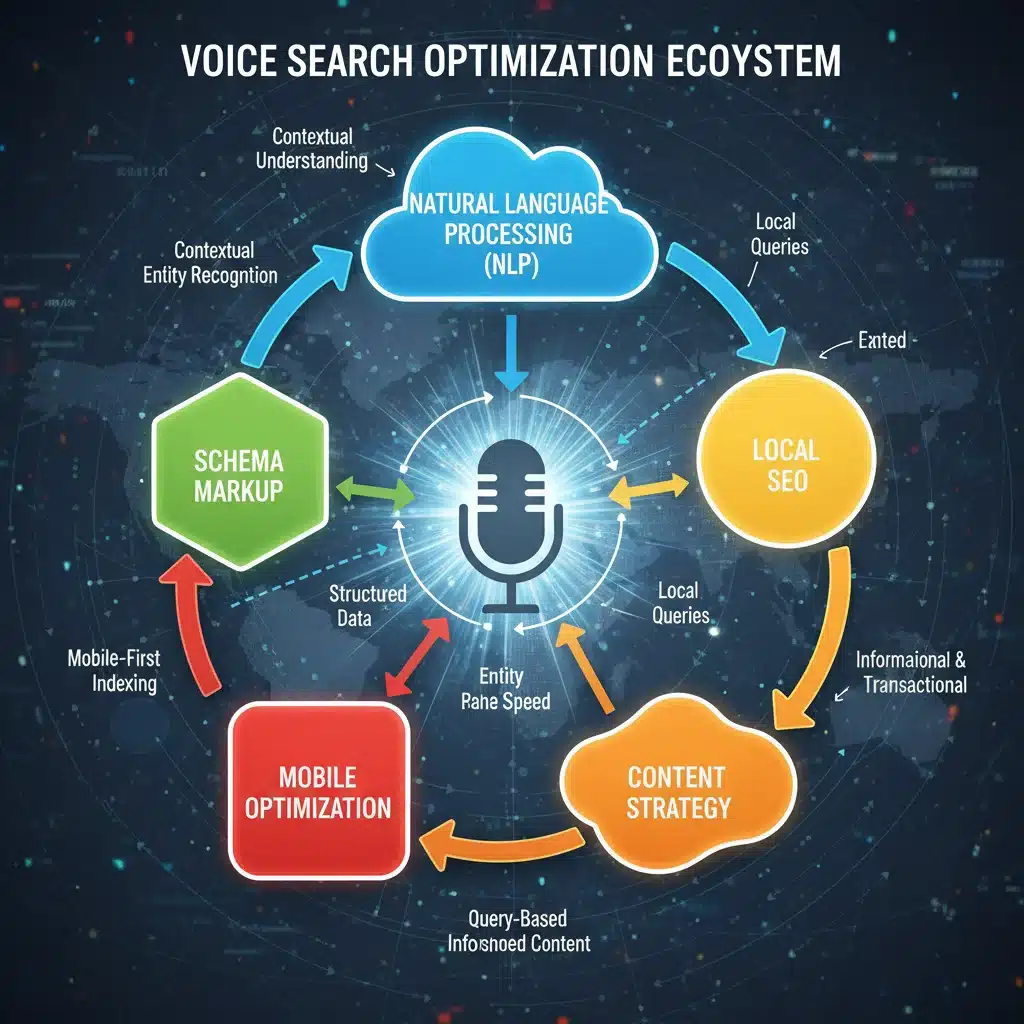
Measuring Success and Adapting Your Voice Search Strategy
Optimizing for voice search is an ongoing process, not a one-time fix. Measuring your performance and continuously adapting your strategy is crucial for long-term success, especially as the landscape evolves towards 2026 and beyond.
Key Metrics to Monitor:
- Featured Snippet Wins: Track how often your content appears in Google’s Featured Snippets. Tools like Semrush and Ahrefs can help monitor this.
- Organic Traffic to Question-Based Content: Analyze traffic to your FAQ pages, "How-to" articles, and other content optimized for conversational queries.
- Local Pack Rankings: For local businesses, monitor your visibility in Google’s local pack results, as these are frequently served for "near me" voice searches.
- Mobile Traffic and Engagement: Monitor mobile user behavior, bounce rates, and time on page for voice-optimized content.
- Site Speed & Core Web Vitals: Continuously monitor and improve your site’s performance metrics, as they directly impact user experience and search engine rankings.
- Google Search Console Queries: Look for question-based queries that are driving impressions and clicks to your site. This can reveal new opportunities for voice search optimization.
Adapting Your Strategy:
- Stay Updated with Algorithm Changes: Search engine algorithms are constantly evolving, particularly in the realm of NLP and AI. Regularly follow industry news and updates from Google, Amazon, and Apple.
- Analyze User Feedback: Pay attention to what your customers are asking, both directly and through your customer service channels. This provides real-world insights into their voice search needs.
- Competitor Analysis: Regularly analyze what your competitors are doing in the voice search space. Are they winning featured snippets? How are they structuring their local listings?
- Experiment and Test: Don’t be afraid to experiment with different content formats, schema types, and optimization techniques. A/B test changes to see what resonates best with voice assistants and users.
- Integrate Voice into Your Overall SEO Strategy: Voice search optimization should not be a siloed effort but an integrated component of your broader SEO and digital marketing strategy.
The Future of Voice Search and AI in 2026 and Beyond
As we look towards 2026, the integration of AI will become even more seamless and sophisticated in voice search. Generative AI models are already enhancing the capabilities of voice assistants, enabling them to provide more nuanced, personalized, and context-aware responses. This means:
- More Complex Queries: Voice assistants will handle multi-part questions and follow-up queries with greater accuracy.
- Personalized Results: Search results will be increasingly tailored to individual user preferences, history, and location.
- Proactive Information Delivery: Voice assistants may proactively offer information or suggestions based on learned user patterns, moving beyond reactive query answering.
- Multimodal Experiences: The integration of voice with visual interfaces (smart displays, AR/VR) will create richer, more interactive search experiences.
For voice search optimization, this means a continued emphasis on creating high-quality, authoritative, and semantically rich content that a sophisticated AI can easily understand and synthesize. Businesses will need to think not just about answering questions, but about providing comprehensive "knowledge graphs" around their topics.
The race to capture the next 50 million US voice queries is not just about adopting new tools; it’s about embracing a new philosophy of search. It requires a user-centric approach, a deep understanding of natural language, and a commitment to continuous adaptation. The businesses that master these elements will be the ones that dominate the digital landscape in 2026 and well into the future.
Conclusion: Seizing the Voice Search Opportunity
The trajectory of voice search is clear: it’s growing exponentially, driven by convenience, technological advancements, and the pervasive presence of smart devices. For businesses operating in the US, the opportunity to capture an additional 50 million voice queries by 2026 is a compelling call to action.
Effective voice search optimization is no longer an optional add-on; it is a fundamental pillar of modern SEO. It demands a holistic strategy that encompasses:
- Deep understanding of conversational keywords and NLP.
- Strategic content creation focused on direct answers and featured snippets.
- Meticulous technical SEO, including schema markup and mobile optimization.
- Robust local SEO efforts for "near me" queries.
- Continuous monitoring, analysis, and adaptation of your strategy.
The voice search optimization tools discussed in this guide – from advanced keyword research platforms to schema generators and local SEO managers – provide the necessary infrastructure. However, the true power lies in how these tools are integrated into a thoughtful, user-centric approach to content and technical execution.
Don’t let your business be left behind in the silent revolution of voice. Start implementing these strategies today to ensure your brand is not just heard, but understood and chosen, by the millions of Americans who will increasingly rely on their voices to navigate the digital world. The future of search is conversational, and the time to optimize is now.