Blockchain in AdTech 2026: Transparency & Fraud Reduction

By 2026, blockchain technology is poised to revolutionize the AdTech industry, ensuring 100% transparency and significantly reducing ad fraud by 50%, fostering a more reliable and equitable digital advertising ecosystem.
The digital advertising landscape is constantly evolving, yet persistent challenges like ad fraud and a lack of transparency continue to plague the industry. However, by 2026, the integration of blockchain in AdTech transparency is projected to be a game-changer, promising a paradigm shift towards a more honest and efficient ecosystem. Are we truly on the cusp of an era where every ad impression is verifiable and fraudulent activities are drastically minimized?
The Current State of AdTech: A Landscape Ripe for Disruption
The AdTech industry, while innovative, has long been a complex and often opaque environment. Advertisers frequently grapple with issues of trust, unsure if their budgets are being spent effectively or if their campaigns are reaching genuine human audiences. This lack of clear visibility creates significant hurdles for optimizing ad spend and measuring true return on investment.
Publishers, on the other hand, face challenges in proving the authenticity of their inventory and ensuring fair compensation for their valuable ad spaces. The intricate web of intermediaries, from demand-side platforms (DSPs) to supply-side platforms (SSPs) and ad exchanges, often makes it difficult to trace the journey of an ad dollar, leading to a substantial portion being siphoned off by various players before reaching the publisher.
Prevalent Issues: Fraud and Lack of Transparency
Ad fraud, in its myriad forms, remains a multi-billion dollar problem. From bot traffic and domain spoofing to ad stacking and pixel stuffing, malicious actors continuously devise new methods to defraud advertisers. This not only wastes significant financial resources but also distorts campaign data, leading to misguided strategic decisions.
- Bot Traffic: Automated programs mimicking human behavior to generate fake impressions and clicks.
- Domain Spoofing: Falsely representing low-quality inventory as premium publisher sites.
- Ad Stacking: Placing multiple ads on top of each other, with only the top one visible, but all registered as impressions.
- Lack of Data Integrity: Difficulty in verifying the authenticity and accuracy of campaign performance data.
The opaque nature of programmatic advertising exacerbates these issues. Advertisers often lack granular insight into where their ads are served, who sees them, and the true cost breakdown across the supply chain. This absence of transparency undermines trust and stifles genuine innovation within the industry.
In conclusion, the current AdTech ecosystem, despite its technological advancements, is fundamentally challenged by deep-seated issues of fraud and a pervasive lack of transparency. These problems not only erode advertiser confidence but also hinder the growth and sustainability of legitimate publishers, setting the stage for disruptive solutions like blockchain.
Blockchain’s Foundational Principles for AdTech Transformation
At its core, blockchain technology offers a decentralized, immutable, and transparent ledger system that is perfectly suited to address the inherent flaws within the traditional AdTech landscape. Its foundational principles promise to rebuild trust and efficiency by providing an indisputable record of every transaction and interaction.
The distributed nature of blockchain means that data is not stored in a single, vulnerable location, but rather across a network of computers. Each new block of information is cryptographically linked to the previous one, forming an unbreakable chain. This architecture makes it incredibly difficult to alter or tamper with data once it has been recorded, ensuring data integrity.
Decentralization and Immutability: Cornerstones of Trust
Decentralization eliminates the need for central authorities, reducing single points of failure and the potential for manipulation. In AdTech, this means that advertisers and publishers can interact directly, or through verified smart contracts, without relying on numerous intermediaries whose processes may be opaque or self-serving. This direct interaction fosters a more equitable distribution of value.
- Immutable Records: Every ad impression, click, and transaction is permanently recorded and cannot be altered.
- Distributed Ledger: Transaction data is replicated across multiple nodes, enhancing security and preventing data loss.
- Reduced Intermediaries: Streamlines the ad supply chain, potentially cutting out unnecessary third parties.
- Enhanced Auditability: Provides a clear, verifiable trail for every step of an ad campaign.
The immutability of blockchain records is a crucial advantage for combating ad fraud. Once an impression is verified and logged on the blockchain, its authenticity cannot be disputed. This creates an unchangeable audit trail that can be used to track ad spend, verify audience engagement, and identify fraudulent activities with unprecedented accuracy.
Ultimately, blockchain’s core principles of decentralization and immutability provide the technological bedrock for a truly transparent and trustworthy AdTech environment. By building on these tenets, the industry can move towards an era where data integrity is guaranteed, and all participants operate on a level playing field.
Achieving 100% Transparency: A Verifiable Ad Supply Chain
The promise of 100% transparency in the AdTech supply chain, once a distant dream, is becoming a tangible reality with blockchain. By leveraging its distributed ledger capabilities, every step of an ad’s journey, from impression to payment, can be recorded and verified, offering complete visibility to all authorized parties.
This level of transparency means that advertisers can precisely track their ad spend, understanding exactly where their money goes and the true value delivered. Publishers, in turn, can demonstrate the authenticity of their inventory and ensure they receive fair compensation for their ad space, fostering a more equitable distribution of revenue.
Real-time Tracking and Data Verification
Blockchain enables real-time tracking of ad impressions and clicks. Each interaction can be logged as a transaction on the distributed ledger, providing an immutable record that can be accessed and audited by all participants. This eliminates discrepancies and disputes that often arise from siloed data sources and differing measurement methodologies.
- Impression Verification: Cryptographically verifying each ad impression to ensure it was seen by a genuine user on a legitimate site.
- Click Attribution: Transparently tracking clicks and conversions, reducing fraudulent attribution.
- Supply Path Optimization: Gaining clear insights into the entire ad supply chain to identify inefficiencies and unnecessary markups.
- Audience Validation: Using blockchain for secure, privacy-preserving validation of audience segments.
Furthermore, smart contracts can automate the payment process based on predefined conditions, such as verified impressions or conversions. This not only streamlines financial transactions but also reduces the potential for human error and deliberate manipulation. The entire supply chain becomes an open book, fostering a new era of trust.
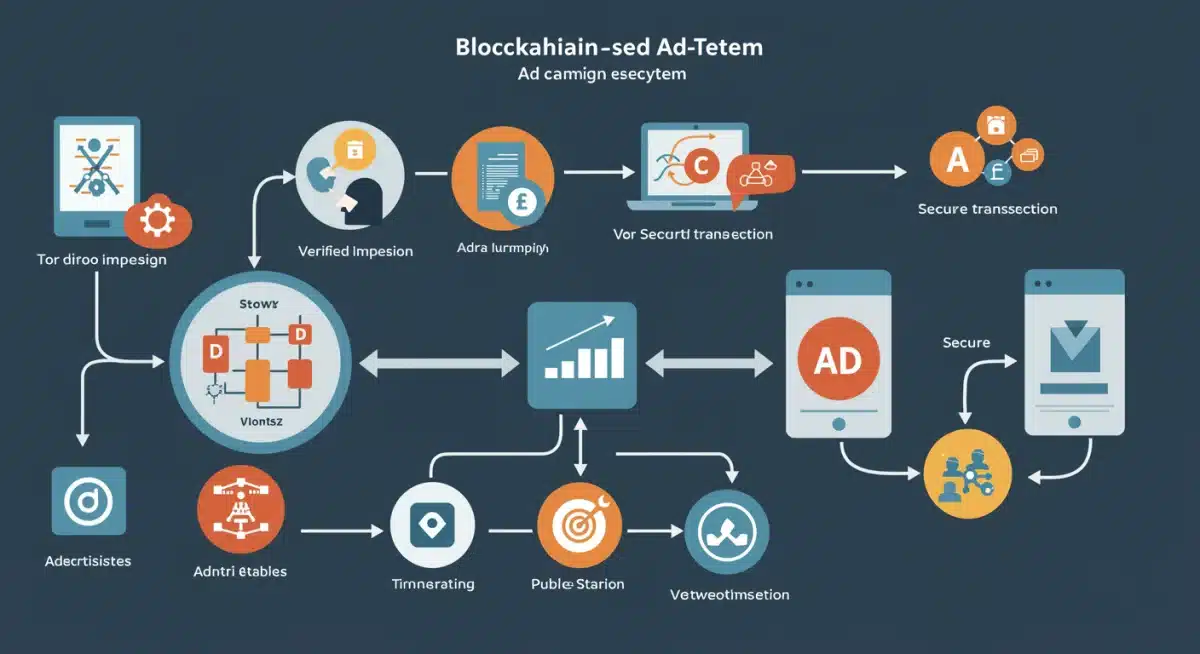
The ability to achieve 100% transparency through blockchain is not merely about exposing data; it’s about empowering all stakeholders with verifiable information, enabling them to make informed decisions and build a more accountable advertising ecosystem.
Reducing Ad Fraud by 50%: Blockchain’s Defensive Mechanisms
One of the most compelling impacts of blockchain on AdTech by 2026 is its projected ability to reduce ad fraud by a significant margin, potentially up to 50%. This reduction stems from the technology’s inherent security features and its capacity to create an environment where fraudulent activities are both difficult to execute and easily detectable.
The immutable ledger makes it nearly impossible for fraudsters to manipulate impression counts or falsely claim clicks without leaving an unalterable trace. This acts as a powerful deterrent, as bad actors understand that their fraudulent activities will be permanently recorded and exposed.
Combating Common Fraud Types with Blockchain
Blockchain provides robust mechanisms to counter various forms of ad fraud. For instance, bot traffic, a pervasive issue, can be mitigated by requiring cryptographic verification of human interaction or by integrating with identity solutions built on blockchain that confirm real users. Domain spoofing becomes incredibly difficult when ad inventory is tokenized and its origin is verifiable on a public ledger.
- Bot Detection: Advanced algorithms combined with blockchain’s verifiable identity solutions to distinguish human from bot traffic.
- Domain Verification: Cryptographically linking ad inventory to verified publisher domains, preventing spoofing.
- Impression Fraud Prevention: Ensuring each impression is unique and legitimate through secure, timestamped recordings.
- Click Fraud Mitigation: Tracking the entire user journey with immutable records to identify suspicious click patterns.
The use of smart contracts further enhances fraud prevention. These self-executing contracts can automatically withhold payments if certain predefined conditions, such as a threshold of fraudulent impressions, are detected. This proactive approach significantly reduces the financial incentive for fraudsters and protects advertiser budgets.
In essence, blockchain introduces a new layer of security and accountability that fundamentally shifts the economics of ad fraud. By making fraud harder to commit, easier to detect, and less profitable, the industry can expect a substantial and sustained reduction in fraudulent activities, leading to a healthier and more trustworthy ecosystem.
Challenges and Adoption Hurdles on the Path to 2026
While the benefits of blockchain in AdTech are clear, its widespread adoption by 2026 is not without significant challenges. The transition from legacy systems to a blockchain-powered infrastructure requires substantial investment, technical expertise, and a concerted effort from all industry stakeholders. Overcoming these hurdles will be crucial for realizing the full potential of this transformative technology.
The complexity of integrating blockchain into existing AdTech stacks, which are often fragmented and proprietary, represents a major technical undertaking. It demands interoperability solutions and standardized protocols to ensure seamless communication and data exchange across different platforms.
Scalability, Regulation, and Industry Collaboration
One of the primary technical challenges is scalability. Current blockchain networks, particularly public ones, can struggle to process the immense volume of transactions generated by the AdTech industry in real-time. Solutions like layer-2 protocols and specialized blockchain architectures are being developed, but their widespread implementation and proven performance are still evolving.
- Technological Integration: Merging blockchain solutions with existing, often complex, AdTech infrastructure.
- Scalability Concerns: Ensuring blockchain networks can handle the high transaction volume of digital advertising.
- Regulatory Landscape: Navigating evolving data privacy laws (e.g., CCPA, GDPR) and new regulations related to digital assets.
- Industry Standardization: The need for common protocols and frameworks to ensure interoperability across platforms.
Furthermore, the regulatory landscape surrounding blockchain and digital assets is still nascent and varies by jurisdiction. AdTech companies must navigate these evolving regulations, particularly concerning data privacy and consumer consent, to ensure compliance. Industry-wide collaboration is also essential to establish common standards and best practices for blockchain implementation.
Despite these challenges, the long-term benefits of increased transparency and reduced fraud provide a powerful incentive for the AdTech industry to invest in and overcome these adoption hurdles. Collaboration, innovation, and a clear understanding of regulatory frameworks will pave the way for a blockchain-powered future.
The Future Ecosystem: Stakeholder Benefits and New Opportunities
By 2026, a maturing blockchain-integrated AdTech ecosystem promises to deliver profound benefits for all stakeholders, fostering a more equitable, efficient, and innovative digital advertising environment. This transformation will not only solve existing problems but also unlock new opportunities for growth and value creation across the industry.
Advertisers will gain unprecedented confidence in their ad spend, knowing that their budgets are reaching genuine audiences and generating verifiable results. This increased trust will lead to more strategic allocation of resources and a higher return on investment from their campaigns.
Empowering Publishers and Enriching User Experiences
Publishers stand to benefit significantly from a blockchain-powered AdTech future. With increased transparency, they can accurately demonstrate the value of their inventory, secure fair pricing, and reduce revenue leakage to intermediaries. This empowerment can lead to greater investment in quality content and a more sustainable business model.
- For Advertisers: Enhanced ROI, verifiable campaign data, reduced fraud risk, and increased confidence in ad spend.
- For Publishers: Fairer compensation, transparent inventory valuation, reduced payment delays, and stronger brand reputation.
- For Consumers: Fewer fraudulent ads, greater control over personal data, and a more relevant ad experience (if consent is given).
- New Business Models: Opportunities for decentralized ad networks, tokenized attention economies, and direct advertiser-publisher relationships.
Consumers, too, will experience improvements. While often overlooked, a more transparent system can lead to fewer deceptive ads and potentially offer users more control over their data and ad preferences, aligning with evolving privacy expectations. This could even pave the way for models where users are compensated for their attention or data, creating a more respectful advertising dynamic.
The future AdTech ecosystem, powered by blockchain, is poised to be a win-win for everyone involved. It will foster a climate of trust, efficiency, and innovation, ultimately leading to a healthier and more sustainable digital advertising industry that truly serves the interests of all participants.
| Key Aspect | Impact on AdTech by 2026 |
|---|---|
| Transparency | 100% verifiable ad supply chain, clear visibility for advertisers and publishers. |
| Fraud Reduction | Up to 50% decrease in ad fraud through immutable records and smart contracts. |
| Data Integrity | Immutable records ensure accuracy and prevent manipulation of campaign data. |
| Stakeholder Benefits | Increased ROI for advertisers, fairer compensation for publishers, and better user experiences. |
Frequently Asked Questions About Blockchain in AdTech
The primary benefit is achieving unprecedented transparency and significantly reducing ad fraud. Blockchain’s immutable ledger ensures every ad impression and transaction is verifiable, fostering trust and accountability across the entire digital advertising supply chain for all participants.
Blockchain reduces ad fraud by providing an unalterable record of all ad interactions, making it difficult for fraudsters to manipulate data. Smart contracts can also automate payment withholdings if fraudulent activity is detected, eliminating financial incentives for bad actors.
While blockchain can streamline the ad supply chain and reduce the reliance on some intermediaries, it is unlikely to eliminate all of them. Instead, it will redefine their roles, focusing on value-added services rather than purely transactional ones, fostering more direct relationships.
Key challenges include technological integration with existing systems, ensuring scalability for high transaction volumes, navigating evolving regulatory landscapes, and achieving industry-wide standardization. Overcoming these requires significant investment and collaborative effort.
Consumers will benefit from fewer fraudulent ads, potentially more relevant ad experiences, and increased control over their personal data. Blockchain can empower users to grant and revoke consent transparently, and even participate in new models that reward their attention.
Conclusion
The journey towards a fully transparent and fraud-resistant AdTech ecosystem by 2026, powered by blockchain, represents a monumental shift for the industry. While challenges in scalability, integration, and regulation persist, the foundational benefits of immutability, decentralization, and enhanced data integrity offer a compelling vision. As the technology matures and industry collaboration intensifies, we can anticipate a future where advertisers confidently invest, publishers are fairly compensated, and consumers engage with digital advertising in a more trustworthy and respectful environment. The promise of 100% transparency and a 50% reduction in ad fraud is not just an aspiration; it’s a rapidly approaching reality that will redefine the standards of digital marketing for years to come.