
Mastering Exit Strategies in 2026: A Guide for U.S. Entrepreneurs Maximizing Valuation by 25%
For many U.S. entrepreneurs, building a successful business is the ultimate dream. But what happens when it’s time to move on? The answer lies in a well-executed exit strategy. As we approach 2026, the landscape for selling or transitioning a business is evolving rapidly. This comprehensive guide is designed to equip you with the knowledge and actionable insights needed to not only navigate these changes but to strategically position your business for a staggering 25% increase in valuation. Optimizing your business exit strategies isn’t just about selling; it’s about maximizing your return on years of hard work and dedication.
The decision to exit a business is often one of the most significant an entrepreneur will make. It’s not merely a transaction; it’s the culmination of a journey, a testament to innovation, perseverance, and vision. However, without a meticulously planned and proactively implemented strategy, this pivotal moment can fall short of its true potential. Many business owners, engrossed in day-to-day operations and growth, often overlook the critical importance of planning for their eventual departure. This oversight can lead to rushed decisions, undervalued assets, and missed opportunities. Our goal here is to shift that paradigm, encouraging a proactive approach to business exit strategies that begins long before the ‘for sale’ sign even enters consideration.
The current economic climate, coupled with technological advancements and shifting market dynamics, presents both challenges and unparalleled opportunities for U.S. businesses. Understanding these macro trends is fundamental to crafting an effective exit plan. From the rise of digital-first businesses to the increasing emphasis on sustainability and social responsibility, every aspect of your operation can either enhance or detract from its ultimate valuation. By understanding the nuances of these trends and integrating them into your strategic planning, you can significantly bolster your business’s appeal to potential buyers or investors. This guide will delve into these critical areas, providing a roadmap to ensure your business is not just ready for an exit, but primed for a premium valuation.
Why Proactive Exit Planning is Non-Negotiable for U.S. Entrepreneurs
The notion that an exit strategy is something you only consider when you’re ready to sell is a common, yet costly, misconception. In reality, a robust exit strategy should be an integral part of your long-term business plan from the outset. Think of it as the ultimate roadmap for your business’s future, ensuring that every decision, every investment, and every strategic move contributes to its eventual maximum value. For U.S. entrepreneurs aiming for a 25% valuation increase by 2026, this proactive approach is not merely beneficial; it’s absolutely essential.
Understanding the Valuation Gap
One of the primary reasons for early exit planning is to address the ‘valuation gap.’ This refers to the difference between what an owner believes their business is worth and what the market is actually willing to pay. This gap often arises from a lack of preparation, insufficient documentation, or an overreliance on intangible assets that are difficult to quantify. By implementing business exit strategies early, you gain the time needed to identify and rectify these discrepancies, systematically building verifiable value that resonates with buyers.
Consider the myriad factors that influence valuation: consistent profitability, diversified customer base, strong management team, proprietary technology, intellectual property, and scalable operations, among others. Each of these elements takes time to develop and refine. Waiting until the last minute to address deficiencies in any of these areas will inevitably lead to a lower sale price. Proactive planning allows you to systematically strengthen these pillars, demonstrating a resilient, attractive, and high-value enterprise.
Mitigating Risks and Ensuring Smooth Transitions
An early focus on business exit strategies also helps in mitigating various risks associated with a business transition. These can range from market downturns and regulatory changes to personal circumstances that might force an unplanned exit. Having a well-defined strategy in place provides a safety net, allowing for a more controlled and less reactive response to unforeseen challenges. It also ensures that the transition, whether through sale, succession, or IPO, is as smooth as possible, preserving the business’s integrity and value.
Moreover, a smooth transition is not just about the financial aspects; it’s also about preserving the legacy and ensuring the continuity of the business you’ve poured your heart and soul into. A well-prepared exit strategy includes provisions for leadership succession, knowledge transfer, and maintaining employee morale during what can be an uncertain period. This foresight not only benefits the seller but also makes the business more attractive to buyers who seek stability and a clear path forward.
Key Market Trends Shaping Exit Strategies for 2026
The U.S. business landscape is dynamic, and staying abreast of key market trends is crucial for any entrepreneur planning an exit. By 2026, several significant trends will profoundly impact business valuations and the attractiveness of various exit options. Ignoring these trends is akin to navigating without a compass; embracing them is how you steer towards that 25% valuation increase.
Digital Transformation and Technology Integration
The acceleration of digital transformation continues to be a dominant force. Businesses that have successfully integrated advanced technologies – AI, machine learning, cloud computing, and robust cybersecurity – into their operations are inherently more valuable. These technologies drive efficiency, enhance customer experience, and open new revenue streams, making a business more scalable and resilient. Buyers are increasingly looking for companies with a strong digital footprint and a clear technology roadmap.
For entrepreneurs, this means investing in digital infrastructure, automating processes, and leveraging data analytics to inform strategic decisions. Demonstrating a clear return on these technological investments will be a key driver of valuation. Furthermore, businesses that can showcase proprietary technology or unique digital assets will command a premium. This isn’t just about having a website; it’s about a holistic digital ecosystem that underpins every aspect of the business.
Emphasis on ESG (Environmental, Social, and Governance) Factors
ESG factors are no longer just buzzwords; they are becoming critical components of business valuation. Investors and buyers are increasingly scrutinizing a company’s environmental impact, social responsibility, and governance practices. Businesses with strong ESG credentials often demonstrate better risk management, attract top talent, and appeal to a broader customer base, all of which contribute to higher valuations.
Incorporating sustainable practices, fostering a diverse and inclusive workplace, and maintaining transparent governance structures can significantly enhance your business’s appeal. Documenting these efforts and showcasing their tangible benefits – reduced operational costs, improved brand reputation, increased employee engagement – will be vital in demonstrating long-term value to potential acquirers. This trend is particularly pronounced among institutional investors and larger corporations seeking to align their portfolios with sustainable and ethical principles.
The Rise of Subscription and Recurring Revenue Models
Businesses built on subscription or recurring revenue models are often valued more highly due to their predictable cash flow and customer stickiness. This trend, prevalent in software-as-a-service (SaaS) and various service industries, offers a level of financial stability that traditional transaction-based models often lack. If your business can transition to or enhance its recurring revenue streams, it will undoubtedly become more attractive to buyers.
Entrepreneurs should explore ways to productize services, offer tiered subscription packages, or implement loyalty programs that encourage repeat business. Demonstrating a low customer churn rate and a high customer lifetime value (CLTV) will be powerful indicators of a healthy, valuable business. This shift towards predictable revenue models provides a clear growth trajectory and reduces the inherent risk for an acquirer, translating directly into a higher valuation multiple.
Actionable Steps to Boost Your Business Valuation by 25% by 2026
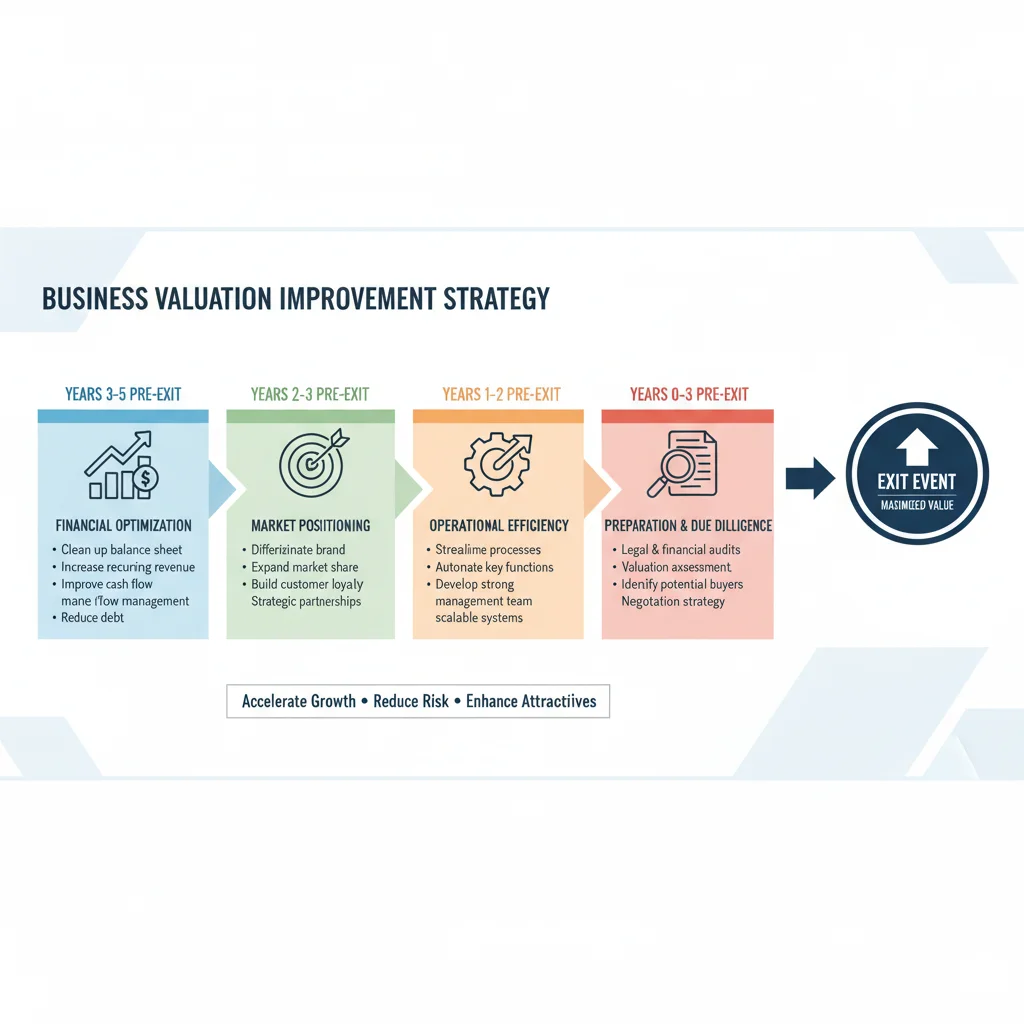
Achieving a 25% increase in valuation requires a systematic and disciplined approach. Here are actionable steps U.S. entrepreneurs can take to optimize their business exit strategies and significantly enhance their company’s worth by 2026.
1. Financial Optimization and Transparency
At the core of any successful exit is impeccable financial health. This means not just profitability, but also consistent, verifiable financial reporting. Clean books, clear revenue streams, and a history of strong cash flow are non-negotiable. Work with a financial advisor to identify areas for cost reduction, revenue enhancement, and balance sheet optimization. Ensure all financial statements are audited and easily understandable.
Beyond the basics, focus on improving key performance indicators (KPIs) that are relevant to your industry. For example, if you’re in e-commerce, optimize customer acquisition cost (CAC) and average order value (AOV). If you’re a service business, focus on utilization rates and project profitability. Demonstrating a clear upward trend in these metrics over several years will be a powerful testament to your business’s health and potential.
2. Strengthen Your Management Team and Succession Plan
Buyers are not just purchasing assets; they are investing in people. A strong, autonomous management team that can operate effectively without the founder’s constant presence significantly de-risks the acquisition. Implement a robust succession plan, empowering key employees and delegating responsibilities. This not only makes your business more attractive but also ensures a smoother transition post-acquisition.
Invest in leadership development programs for your key personnel. Cross-train employees to ensure redundancy in critical roles. Document all processes and procedures to facilitate knowledge transfer. The less reliant the business is on any single individual, especially the founder, the higher its perceived value and the smoother the integration process for an acquirer. This demonstrates a mature, well-structured organization capable of sustained performance.
3. Diversify Your Customer Base and Revenue Streams
Over-reliance on a single customer or a limited number of clients can be a major red flag for potential buyers. Diversifying your customer base reduces risk and demonstrates the broader market appeal of your products or services. Similarly, exploring multiple revenue streams – whether through new product lines, service offerings, or geographic expansion – adds resilience and growth potential.
Actively pursue new market segments and develop strategies to acquire new customers. Analyze your existing customer data to identify opportunities for upselling or cross-selling. The goal is to show a resilient business model that is not vulnerable to the loss of a single major account or a shift in a niche market. This diversification translates directly into a more stable and attractive valuation.
4. Document Processes and Intellectual Property
From operational procedures to sales methodologies and customer service protocols, thoroughly documenting all aspects of your business creates significant value. This institutional knowledge makes the business easier to run, scale, and integrate into a larger entity. Furthermore, clearly identifying and protecting your intellectual property (IP) – patents, trademarks, copyrights, trade secrets – is paramount.
Create detailed operations manuals, standard operating procedures (SOPs), and training materials. Ensure all proprietary software, unique methodologies, and brand assets are legally protected. IP can be a significant asset, and its clear ownership and protection can dramatically increase a business’s valuation, especially in technology-driven industries. Buyers are willing to pay a premium for defensible competitive advantages.
5. Enhance Your Brand and Market Position
A strong brand identity and a clear market position differentiate your business from competitors. Invest in marketing, public relations, and customer experience to build a reputable brand. A strong brand not only attracts customers but also commands higher prices and fosters loyalty, making your business more valuable.
Clearly articulate your unique selling proposition (USP) and ensure it resonates with your target market. Gather testimonials, case studies, and positive reviews to showcase your brand’s impact. A business with a strong, recognizable brand and a loyal customer base is inherently more attractive and commands a higher valuation than one that is simply a commodity. This involves consistent branding across all touchpoints, from digital presence to customer service interactions.
6. Optimize Operational Efficiency and Scalability
Buyers are looking for businesses that are not only profitable but also efficient and scalable. Streamline your operations, eliminate redundancies, and invest in technologies that automate tasks. Demonstrate a clear path for growth without a proportional increase in costs. This shows that your business has the potential for significant future earnings under new ownership.
Implement lean methodologies, optimize supply chain management, and leverage technology to improve productivity. Highlight any proprietary systems or processes that give you a competitive edge in efficiency. A business that can demonstrate its ability to scale operations efficiently and effectively will be perceived as a low-risk, high-reward investment, significantly boosting its valuation.
Choosing the Right Exit Strategy for Your Business
Once your business is primed for maximum valuation, selecting the appropriate business exit strategies becomes the next critical step. There isn’t a one-size-fits-all solution; the best strategy depends on your personal goals, the nature of your business, and prevailing market conditions.
Mergers and Acquisitions (M&A)
Selling your business to another company (M&A) is one of the most common exit routes. This can involve a strategic buyer (a company in the same industry seeking synergy) or a financial buyer (private equity firms looking for strong returns). Strategic buyers often pay a premium for synergistic value, while financial buyers focus on growth potential and operational improvements.
Preparing for an M&A involves rigorous due diligence, identifying potential buyers, and negotiating terms. This process can be complex and often requires the expertise of M&A advisors and legal counsel. A well-prepared business with clear financial records and a compelling growth story will be more attractive to a wider range of acquirers, increasing competitive bidding and thus, valuation.

Management Buyout (MBO) or Employee Stock Ownership Plan (ESOP)
If you wish to maintain the legacy of your business and reward loyal employees, an MBO or ESOP can be excellent alternatives. An MBO involves selling the business to its existing management team, often with financial backing. An ESOP allows employees to own shares in the company, providing a tax-efficient way to transition ownership.
These options require careful planning to ensure the management team or employees have the financial capacity and leadership skills to take over. They can offer a smoother transition and preserve company culture, but may not always yield the highest financial return compared to an external sale, depending on the structure and financing. However, the non-financial benefits, such as preserving jobs and community ties, can be substantial.
Initial Public Offering (IPO)
For high-growth businesses with significant scale and market potential, an IPO (going public) can be an attractive exit strategy. This involves selling shares to the general public on a stock exchange. While potentially offering the highest valuation, an IPO is an extremely complex, time-consuming, and expensive process, requiring extensive regulatory compliance and a robust corporate governance structure.
Only a small percentage of businesses are suitable for an IPO. It requires a strong track record of growth, a clear competitive advantage, and a management team capable of operating in the public eye. For those that qualify, an IPO can provide substantial liquidity and capital for future expansion, but it also comes with increased scrutiny and reporting requirements.
Liquidation (as a last resort)
While not an optimal exit strategy for maximizing value, liquidation involves selling off the business’s assets and distributing the proceeds to creditors and owners. This is typically pursued when a business is struggling or when other exit options are not viable. Our focus here is on maximizing valuation, so liquidation is generally considered a strategy to avoid if possible, by planning proactively.
However, understanding liquidation is important for risk assessment. Even in situations where a full sale is not feasible, a well-managed liquidation can still salvage significant value for stakeholders. The key is to avoid a distressed sale by having a proactive plan, allowing for a more controlled winding-down process if necessary.
The Role of Professional Advisors in Your Exit Strategy
Navigating the complexities of business exit strategies requires a team of experienced professionals. Engaging the right advisors early in the process can significantly impact your valuation and the overall success of your exit.
M&A Advisors and Investment Bankers
These professionals specialize in selling businesses. They can help you prepare your company for sale, identify potential buyers, market your business effectively, and negotiate the best possible terms. Their expertise is invaluable in maximizing your valuation and streamlining the transaction process.
Attorneys
Legal counsel is essential to ensure all contracts, agreements, and regulatory compliance are handled correctly. They will protect your interests throughout the negotiation and closing phases, minimizing legal risks and ensuring a smooth transfer of ownership.
Accountants and Tax Advisors
Expert accountants and tax advisors will help you optimize your financial statements, conduct due diligence, and structure the deal in a tax-efficient manner. Proper tax planning can significantly increase the net proceeds you receive from the sale.
Business Valuators
Independent business valuators can provide an objective assessment of your company’s worth, helping you set a realistic asking price and understand your negotiation leverage. Their reports are crucial for both internal planning and external negotiations.
Preparing for Due Diligence: What Buyers Look For
Once a potential buyer expresses interest, they will conduct extensive due diligence. This is a critical phase where all aspects of your business are scrutinized. Being prepared for this process can make or break a deal and directly impacts your valuation. Buyers are looking for certainty and minimized risk, and your ability to provide clear, organized, and complete information will instill confidence.
Financial Records
Expect a deep dive into your financial statements, tax returns, projections, and cash flow. Ensure these are accurate, consistent, and easily accessible. Any discrepancies or inconsistencies will raise red flags and can lead to a lower offer or even a collapsed deal. Having audited financials is a significant advantage.
Legal Documentation
All legal contracts, including customer agreements, vendor contracts, employee agreements, intellectual property registrations, and corporate governance documents, will be reviewed. Ensure everything is up-to-date, properly filed, and legally sound.
Operational Data
Buyers will want to understand your operational efficiency, supply chain, customer acquisition processes, and retention rates. Provide detailed documentation on your systems, processes, and KPIs. This demonstrates the stability and scalability of your operations.
Sales and Marketing Performance
Be ready to present data on your sales pipeline, marketing effectiveness, customer demographics, and market share. Strong, verifiable growth metrics are highly attractive. Show how you acquire and retain customers, and what your competitive advantages are in the market.
Human Resources
Information on your organizational structure, key personnel, employee benefits, and any pending litigation will be required. A stable and competent team is a major asset, and buyers will assess the risk of key employee departures post-acquisition.
The Future of Business Exits: Beyond 2026
While our focus is on optimizing business exit strategies for 2026, it’s important to recognize that the landscape will continue to evolve. Staying agile and continuously evaluating your long-term strategy will be key to sustained success and future wealth creation.
Emerging technologies like blockchain and advanced AI could further revolutionize how businesses are valued and transacted. The increasing emphasis on sustainable and ethical business practices will only grow stronger. Entrepreneurs who embed these future-forward considerations into their ongoing business strategy will not only be better prepared for their next exit but will also build more resilient and impactful companies in the long run.
Consider the potential for new types of buyers entering the market, such as decentralized autonomous organizations (DAOs) or impact investors who prioritize social and environmental returns alongside financial gains. Understanding these evolving motivations can open up new avenues for exit and potentially higher valuations for businesses that align with these emerging trends. The future of business exits is likely to be more diverse, complex, and rewarding for those who plan ahead.
Conclusion: Your Roadmap to a 25% Valuation Increase
Optimizing your business exit strategies for 2026 is an ambitious yet entirely achievable goal for U.S. entrepreneurs. By proactively focusing on financial health, strengthening your team, diversifying your revenue, protecting your IP, enhancing your brand, and streamlining operations, you lay the groundwork for a significant increase in valuation. The target of a 25% boost is not merely aspirational; it is a tangible outcome of diligent preparation and strategic foresight.
Remember, an exit strategy is not a last-minute scramble; it’s a strategic imperative that should be woven into the very fabric of your business planning from day one. By embracing the market trends of digital transformation and ESG, and by leveraging the expertise of professional advisors, you position yourself to make the most of your entrepreneurial journey. Start planning today, and set your business on a trajectory to not only achieve but exceed your valuation goals by 2026.
The journey of an entrepreneur is filled with challenges and triumphs. The exit, when executed strategically, should be the ultimate triumph, providing a fulfilling culmination to years of hard work and setting the stage for your next chapter. With the insights and actionable steps provided in this guide, you are well-equipped to navigate this critical phase and secure the maximum possible value for your enterprise.