Mastering Advanced Negotiation: Close 8% More High-Value Deals in 2026

In the dynamic and often unpredictable business landscape of 2026, the ability to negotiate effectively is no longer just a valuable skill; it’s a critical differentiator. As markets evolve, competition intensifies, and client expectations soar, mastering advanced negotiation techniques becomes paramount for anyone looking to secure high-value deals consistently. This comprehensive guide, ‘The 2026 Playbook,’ is designed to equip you with the strategies, insights, and tools necessary to not only participate in but dominate complex negotiations, aiming to increase your deal-closing rate by a significant 8% this year. We’re not just talking about closing more deals; we’re talking about closing better deals, deals that deliver superior value, foster stronger relationships, and drive sustainable growth for your organization.
The art and science of negotiation are constantly evolving. What worked effectively five or even two years ago might be less impactful today. The shift towards remote and hybrid work models has introduced new communication challenges and opportunities. The increasing availability of data and AI-driven insights has changed how parties prepare and execute their negotiation strategies. Moreover, the global economic climate often adds layers of complexity, demanding greater adaptability and resilience from negotiators. To thrive in this environment, a superficial understanding of negotiation tactics simply won’t suffice. You need a deep dive into the psychological underpinnings, the strategic frameworks, and the practical applications of advanced negotiation techniques.
This playbook goes beyond the basics. We will explore how to anticipate objections, leverage emotional intelligence, and construct offers that are not just accepted but enthusiastically embraced. We will delve into the nuances of cross-cultural negotiations, the power of silence, and the strategic deployment of concessions. Our goal is to transform your approach to negotiations, moving you from a reactive stance to a proactive, strategic one, ensuring you are always one step ahead. By integrating these advanced methodologies, you will not only enhance your personal negotiation prowess but also contribute significantly to your organization’s bottom line by consistently securing those elusive high-value agreements.
The Evolving Landscape of Negotiation: Why 2026 Demands More
The year 2026 presents a unique set of challenges and opportunities for negotiators. Digital transformation, global connectivity, and an increasingly informed customer base have reshaped the playing field. Buyers are more sophisticated, equipped with vast amounts of information, and often have multiple alternatives at their fingertips. This necessitates a more nuanced and strategic approach to negotiation. The traditional ‘win-lose’ mentality is being replaced by a ‘win-win’ or ‘win-more’ philosophy, where long-term relationships and mutual value creation are prioritized. Understanding these shifts is the first step in adopting truly advanced negotiation techniques.
One of the most significant changes is the rise of data-driven negotiation. Access to market intelligence, competitor analysis, and even predictive analytics can provide an unprecedented advantage. Negotiators in 2026 are expected to not only understand their own position but also to accurately forecast the other party’s likely strategies and constraints. This requires a blend of analytical rigor and intuitive judgment. Furthermore, the emphasis on ethical negotiation and transparent dealings has grown, as reputation and trust are more valuable than ever in a highly interconnected world. Companies and individuals alike are scrutinized, making integrity a non-negotiable aspect of any successful negotiation strategy.
Remote negotiation, accelerated by recent global events, has also become a permanent fixture. While offering convenience, it also removes some of the non-verbal cues crucial for effective communication. Mastering virtual negotiation environments, understanding how to build rapport through screens, and effectively managing digital communication channels are now essential components of advanced negotiation techniques. This section will lay the groundwork by exploring these macro trends and how they impact your negotiation strategy, setting the stage for the specific tactics we will uncover.
Pillars of Advanced Negotiation: Beyond the Basics
To consistently close 8% more high-value deals, you must move beyond foundational negotiation skills and embrace the pillars of advanced negotiation techniques. These pillars encompass a deeper understanding of human psychology, strategic planning, and adaptive execution. They are designed to give you an unfair advantage, not by being manipulative, but by being exceptionally prepared, perceptive, and persuasive.
1. Strategic Pre-Negotiation Planning: The 80/20 Rule
The adage that 80% of negotiation success comes from 20% of the effort holds particularly true for planning. For high-value deals, this ratio might even be skewed further towards preparation. Advanced negotiators don’t just ‘think’ about their goals; they meticulously research, analyze, and strategize. This includes:
- Deep Dive into Counterparty Analysis: Beyond understanding their stated needs, delve into their underlying motivations, constraints, political pressures, and past negotiation behaviors. What are their non-negotiables? What are their aspirations? Use publicly available data, industry reports, and even social media insights to build a comprehensive profile.
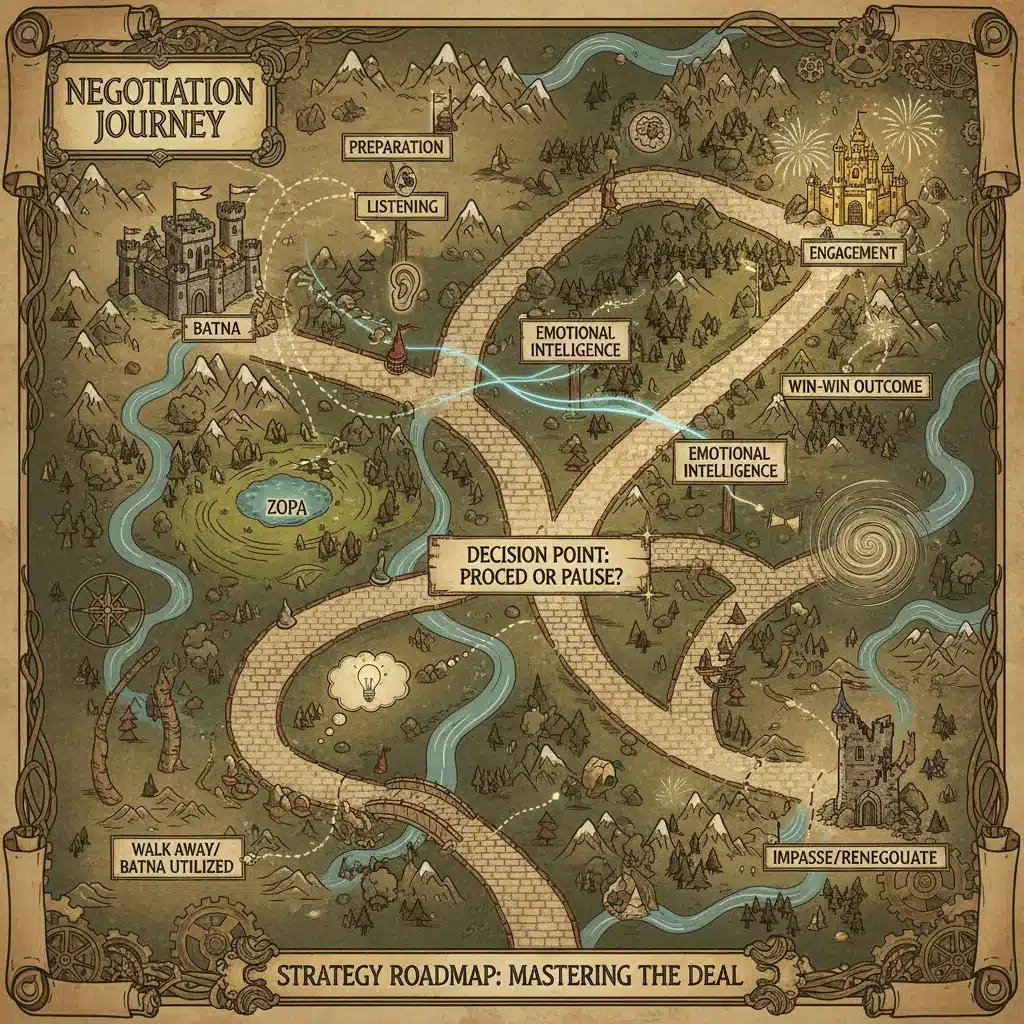
- BATNA (Best Alternative to a Negotiated Agreement) & WATNA (Worst Alternative to a Negotiated Agreement) Refinement: While basic negotiation teaches you to identify your BATNA, advanced techniques involve actively strengthening it. Can you cultivate other alternatives before the negotiation? How can you weaken the other party’s BATNA? Understanding your WATNA also helps set realistic walk-away points and manage risk.
- ZOPA (Zone of Possible Agreement) Mapping: Don’t just estimate the ZOPA; actively try to define it from both perspectives. What’s the lowest you’ll go? What’s the highest they’ll pay? Where is the overlap? This mapping allows you to identify potential areas for mutual gain and avoid wasting time on impossible demands.
- Scenario Planning & Contingency Development: What if they say no to your primary offer? What if they introduce an unexpected demand? Advanced negotiators prepare for multiple scenarios, developing contingency plans and alternative proposals. This foresight reduces surprise and maintains composure under pressure.
- Defining Your Interests vs. Positions: Clearly articulate your core interests (why you want something) rather than just your positions (what you want). This allows for creative problem-solving and finding solutions that satisfy underlying interests for both parties, often leading to more robust and sustainable agreements.
2. Mastering Psychological Leverage & Influence
Negotiation is as much a psychological game as it is a strategic one. Advanced negotiation techniques harness insights from behavioral economics and psychology to influence outcomes positively. This isn’t about manipulation, but about understanding human decision-making and communication patterns.
- Anchoring & Framing: The first offer often sets the tone. Learn to strategically anchor the negotiation to your advantage. Frame your offers and arguments in a way that highlights benefits and minimizes perceived costs for the other party. Understand how different frames (e.g., gain vs. loss) can impact decision-making.
- Reciprocity Principle: The human tendency to return favors can be a powerful tool. Strategic, small concessions or sharing valuable information early on can create an obligation for the other party to reciprocate.
- Scarcity & Urgency: While used cautiously, creating legitimate scarcity (e.g., limited availability, expiring offers) or urgency (e.g., impending deadlines) can motivate action. This must be authentic to maintain trust.
- Social Proof: Highlighting testimonials, successful case studies, or the popularity of your solution can provide powerful social proof, influencing the other party’s perception of value and credibility.
- Emotional Intelligence (EQ) in Action: Beyond just reading body language, it’s about understanding the emotions at play – yours and theirs. Empathy, active listening, and managing your own emotional responses are critical. Acknowledging their concerns, even if you don’t agree, can defuse tension and build rapport.
- The Power of Silence: Many negotiators rush to fill silence. Advanced negotiators use strategic pauses to encourage the other party to speak more, revealing valuable information, or to emphasize a point.
3. Crafting Irresistible Offers & Concessions
The way you present your offers and manage concessions can significantly impact the final deal. This is where many negotiations falter, as parties either give too much too soon or too little too late. Implementing advanced negotiation techniques in this area involves a delicate balance.
- Bundling & Unbundling: Instead of a single price point, consider bundling multiple services or products to create perceived added value. Conversely, unbundling can help identify specific pain points and offer tailored solutions, justifying premium pricing for certain components.
- Value-Based Pricing: Shift the focus from cost to the value your solution delivers. Quantify the ROI, efficiencies, or competitive advantages your offer provides, making the price seem a small investment for a significant return.
- Strategic Concession Planning: Never give a concession without getting something in return. Plan your concessions in advance, categorizing them by importance and cost. Start with smaller, less impactful concessions and save the more significant ones for critical junctures.
- Contingent Concessions: ‘I can do X if you can do Y.’ This ties your concession to a specific action or concession from the other party, ensuring mutual movement and preventing one-sided giving.
- The Art of the ‘Nibble’: While often seen as a last-minute tactic, understanding how to counter a ‘nibble’ or even strategically deploy one (if ethical and justified) is part of advanced play.
Navigating Complexities: Multi-Party & Cross-Cultural Negotiations
High-value deals often involve multiple stakeholders, diverse cultural backgrounds, and intricate organizational structures. Mastering these complexities is a hallmark of advanced negotiation techniques. These scenarios demand heightened awareness, adaptability, and an even more robust preparation strategy.
1. Multi-Party Negotiation Dynamics
When more than two parties are involved, the negotiation landscape shifts dramatically. Coalitions can form, interests can diverge significantly, and the decision-making process becomes more convoluted. To excel in multi-party negotiations:
- Identify All Stakeholders and Their Interests: Beyond the individuals at the table, understand who else influences their decisions. Map out their individual and collective interests, priorities, and power dynamics.
- Coalition Building & Management: Proactively identify potential allies and build coalitions that support your objectives. Understand how to manage opposing coalitions or prevent their formation if they are detrimental to your goals.
- Agenda Control: In multi-party settings, controlling the agenda – what’s discussed, when, and in what order – can be a powerful tool to steer the negotiation towards your desired outcomes.
- Facilitation Skills: Often, the most effective role in a multi-party negotiation is that of a facilitator, guiding the discussion, identifying common ground, and mediating disputes, even if you are a party to the negotiation.
- Information Management: Decide what information to share with whom, and when. Strategic disclosure or withholding of information can influence perceptions and decisions across multiple parties.
2. Cross-Cultural Negotiation Nuances
In a globalized economy, cross-cultural negotiations are increasingly common for high-value deals. What is considered polite or persuasive in one culture might be offensive or ineffective in another. Applying advanced negotiation techniques in this context requires cultural intelligence.
- Research Cultural Norms: Before entering a cross-cultural negotiation, thoroughly research the other party’s cultural communication styles, decision-making processes, concepts of time, and attitudes towards hierarchy and relationships.
- Adapt Communication Style: Be prepared to adjust your verbal and non-verbal communication. This might include pacing of speech, use of direct vs. indirect language, eye contact, and personal space.
- Understand Perceptions of Trust & Relationships: In some cultures, trust is built slowly over time through personal relationships before business can be discussed. In others, trust is assumed until proven otherwise. Adapt your approach to relationship building accordingly.
- Time Orientation: Some cultures are polychronic (flexible with time and multiple tasks), while others are monochronic (linear and punctual). Understand how this impacts scheduling, deadlines, and the pace of negotiation.
- Hierarchy & Authority: Recognize the role of hierarchy. Who makes the final decisions? Is it a collective process or an individual authority? Tailor your interactions and proposals to respect these power structures.
- Emotional Expression: Different cultures have varying norms for expressing emotions. Be aware of these differences to avoid misinterpreting reactions or inadvertently causing offense.
Leveraging Technology and Data for Superior Outcomes
The year 2026 places a significant emphasis on data-driven decision-making. Integrating technology into your negotiation strategy is no longer optional; it’s a competitive necessity for those aiming to deploy truly advanced negotiation techniques and close 8% more high-value deals.
1. Data Analytics for Pre-Negotiation Insights
Modern tools can provide unparalleled insights into market trends, competitor pricing, and even the historical negotiation patterns of specific companies or individuals. Leveraging these tools means:
- Predictive Analytics: Use AI-powered tools to analyze past deals and predict likely outcomes or concession patterns from the other party. This can help you anticipate their moves and prepare counter-strategies.
- Market Benchmarking: Access real-time data to benchmark your offers against industry standards, ensuring your proposals are competitive yet profitable.
- Sentiment Analysis: In some cases, analyzing public statements or social media activity related to the counterparty can provide insights into their current priorities or potential pain points.
2. Virtual Negotiation Platforms & Tools
As remote negotiations become more common, mastering the tools that facilitate them is crucial:
- High-Quality Video Conferencing: Ensure stable connections and professional setups. Eye contact, even virtual, remains important.
- Shared Digital Workspaces: Use collaborative platforms for sharing documents, proposals, and tracking changes in real-time, enhancing transparency and efficiency.
- Digital Whiteboards & Brainstorming Tools: Recreate the collaborative environment of in-person meetings to foster creativity and problem-solving, even when physically apart.
3. CRM and Relationship Management
For high-value, long-term deals, maintaining strong relationships is key. CRM systems can be powerful tools for tracking interactions, understanding client histories, and identifying opportunities for value creation beyond the immediate negotiation.
- Personalized Communication: Use CRM data to tailor your communication and offers, demonstrating that you understand their specific needs and history.
- Post-Negotiation Follow-up: Track commitments and ensure timely follow-up, reinforcing trust and paving the way for future deals.

Advanced Tactics for Breaking Deadlocks and Closing Strong
Even with the best preparation, negotiations can hit impasses. The ability to break deadlocks and close deals effectively, especially high-value ones, distinguishes an average negotiator from one employing advanced negotiation techniques.
1. Re-framing & Re-anchoring
When a negotiation stalls due to fixed positions, re-framing the discussion can open new avenues. Shift the focus from ‘what we want’ to ‘how we can achieve mutual goals’ or ‘what problem are we trying to solve together.’ If the initial anchor was unfavorable, strategically introduce a new, more beneficial anchor point based on new information or a revised proposal.
2. The Art of the Impasse & Strategic Retreat
Sometimes, the best move is to pause or even strategically retreat. This isn’t giving up; it’s creating space for reflection, allowing emotions to cool, or giving the other party time to reconsider their position. A well-executed pause can increase the perceived value of your offer or make the other party more amenable to compromise upon resumption.
3. Splitting the Difference (Strategically)
While often a simple solution, splitting the difference can be strategic if done correctly. Only offer to split the difference when you are already in a favorable position, or when it represents a genuinely equitable solution that moves the deal forward without significant compromise on your core interests. Avoid it if it means giving away too much. For advanced negotiation techniques, ensure you’re splitting a difference that still heavily favors your overall objectives.
4. Focusing on Non-Monetary Value
High-value deals aren’t always just about the price. Explore non-monetary concessions or benefits that might be highly valuable to the other party but low cost to you. This could include extended warranty, priority support, exclusive access, training, or flexible payment terms. These ‘value-adds’ can often unlock a deal when monetary terms are stuck.
5. The Final Offer & Commitment Tactics
When presenting your final offer, do so with confidence and clarity. Be prepared to walk away if it’s not accepted, but also ensure you’ve explored all viable options. Commitment tactics, such as making a public statement of intent (if appropriate), can solidify an agreement and make it harder for parties to back out. However, use such tactics ethically and transparently.
Measuring Success and Continuous Improvement
Closing 8% more high-value deals isn’t a one-time achievement; it’s the result of continuous learning and refinement. Applying advanced negotiation techniques requires a commitment to ongoing evaluation and improvement.
1. Post-Negotiation Analysis
After each significant negotiation, conduct a thorough debrief. What went well? What could have been done differently? Were your initial assumptions accurate? Did you achieve your target outcomes? Analyze both the process and the results. This critical reflection is vital for internalizing lessons and refining your approach.
2. Quantifying Value Beyond Price
Success isn’t solely measured by the final price. Evaluate the overall value of the deal, including long-term relationship potential, strategic advantages gained, risk mitigation, and any non-monetary benefits. This holistic view provides a more accurate measure of your negotiation effectiveness.
3. Feedback and Coaching
Seek feedback from colleagues, mentors, or even the other party (if appropriate and constructive). Consider engaging in negotiation coaching to get personalized insights and develop specific areas of weakness. Continuous learning, through workshops, books, and real-world practice, is essential for staying ahead.
4. Adapting to Future Trends
The business world will continue to evolve. Stay informed about emerging technologies, economic shifts, and changes in buyer behavior. Regularly update your playbook of advanced negotiation techniques to remain agile and effective in future negotiations. The ability to adapt quickly to new circumstances is perhaps the most advanced negotiation skill of all.
Conclusion: Your Path to 8% More High-Value Deals
The 2026 playbook for advanced negotiation techniques is not just a collection of tactics; it’s a mindset shift. It’s about approaching every high-value deal with meticulous preparation, psychological acumen, cultural sensitivity, and technological leverage. By integrating these strategies, you equip yourself to not only navigate complex discussions but to actively shape outcomes that are profoundly beneficial. The goal of closing 8% more high-value deals is ambitious, but entirely achievable with the systematic application of these advanced principles.
Remember, every negotiation is an opportunity to create value, build relationships, and demonstrate leadership. By mastering these advanced techniques, you will transform your negotiation capabilities, becoming a formidable force at the table. Start implementing these strategies today, analyze your results, and commit to continuous improvement. The rewards, in terms of increased deal flow, enhanced profitability, and stronger business partnerships, will be substantial and long-lasting.
Embrace the challenge, refine your skills, and make 2026 the year you redefine what’s possible in your negotiations. The power to secure those coveted high-value deals is now firmly within your grasp.