Mastering Predictive Sales Analytics 2026: Identify High-Value Leads Early

Mastering Predictive Sales Analytics 2026: Identify High-Value Leads Early
In the fiercely competitive landscape of 2026, the ability to anticipate market shifts and customer behavior is no longer a luxury but a necessity. Businesses are constantly seeking an edge, a way to not just react to the market but to proactively shape their destiny. This is where predictive sales analytics emerges as a game-changer, offering an unparalleled opportunity to identify high-value leads up to three months sooner than traditional methods. Imagine the strategic advantage of knowing which prospects are most likely to convert, which customers are at risk of churning, and what products will resonate with specific segments before your competitors even catch a whiff. This comprehensive guide will delve deep into the world of predictive sales analytics, exploring its foundational principles, practical applications, and the transformative impact it can have on your sales organization in 2026 and beyond.
The Dawn of Data-Driven Sales: Why Predictive Sales Analytics is Crucial for 2026
The sales environment has undergone a seismic shift. The days of relying solely on intuition, cold calling, and generic outreach are rapidly fading into obsolescence. Today’s customers are more informed, more discerning, and demand personalized experiences. To succeed, sales teams need to move beyond historical reporting and embrace forward-looking insights. This is precisely what predictive sales analytics delivers. By leveraging vast amounts of data, advanced algorithms, and artificial intelligence (AI), businesses can forecast future outcomes with remarkable accuracy, transforming their sales strategies from reactive to proactive.
Understanding the Core of Predictive Sales Analytics
At its heart, predictive sales analytics is the application of statistical modeling and machine learning techniques to historical sales data to make informed predictions about future sales performance. This isn’t just about predicting how much you’ll sell; it’s about understanding the ‘why’ and the ‘who.’ It encompasses:
- Lead Scoring and Prioritization: Identifying which leads are most likely to convert based on their historical behavior, demographics, and engagement patterns.
- Sales Forecasting: More accurately predicting future sales volumes, revenue, and market trends.
- Customer Churn Prediction: Pinpointing customers who are at risk of leaving, allowing for proactive retention efforts.
- Product Recommendation: Suggesting the most relevant products or services to customers based on their past purchases and browsing history.
- Optimizing Sales Processes: Identifying bottlenecks and inefficiencies in the sales funnel and suggesting improvements.
In 2026, the sophistication of these models has reached new heights. With the proliferation of big data and increasingly powerful AI, the insights derived from predictive sales analytics are more granular, more accurate, and more actionable than ever before.
The Mechanics of Predictive Sales Analytics: How It Works
Implementing effective predictive sales analytics involves a systematic approach, starting with data collection and culminating in actionable insights. Let’s break down the key stages:
1. Data Collection and Integration
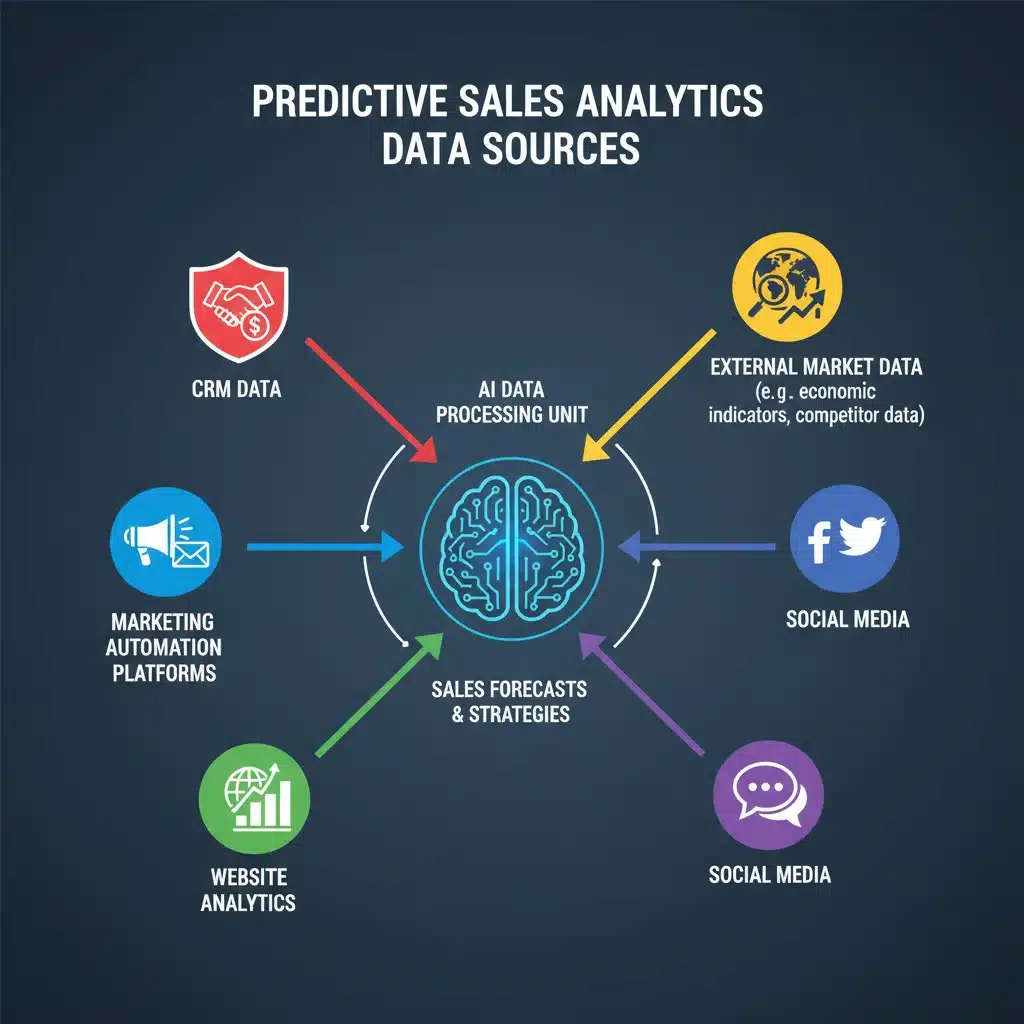
The foundation of any robust predictive model is high-quality, comprehensive data. This includes:
- CRM Data: Customer interactions, purchase history, lead status, sales rep notes.
- Marketing Automation Data: Email opens, click-through rates, website visits, content downloads.
- Website Analytics: User behavior, time on page, conversion paths.
- Social Media Data: Engagement, sentiment analysis, brand mentions.
- External Data: Market trends, economic indicators, competitor activity, demographic information.
The challenge lies in integrating these disparate data sources into a unified platform, often a data warehouse or data lake, to create a holistic view of the customer and market. Data cleanliness and consistency are paramount here; ‘garbage in, garbage out’ applies more than ever in predictive sales analytics.
2. Data Preparation and Feature Engineering
Raw data is rarely suitable for direct use in predictive models. This stage involves:
- Cleaning: Removing duplicates, correcting errors, handling missing values.
- Transformation: Converting data into a format suitable for analysis (e.g., standardizing numerical values, encoding categorical variables).
- Feature Engineering: Creating new variables (features) from existing data that can improve the model’s predictive power. For example, instead of just ‘number of website visits,’ you might create ‘frequency of website visits in the last 30 days’ or ‘time since last website interaction.’ This is a critical step in building effective predictive sales analytics models.
3. Model Selection and Training
Once the data is prepared, the next step is to choose and train appropriate machine learning models. Common algorithms used in predictive sales analytics include:
- Regression Models: For predicting continuous values like sales revenue or conversion rates.
- Classification Models: For predicting discrete outcomes, such as whether a lead will convert (yes/no) or a customer will churn.
- Clustering Models: For segmenting customers or leads into groups with similar characteristics.
- Time Series Models: For forecasting future sales based on historical patterns over time.
The models are trained using historical data, learning patterns and relationships between input variables (features) and the target variable (what you want to predict). This iterative process involves tuning parameters and evaluating model performance using various metrics.
4. Model Deployment and Monitoring
After training and validation, the predictive models are deployed into the sales workflow. This means integrating them with CRM systems, marketing automation platforms, and other sales tools. Ongoing monitoring is essential to ensure the models remain accurate and relevant as market conditions and customer behaviors evolve. Regular retraining with fresh data keeps the predictive sales analytics system sharp and effective.
Key Applications of Predictive Sales Analytics in 2026
The tangible benefits of predictive sales analytics manifest across various critical sales functions:
1. Superior Lead Scoring and Prioritization
One of the most immediate and impactful applications of predictive sales analytics is its ability to revolutionize lead management. Traditional lead scoring often relies on static rules and demographic data. Predictive models, however, analyze hundreds, if not thousands, of data points to assign a dynamic score to each lead, indicating their likelihood to convert. This allows sales teams to:
- Focus on High-Potential Leads: Sales representatives can dedicate their time and resources to leads that are genuinely interested and ready to buy, dramatically increasing conversion rates.
- Optimize Outreach: Tailor messages and communication channels based on predictive insights into a lead’s preferences and stage in the buying journey.
- Shorten Sales Cycles: By identifying high-value leads earlier, sales teams can initiate contact and move prospects through the funnel more efficiently, cutting down the time from initial engagement to closed deal. This is where the ability to identify high-value leads 3 months sooner truly shines.
Imagine a scenario where your sales team receives a daily list of leads, each with a conversion probability score. They can then prioritize their outreach, focusing on the top 10% of leads that have an 80% or higher chance of closing. This targeted approach is a hallmark of effective predictive sales analytics.
2. Accurate Sales Forecasting
Gone are the days of guesswork in sales forecasting. Predictive sales analytics provides a data-driven approach to anticipate future sales with greater precision. By analyzing historical sales data, seasonal trends, economic indicators, and even competitor activities, these models can generate highly accurate forecasts. This enables businesses to:
- Optimize Resource Allocation: Ensure adequate staffing, inventory levels, and marketing spend aligned with anticipated demand.
- Improve Budgeting and Planning: Make more informed financial decisions based on reliable revenue projections.
- Identify Potential Gaps: Proactively address any forecasted shortfalls and adjust strategies to meet targets.
The ability to predict sales trends months in advance empowers leadership to make strategic decisions that impact the entire organization, from manufacturing to marketing. This foresight is a direct benefit of robust predictive sales analytics.
3. Proactive Customer Churn Prevention
Acquiring new customers is often significantly more expensive than retaining existing ones. Predictive sales analytics can identify customers who exhibit behavior patterns indicative of churn risk. By analyzing factors such as decreased engagement, service complaints, or changes in usage, models can flag at-risk customers, allowing sales and customer success teams to intervene proactively with:
- Targeted Retention Offers: Provide personalized incentives or solutions to address specific pain points.
- Enhanced Customer Support: Offer additional support or training to improve customer satisfaction.
- Personalized Outreach: Re-engage customers with relevant content or product updates.
Preventing churn not only saves acquisition costs but also strengthens customer loyalty and lifetime value, making it a critical aspect of modern predictive sales analytics strategies.

4. Dynamic Pricing and Product Recommendations
Predictive sales analytics extends beyond just identifying leads; it also helps optimize the sales process itself. By analyzing customer preferences and market dynamics, businesses can:
- Implement Dynamic Pricing: Adjust prices in real-time based on demand, competitor pricing, and a customer’s willingness to pay.
- Offer Personalized Product Recommendations: Leverage past purchase history, browsing behavior, and similar customer profiles to suggest relevant products or services, increasing cross-selling and up-selling opportunities.
This level of personalization not only boosts sales but also enhances the customer experience, fostering greater loyalty and satisfaction, all powered by sophisticated predictive sales analytics.
Challenges and Considerations in Implementing Predictive Sales Analytics
While the benefits are clear, implementing predictive sales analytics is not without its challenges. Organizations must be prepared to address several key considerations:
1. Data Quality and Availability
As mentioned, the success of predictive models hinges on the quality and completeness of your data. Many organizations struggle with fragmented data, silos, and inconsistent data entry. Investing in robust data governance, data integration tools, and data cleansing processes is crucial before embarking on a predictive sales analytics journey.
2. Talent and Expertise
Developing and maintaining sophisticated predictive models requires specialized skills in data science, machine learning, and statistical analysis. Companies may need to hire dedicated data scientists or partner with external experts to build and manage their predictive sales analytics capabilities.
3. Technology Infrastructure
Processing and analyzing large datasets for predictive modeling requires significant computing power and specialized software. Organizations need to invest in scalable cloud infrastructure, powerful analytics platforms, and integration tools to support their predictive sales analytics initiatives.
4. Ethical Considerations and Bias
AI and machine learning models can inadvertently perpetuate or amplify existing biases present in the training data. It’s essential to carefully scrutinize models for fairness and ethical implications, ensuring that predictions are not discriminatory and do not lead to unfair treatment of certain customer segments. Responsible development and deployment are vital for successful predictive sales analytics.
5. Change Management
Adopting predictive sales analytics represents a significant shift in how sales teams operate. It requires a cultural change, moving from intuition-driven decisions to data-driven insights. Proper training, clear communication of benefits, and strong leadership buy-in are essential to ensure successful adoption and prevent resistance from sales personnel.
The Future of Sales: Integrating AI and Predictive Sales Analytics
Looking ahead to 2026 and beyond, the convergence of AI, machine learning, and predictive sales analytics will continue to redefine the sales landscape. We can expect:
- Even More Personalized Experiences: AI-powered insights will enable hyper-personalization at every touchpoint, from initial outreach to post-purchase support.
- Autonomous Sales Processes: Certain routine sales tasks, such as initial lead qualification or follow-up scheduling, may become increasingly automated based on predictive triggers.
- Prescriptive Analytics: Moving beyond just predicting what will happen, systems will increasingly recommend what actions to take to achieve desired outcomes. For example, ‘contact customer X with offer Y to prevent churn.’
- Enhanced Sales Training: Predictive models can analyze sales call transcripts and demos to identify effective sales behaviors and provide personalized coaching to reps.
- Real-time Insights: The ability to process and analyze data in real-time will provide immediate actionable insights, allowing sales teams to adapt and respond instantaneously to changing conditions.
The evolution of predictive sales analytics will empower sales professionals to be more strategic, more efficient, and ultimately, more successful. It will free them from mundane tasks, allowing them to focus on building deeper relationships and closing more complex deals.
Building Your Predictive Sales Analytics Strategy for 2026
For organizations looking to harness the power of predictive sales analytics, a structured approach is recommended:
1. Define Clear Objectives
What specific sales challenges are you trying to solve? Are you aiming to increase lead conversion, reduce churn, improve forecasting accuracy, or all of the above? Clear objectives will guide your data collection, model development, and success metrics.
2. Assess Your Data Landscape
Conduct a thorough audit of your existing data sources. Identify gaps, assess data quality, and plan for necessary integrations and cleansing processes. Remember, the quality of your insights directly correlates with the quality of your data when it comes to predictive sales analytics.
3. Start Small and Scale Up
Begin with a pilot project focused on a specific, manageable problem, such as lead scoring for a particular product line or predicting churn for a small customer segment. This allows you to learn, refine your models, and demonstrate value before scaling up your predictive sales analytics efforts across the entire organization.
4. Invest in the Right Technology and Talent
Choose robust analytics platforms, CRM systems with strong integration capabilities, and consider bringing in data science expertise, either internally or through partnerships. The right tools and people are indispensable for successful predictive sales analytics implementation.
5. Foster a Data-Driven Culture
Educate your sales team on the benefits of predictive sales analytics. Provide training on how to interpret and act on the insights. Encourage experimentation and celebrate successes to build enthusiasm and adoption. Leadership must champion the initiative and lead by example.
Conclusion: The Undeniable Power of Predictive Sales Analytics
In 2026, the competitive advantage will undeniably belong to those who master the art and science of anticipation. Predictive sales analytics offers a powerful framework for businesses to move beyond rearview mirror analysis and embrace a future-forward approach. By accurately identifying high-value leads months in advance, optimizing sales processes, and proactively addressing customer needs, organizations can unlock unprecedented levels of growth and efficiency. The journey to becoming a truly data-driven sales organization may present its challenges, but the rewards – increased revenue, improved customer satisfaction, and a significant competitive edge – make it an imperative investment for any forward-thinking business. Embrace predictive sales analytics today, and position your sales team for unparalleled success tomorrow.