Predictive Analytics for Lead Scoring: Identify High-Value Leads 30% Faster in 2026

In the fiercely competitive landscape of modern business, the ability to identify and prioritize high-value leads with speed and accuracy is no longer a luxury, but a necessity. Traditional lead scoring methods, while foundational, often fall short in providing the real-time, nuanced insights required to stay ahead. This is where predictive lead scoring emerges as a game-changer. By leveraging advanced analytics and machine learning, businesses can not only understand their leads better but also anticipate their behavior, leading to significantly faster identification of high-potential prospects. Our goal with this comprehensive guide is to equip you with the knowledge and actionable steps to implement a robust predictive lead scoring system, aiming to identify high-value leads a remarkable 30% faster by 2026.
The promise of predictive analytics for lead scoring isn’t just about efficiency; it’s about transforming your entire sales and marketing ecosystem. Imagine a scenario where your sales team spends less time chasing dead ends and more time engaging with prospects who are genuinely ready to convert. This isn’t a distant dream; it’s the tangible outcome of effectively integrating predictive lead scoring into your strategy. This article will delve into the core concepts, benefits, implementation roadmap, and best practices to ensure your organization harnesses the full power of this transformative technology.
We’ll explore how predictive models analyze vast datasets of historical customer interactions, demographic information, behavioral patterns, and firmographic data to assign a dynamic score to each lead. This score indicates not just a lead’s interest, but their likelihood of converting, their potential value, and even the best time and channel to engage with them. The journey towards a more intelligent, data-driven sales process begins here.
Understanding Predictive Lead Scoring: Beyond the Basics
Before we dive into the ‘how,’ let’s solidify our understanding of ‘what’ predictive lead scoring truly entails. At its heart, it’s a sophisticated methodology that uses statistical algorithms and machine learning techniques to analyze a multitude of data points to predict a lead’s future behavior. Unlike traditional rule-based scoring, which relies on manually assigned points for specific actions (e.g., +5 points for downloading an eBook, +10 for visiting the pricing page), predictive models learn from historical data to identify complex patterns and correlations that human analysts might miss.
Think of it this way: traditional lead scoring is like a simple checklist, while predictive lead scoring is a highly intelligent detective. The checklist tells you if a lead has performed certain actions. The detective analyzes hundreds, if not thousands, of past cases (your previous leads and customers) to understand which combination of characteristics and behaviors most reliably led to a successful outcome. This allows for a far more nuanced and accurate assessment of a lead’s potential.
The Limitations of Traditional Lead Scoring
While traditional lead scoring has served its purpose, it often suffers from several drawbacks:
- Static Rules: Rules are often set manually and can become outdated quickly as market dynamics or customer behaviors change.
- Subjectivity: The assignment of points can be subjective and vary significantly between different marketing and sales teams.
- Lack of Nuance: It struggles to account for the complex interplay of various factors. For example, visiting a pricing page might be a strong indicator for one segment but less so for another.
- Scalability Issues: As the volume of leads and data increases, manually managing and updating rules becomes cumbersome and inefficient.
- Missed Opportunities: Critical patterns in data that indicate high intent might be overlooked if they don’t fit into predefined rules.
The Power of Predictive Analytics for Lead Scoring
Predictive lead scoring overcomes these limitations by:
- Dynamic Adaptation: Models continuously learn and adapt as new data becomes available, ensuring scores remain relevant and accurate.
- Objectivity: Decisions are data-driven, minimizing human bias and ensuring consistency across all leads.
- Complex Pattern Recognition: It can uncover subtle, non-obvious relationships between lead attributes and conversion outcomes.
- Enhanced Efficiency: Automates the scoring process, allowing sales and marketing teams to focus on engagement rather than manual qualification.
- Optimized Resource Allocation: Directs sales efforts towards the leads most likely to convert, maximizing ROI.
By shifting to a predictive approach, businesses can move from reactive lead management to proactive engagement, significantly improving their sales funnel efficiency and conversion rates. This proactive stance is crucial for identifying high-value leads systematically and quickly.
The Benefits: Why Implement Predictive Lead Scoring Now?
The advantages of adopting predictive lead scoring extend far beyond mere lead prioritization. It fundamentally reshapes how sales and marketing teams operate, leading to measurable improvements across the board. The quest to identify high-value leads faster is a primary driver, but the ripple effects are equally impactful.
1. Increased Sales Efficiency and Productivity
One of the most immediate and tangible benefits is the dramatic increase in sales efficiency. Sales representatives no longer have to sift through a vast pool of leads, guessing which ones are most promising. Instead, they receive a pre-qualified list of leads with high conversion potential, allowing them to focus their energy and expertise where it matters most. This translates to:
- Reduced Time-to-Conversion: By engaging with warmer leads, the sales cycle shortens significantly.
- Higher Conversion Rates: Focusing on high-potential leads naturally leads to a greater percentage of successful deals.
- Optimized Sales Pipeline: A healthier pipeline with a higher proportion of quality leads.
2. Improved Marketing ROI
Marketing teams also reap substantial benefits. By understanding which lead attributes and behaviors correlate with high conversion rates, marketers can fine-tune their campaigns to attract more of these ideal prospects. This means:
- More Targeted Campaigns: Marketing efforts become more precise, reaching the right audience with the right message.
- Lower Customer Acquisition Cost (CAC): Wasting fewer resources on unqualified leads reduces overall marketing spend per customer.
- Better Content Strategy: Insights from predictive models can inform content creation, focusing on topics and formats that resonate with high-value leads.
3. Enhanced Sales and Marketing Alignment
Often, a disconnect exists between sales and marketing teams regarding lead quality. Predictive lead scoring provides a common, data-driven language for both departments. When both teams agree on what constitutes a ‘good’ lead based on objective data, collaboration improves, and friction decreases. This alignment ensures a seamless handover of leads and a unified approach to customer engagement.
4. Better Customer Experience
When sales teams engage with leads who are genuinely interested and ready to buy, the interaction is more relevant and valuable for the prospect. This leads to a more positive customer experience, building trust and potentially fostering long-term relationships from the outset.
5. Competitive Advantage
Businesses that leverage predictive lead scoring gain a significant edge over competitors still relying on outdated methods. The ability to quickly identify and convert high-value leads means market share growth and sustained business success in an increasingly competitive environment. The 30% faster identification rate we aim for isn’t just a number; it’s a strategic advantage.
Step-by-Step Guide to Implementing Predictive Lead Scoring
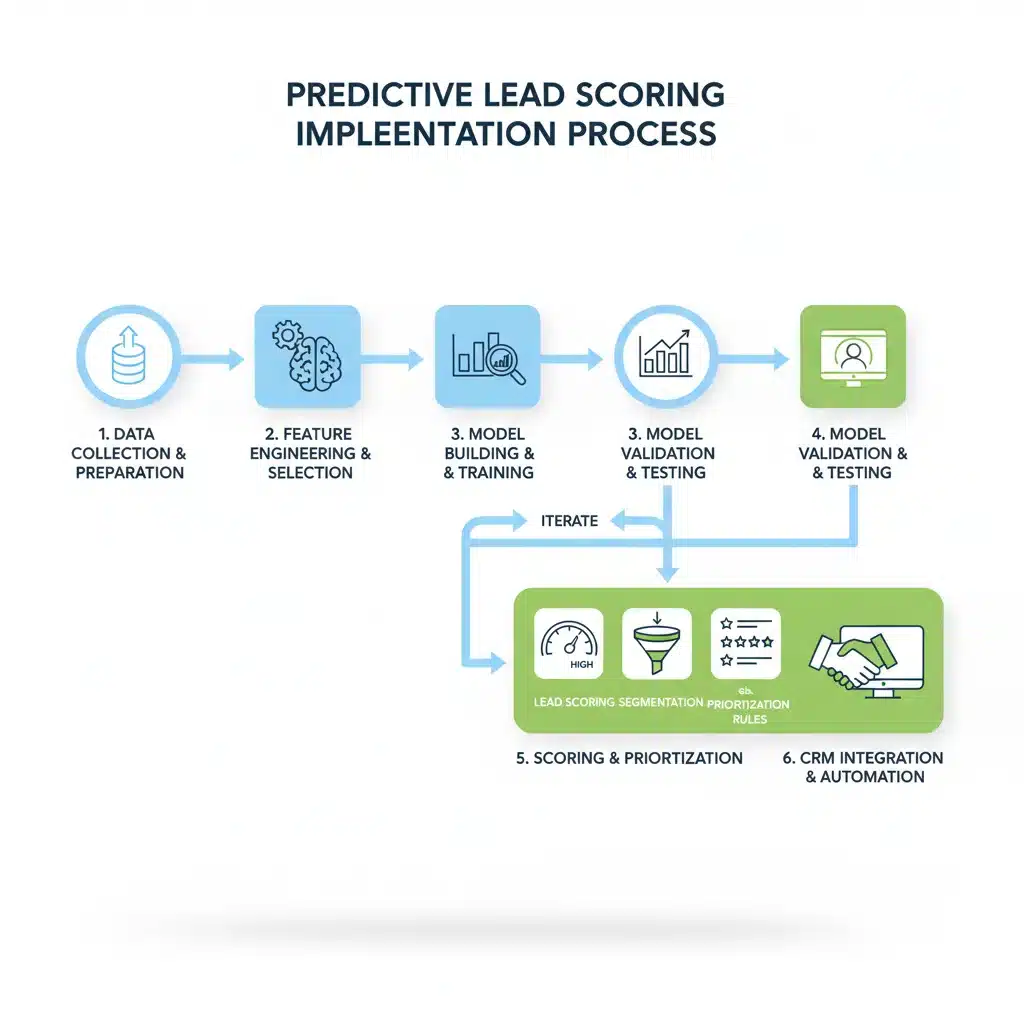
Implementing a successful predictive lead scoring system requires a structured approach. It’s not a ‘set it and forget it’ solution but an iterative process of data collection, model building, deployment, and continuous refinement. Here’s a detailed roadmap to get you started:
Step 1: Define Your Goals and Success Metrics
Before you even think about data, clearly articulate what you want to achieve. Are you aiming to increase conversion rates, reduce sales cycle length, improve sales team productivity, or all of the above? Define specific, measurable, achievable, relevant, and time-bound (SMART) goals. For instance, ‘Increase conversion rate of marketing-qualified leads (MQLs) to sales-qualified leads (SQLs) by 15% within six months’ or ‘Reduce the average sales cycle for high-value leads by 20%.’ This initial clarity will guide your entire implementation process and help you identify high-value leads more effectively.
Step 2: Gather and Prepare Your Data
Data is the lifeblood of any predictive model. The quality and quantity of your data will directly impact the accuracy and effectiveness of your predictive lead scoring system. You’ll need historical data on your leads, including:
- Demographic Information: Job title, industry, company size, location.
- Firmographic Data: Revenue, employee count, technologies used, growth rate.
- Behavioral Data: Website visits, content downloads, email opens/clicks, webinar attendance, product usage (for existing trial users).
- Engagement History: Interactions with sales, customer service, previous purchases.
- Conversion Outcomes: Most importantly, data indicating which leads converted into paying customers and which did not, along with their associated revenue.
Data Cleaning and Transformation: This is a critical sub-step. Your data will likely be messy. You’ll need to:
- Handle missing values.
- Remove duplicates.
- Standardize formats.
- Identify and correct inaccuracies.
- Aggregate data from various sources (CRM, marketing automation platform, website analytics, etc.).
The more comprehensive and clean your data, the better your predictive model will perform in identifying high-value leads.
Step 3: Choose Your Predictive Analytics Tools and Techniques
Several tools and techniques are available for predictive lead scoring. Your choice will depend on your budget, technical expertise, and specific requirements.
- Machine Learning Algorithms: Common algorithms include Logistic Regression, Decision Trees, Random Forests, Gradient Boosting Machines (GBM), and Neural Networks. These algorithms are designed to identify complex patterns within your data.
- Specialized Lead Scoring Platforms: Many vendors offer dedicated predictive lead scoring solutions (e.g., Salesforce Pardot, HubSpot, Infer, Lattice Engines). These platforms often integrate seamlessly with existing CRMs and marketing automation systems and provide pre-built models that can be customized.
- Data Science Platforms: For larger organizations with in-house data science teams, platforms like Python (with libraries like scikit-learn, TensorFlow) or R offer maximum flexibility for building custom models.
For most businesses, starting with an integrated platform that connects with your CRM and marketing automation system is often the most practical approach, as it streamlines the data flow and deployment.
Step 4: Build and Train Your Predictive Model
This is where the magic happens. Using your cleaned historical data, the chosen algorithm will be trained to identify the characteristics and behaviors that differentiate successful conversions from non-conversions. The model learns to assign a probability score to each lead, indicating their likelihood of becoming a customer.
- Feature Engineering: This involves creating new variables from existing data to improve the model’s predictive power. For example, instead of just ‘website visits,’ you might create ‘number of visits in the last 30 days’ or ‘time spent on key pages.’
- Model Training: The algorithm is fed the historical data, and it learns the relationships between lead attributes and conversion outcomes.
- Model Validation: It’s crucial to test your model on a separate dataset (data it hasn’t seen before) to ensure it generalizes well and isn’t just memorizing your training data. Metrics like accuracy, precision, recall, and F1-score are used to evaluate performance.
The output of this step is a robust model capable of assigning a predictive lead scoring to new incoming leads.
Step 5: Integrate and Deploy the System
A predictive model is only valuable if its insights are accessible and actionable. Integrate your predictive scoring system with your CRM (e.g., Salesforce, HubSpot) and marketing automation platform (e.g., Marketo, Pardot). This ensures that:
- New leads are automatically scored upon entry into your system.
- Sales teams can view lead scores directly within their CRM interface.
- Marketing teams can use scores for segmentation and targeted nurturing campaigns.
- Automated workflows can be triggered based on lead scores (e.g., highly scored leads are immediately routed to sales).
Seamless integration is key to realizing the intended 30% faster identification of high-value leads.
Step 6: Define Lead Prioritization and Routing Rules
Once leads are scored, you need clear rules for how sales and marketing teams will act on these scores. This involves:
- Score Thresholds: Define what constitutes a ‘hot,’ ‘warm,’ or ‘cold’ lead based on their predictive score.
- Routing Logic: Establish rules for routing leads to the appropriate sales reps or teams based on their score, geographic location, industry, or other relevant factors.
- Service Level Agreements (SLAs): Set expectations between sales and marketing regarding follow-up times for leads of different score levels.
This step translates the predictive insights into concrete actions for identifying high-value leads and driving conversions.
Step 7: Monitor, Evaluate, and Refine
Predictive lead scoring is an ongoing process. The market, customer behavior, and your product offerings evolve, and so too should your model. Regularly monitor the performance of your system:
- Track Key Metrics: Continuously measure conversion rates, sales cycle length, pipeline velocity, and ROI.
- Gather Feedback: Solicit input from sales teams on the quality of leads they are receiving.
- Retrain the Model: Periodically retrain your model with new data to ensure its accuracy and relevance. This is crucial for maintaining the desired speed in identifying high-value leads.
- A/B Testing: Experiment with different scoring thresholds or routing rules to optimize performance.
Continuous improvement is vital to maintaining the accuracy and effectiveness of your predictive lead scoring system and achieving your long-term goals.
Best Practices for Maximizing Predictive Lead Scoring Success
Implementing predictive lead scoring is a significant undertaking, but following certain best practices can significantly enhance your chances of success and ensure you consistently identify high-value leads.
1. Start Small, Scale Up
Don’t try to build the perfect, all-encompassing model on day one. Begin with a minimum viable product (MVP) – a simpler model focusing on your most critical conversion event or a specific lead segment. Gather feedback, demonstrate success, and then iteratively expand and refine your model. This approach reduces risk and allows for quicker wins, building momentum for further investment in predictive lead scoring.
2. Ensure Data Quality and Volume
As emphasized earlier, your model is only as good as your data. Invest time and resources in data cleaning, consolidation, and enrichment. The more accurate, comprehensive, and relevant your historical data, the more precise your predictions will be. A robust dataset is foundational for reliably identifying high-value leads.
3. Foster Sales and Marketing Collaboration
This cannot be overstated. For predictive lead scoring to truly shine, sales and marketing teams must be aligned. Marketing needs to understand what sales considers a ‘qualified’ lead, and sales needs to trust the scores provided by marketing. Regular meetings, shared goals, and transparent feedback loops are essential. This collaboration ensures that the predictive model serves both teams effectively.

4. Don’t Ignore Negative Data Points
It’s just as important to understand why leads *don’t* convert as it is to understand why they do. Include data on lost opportunities, unsubscribes, and leads that never progressed. This ‘negative’ data provides crucial insights that help the model accurately identify characteristics of low-quality leads, preventing sales teams from wasting time on them and further enhancing the speed of identifying high-value leads.
5. Combine Predictive with Traditional Scoring (Hybrid Approach)
While predictive models are powerful, sometimes a hybrid approach can be even more effective. You might use predictive analytics to assign a foundational probability score and then layer on a few critical, rule-based scores for specific, non-negotiable criteria (e.g., ‘must be in a specific industry’ or ‘must have a budget of X’). This blending of methodologies can offer the best of both worlds, ensuring comprehensive lead qualification.
6. Educate Your Sales Team
Sales teams need to understand how the predictive lead scoring system works, what the scores mean, and how to leverage them effectively. Provide training, clear documentation, and ongoing support. Address any skepticism by demonstrating the tangible benefits they will experience, such as fewer wasted calls and more successful closes. Their buy-in is critical for adoption and overall success.
7. Be Patient and Iterative
Building and optimizing a predictive lead scoring system is not an overnight process. It requires continuous monitoring, evaluation, and refinement. Be prepared to iterate, test, and adjust your models and processes based on performance data and feedback. The journey to identifying high-value leads 30% faster is a marathon, not a sprint.
8. Consider External Data Sources
To further enrich your lead data and improve predictive accuracy, consider integrating external data sources. This could include third-party firmographic data providers, technographic data (information about the technology a company uses), or even public social media data (with appropriate privacy considerations). These additional data points can uncover deeper insights and improve the model’s ability to identify high-value leads.
Challenges and How to Overcome Them
While the benefits of predictive lead scoring are compelling, organizations may encounter challenges during implementation. Being aware of these hurdles and having strategies to overcome them is crucial for success.
1. Data Silos and Inconsistent Data
Challenge: Data is often scattered across various systems (CRM, marketing automation, ERP, spreadsheets) and may be inconsistent, incomplete, or outdated. This makes it difficult to gather a unified view of a lead and train an accurate model.
Solution: Invest in data integration tools and processes to consolidate data into a central repository. Establish strict data governance policies to ensure data quality, consistency, and regular updates. Automated data cleaning and validation routines are essential.
2. Lack of Historical Conversion Data
Challenge: For new businesses or those with short sales cycles, there might not be enough historical conversion data to train a robust predictive model accurately.
Solution: Start by defining conversion more broadly (e.g., MQL to SQL conversion) and build models based on intermediate milestones. As more conversion data accumulates, refine your models. Alternatively, consider leveraging industry benchmarks or third-party data to supplement your initial efforts, though this should be approached with caution and validated against your specific context.
3. Resistance from Sales Teams
Challenge: Sales teams may be skeptical of new technologies or feel that an algorithm is replacing their intuition. They might resist adopting the new scoring system.
Solution: Involve sales teams early in the process. Educate them on how predictive lead scoring will make their jobs easier and more productive, not replace them. Emphasize that it’s a tool to empower them to identify high-value leads faster. Provide comprehensive training and demonstrate tangible results with pilot programs. Highlight how it allows them to focus on true selling rather than qualification.
4. Model Drift and Staleness
Challenge: Market conditions, customer behaviors, and product offerings change over time, causing the predictive model’s accuracy to degrade (model drift).
Solution: Implement a continuous monitoring and retraining strategy. Schedule regular model evaluations and retrain the model with fresh data periodically. Automate the retraining process where possible. Stay abreast of market trends and adjust model features accordingly to ensure the system remains adept at identifying new high-value leads.
5. Technical Expertise and Resources
Challenge: Building and maintaining predictive models often requires specialized data science or machine learning expertise, which may not be available in-house.
Solution: Consider leveraging off-the-shelf predictive lead scoring platforms that require less technical expertise. Alternatively, partner with a data science consultancy or hire specialized talent. For smaller businesses, focusing on simpler, rule-based scoring initially and gradually introducing predictive elements as resources allow can be a viable path.
The Future of Lead Scoring: AI and Beyond
The journey with predictive lead scoring doesn’t end with implementation. The field of AI and machine learning is constantly evolving, promising even more sophisticated approaches to identifying high-value leads. We can expect future developments to include:
- Deep Learning Models: More complex neural networks capable of uncovering even subtler patterns in unstructured data (e.g., text from customer interactions, voice analysis).
- Real-time Scoring: Instantaneous scoring based on real-time behavioral data, allowing for immediate, hyper-personalized engagement.
- Prescriptive Analytics: Moving beyond just predicting who will convert to recommending the best next action for each lead (e.g., ‘send email A, then call in 2 hours’).
- Explainable AI (XAI): Developing models that can not only make predictions but also explain *why* a lead received a particular score, increasing trust and usability for sales teams.
Embracing predictive lead scoring today is not just about gaining a present advantage; it’s about positioning your organization to thrive in the data-driven future of sales and marketing. The goal of identifying high-value leads 30% faster by 2026 is an ambitious yet entirely achievable target with the right strategy and tools.
Conclusion: Your Path to Faster, Smarter Lead Conversion
The imperative for businesses to identify high-value leads quickly and efficiently has never been greater. Traditional lead scoring methods, while foundational, are increasingly insufficient in the face of vast data volumes and dynamic customer behaviors. Predictive lead scoring offers a powerful, data-driven solution, enabling organizations to move beyond educated guesses to precise, actionable insights.
By following the step-by-step guide outlined in this article – from defining clear goals and meticulously preparing data to building robust models, integrating systems, and continuously refining your approach – you can unlock a new era of sales efficiency and marketing effectiveness. The benefits are clear: increased conversion rates, shorter sales cycles, improved ROI, and a significant competitive advantage. The commitment to identify high-value leads 30% faster by 2026 is a strategic investment that will yield substantial returns.
The future of sales and marketing is intelligent, proactive, and data-powered. By adopting predictive lead scoring, you’re not just optimizing a process; you’re transforming your entire approach to growth, ensuring that your sales team spends their valuable time engaging with the prospects most likely to become your next loyal customers. Start your journey today and empower your business with the foresight to win in tomorrow’s market.