SEO Landscape 2025: Google Algorithm Adjustments

Adapting to the dynamic 2025 SEO landscape requires strategic shifts in content creation, technical optimization, user experience, and authority building to align with Google’s sophisticated algorithm updates.
The digital marketing world is in a constant state of flux, and nowhere is this more evident than in search engine optimization. As we look towards 2025, understanding The Evolving SEO Landscape: 4 Core Strategy Adjustments for Google’s Latest Algorithm Updates of 2025 isn’t just beneficial; it’s absolutely crucial for any business aiming to maintain or improve its online visibility. Google’s algorithms are becoming increasingly intelligent and nuanced, demanding a more sophisticated approach from marketers. Are you ready to refine your strategy?
Understanding Google’s AI-Driven Evolution in 2025
Google’s commitment to delivering the most relevant and high-quality search results continues to drive its algorithm updates. In 2025, artificial intelligence and machine learning are more deeply integrated than ever, influencing how content is perceived, ranked, and presented to users. This evolution moves beyond simple keyword matching, focusing instead on contextual understanding, user intent, and the overall value a page provides.
The emphasis is squarely on E-E-A-T (Experience, Expertise, Authoritativeness, Trustworthiness), which Google uses to evaluate content creators and their output. Websites that can demonstrate genuine experience and deep expertise will naturally fare better. This means content must not only be informative but also reflect real-world knowledge and credible sources.
The Rise of Semantic Search and Entity Understanding
Google’s algorithms are increasingly adept at understanding the relationships between entities and concepts, rather than just individual keywords. This shift, known as semantic search, means that your content needs to cover topics comprehensively and demonstrate a deep understanding of your niche. It’s no longer enough to simply sprinkle keywords throughout your text.
- Focus on topical authority over keyword density.
- Create content clusters around core themes.
- Use structured data to help Google understand entities.
- Answer related questions within your content naturally.
This approach helps Google connect the dots, recognizing your site as a valuable resource for a given topic. By doing so, you improve your chances of ranking for a wider array of related queries and long-tail keywords. It’s about building a knowledge hub that genuinely serves user needs.
In essence, the 2025 SEO landscape demands a more holistic view of content creation. It’s about becoming an indispensable source of information in your field, reflecting the genuine expertise and trustworthiness that Google’s AI craves. Ignoring these foundational changes will undoubtedly lead to diminishing returns in search visibility.
Core Strategy Adjustment 1: Prioritizing User Experience (UX) Signals
User experience has transformed from a secondary consideration to a primary ranking factor. Google’s algorithm updates in 2025 place significant weight on how users interact with your website. Metrics like Core Web Vitals (Largest Contentful Paint, First Input Delay, Cumulative Layout Shift) are more critical than ever, but UX extends beyond these technical aspects to encompass the overall journey a user takes on your site.
A positive user experience cultivates trust and encourages engagement, signaling to Google that your site provides value. This translates into lower bounce rates, longer session durations, and higher conversion rates, all of which are strong indicators of content quality and relevance.
Optimizing for Core Web Vitals and Beyond
Ensuring your website loads quickly, is visually stable, and offers a smooth interactive experience is non-negotiable. This involves continuous monitoring and optimization of your site’s performance. Beyond Core Web Vitals, consider the intuitiveness of your navigation, the clarity of your content presentation, and the responsiveness across different devices.
- Regularly audit site speed and performance.
- Implement responsive design for all devices.
- Simplify navigation and site structure.
- Ensure clear and readable typography.
Google’s algorithms are designed to reward websites that prioritize their users. A frustrated user is unlikely to return, and this negative signal can impact your rankings. Therefore, every design and development decision should be made with the user at the forefront, creating an enjoyable and efficient browsing experience.
The holistic view of UX in 2025 also includes accessibility. Making your website usable for everyone, regardless of ability, not only broadens your audience but also aligns with Google’s mission to make information universally accessible. Investing in robust UX is no longer just good practice; it’s an essential SEO strategy.
Core Strategy Adjustment 2: Mastering E-E-A-T Through Content Excellence
The E-E-A-T framework—Experience, Expertise, Authoritativeness, and Trustworthiness—is at the heart of Google’s quality guidelines and is more influential than ever in 2025. This means that merely creating content is insufficient; you must demonstrate genuine knowledge and credibility within your niche. Google wants to ensure that the information it presents to users is reliable and comes from trustworthy sources.
For marketers, this translates into a need for content that goes beyond surface-level information. It requires deep dives, original research, and a clear demonstration of the author’s or organization’s experience in the subject matter. Content excellence is now synonymous with verifiable quality and demonstrable authority.
Showcasing Genuine Experience and Expertise
To satisfy the ‘Experience’ and ‘Expertise’ components of E-E-A-T, content creators must actively showcase their practical knowledge. This can involve sharing case studies, personal anecdotes, original data, or detailed how-to guides that reflect real-world application. It’s about proving you’ve ‘been there, done that,’ not just read about it.
- Feature author bios with relevant credentials.
- Include original research and data points.
- Share practical examples and case studies.
- Cite reputable sources and studies.
Furthermore, building a strong personal brand for your content creators can significantly boost your E-E-A-T. When Google can associate high-quality content with recognized experts, it enhances the perceived authority and trustworthiness of your entire website. This is particularly crucial in YMYL (Your Money or Your Life) topics where accuracy and reliability are paramount.
The continuous evolution of Google’s algorithms means that content creators must think like genuine experts and educators. The goal is to produce content that not only answers questions but also builds a comprehensive understanding for the reader, establishing your site as an authoritative voice. This foundational shift in content strategy is vital for long-term SEO success in the modern landscape.
Core Strategy Adjustment 3: Adapting to AI-Powered Search and Generative AI
The integration of AI into Google’s search capabilities, particularly with developments in generative AI and conversational search, is profoundly reshaping how users find information and how websites need to optimize. In 2025, search results are becoming more dynamic, personalized, and often summarize information directly, posing new challenges and opportunities for SEO professionals.
This shift means that simply ranking high for a keyword might not be enough if a generative AI summary answers the user’s query directly within the search results. Content must be structured to be easily digestible by AI and provide unique insights that go beyond basic factual recall.
Optimizing for Generative AI and Featured Snippets
To appear in AI-generated summaries or featured snippets, content needs to be precise, concise, and directly answer common user questions. This involves structuring your content with clear headings, question-and-answer formats, and bulleted or numbered lists that AI can easily extract and rephrase. The goal is to become the authoritative source that Google’s AI trusts for specific queries.
- Structure content with clear H2s and H3s.
- Use question-and-answer sections.
- Provide direct, concise answers to common queries.
- Ensure factual accuracy and up-to-date information.
Moreover, the rise of conversational search means that queries are often longer and more natural-language based. Optimizing for these long-tail, conversational queries requires a deeper understanding of user intent and the nuances of human language. Your content should anticipate these questions and provide comprehensive answers that flow naturally, as if in a conversation.
Embracing AI-powered search also means understanding the role of multimodal search, where users can search using images, voice, and even video. While text remains foundational, considering how your content can be optimized for these alternative search methods will provide a significant competitive edge. The future of search is intelligent, and your content strategy must reflect that intelligence.
Core Strategy Adjustment 4: Re-evaluating Link Building and Off-Page SEO
While content and user experience are paramount, off-page SEO, particularly link building, remains a critical component of Google’s ranking algorithms in 2025. However, the nature of effective link building has evolved significantly. Google is increasingly sophisticated at identifying manipulative link schemes, placing a higher value on editorial links from genuinely authoritative and relevant sources.
The focus has shifted from quantity to quality, with an emphasis on natural, earned backlinks that signal true authority and trust. Any attempt to artificially inflate link profiles can lead to penalties, making a strategic and ethical approach more important than ever.
Building Authority Through Genuine Relationships
Effective link building in 2025 is about fostering genuine relationships and creating content that is so valuable it naturally attracts backlinks. This involves outreach to industry leaders, journalists, and complementary businesses, offering insights or resources that they would genuinely want to link to. Guest posting, when done ethically and on relevant, high-authority sites, can still be effective.
- Create link-worthy content (e.g., original research, comprehensive guides).
- Engage in strategic outreach to industry influencers.
- Participate in community discussions and forums.
- Monitor your backlink profile for toxic links.
Furthermore, local SEO and brand mentions play an increasingly important role in off-page signals. Google’s algorithms are adept at understanding brand reputation and relevance through mentions across the web, even without a direct hyperlink. Building a strong brand presence and fostering positive online sentiment contributes significantly to your overall authority.
The re-evaluation of link building in 2025 emphasizes authenticity and value. It’s about building a web presence that naturally commands respect and attention, leading to organic mentions and links. Moving away from outdated, manipulative tactics and embracing a truly ethical approach to off-page SEO will be crucial for sustainable ranking success.
The Interconnectedness of Modern SEO Strategies
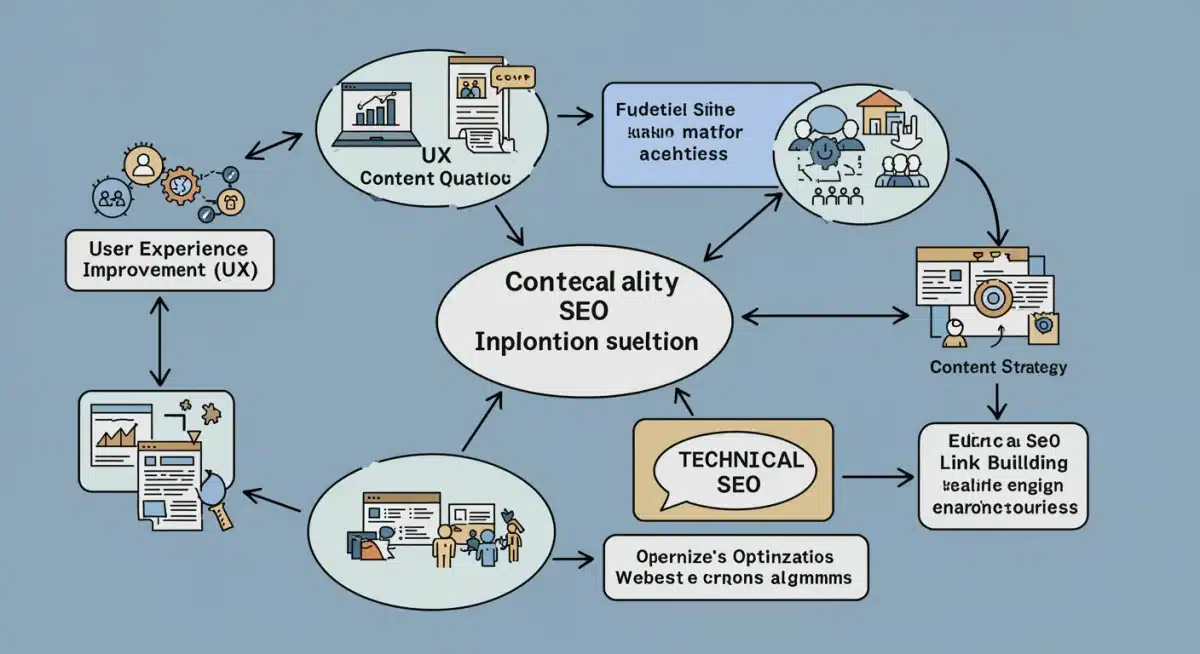
It’s important to recognize that these four core strategy adjustments are not isolated efforts but are deeply interconnected. In the 2025 SEO landscape, content excellence feeds into user experience, which in turn influences how Google’s AI interprets your site, and all these factors contribute to your overall authority and ability to earn valuable backlinks. A weakness in one area can undermine strengths in another.
For instance, even the most expertly crafted content will struggle if your website loads slowly or offers a poor mobile experience. Similarly, a technically perfect site won’t rank without high-quality content that satisfies user intent and demonstrates E-E-A-T. Success in modern SEO requires a holistic and integrated approach.
Regular audits and continuous adaptation are key. Google’s algorithms are constantly evolving, and what works today might need refinement tomorrow. Staying informed about industry trends, monitoring your performance metrics, and being agile in your strategy will ensure your business remains competitive and visible in the ever-changing search landscape. The commitment to continuous learning and optimization is perhaps the most crucial adjustment of all.
| Key Adjustment | Brief Description |
|---|---|
| User Experience (UX) | Prioritize site speed, mobile responsiveness, and intuitive navigation for positive user signals. |
| E-E-A-T Content | Create content demonstrating genuine experience, expertise, authoritativeness, and trustworthiness. |
| AI-Powered Search | Optimize content for generative AI summaries, conversational queries, and structured data. |
| Ethical Link Building | Focus on earning natural, high-quality backlinks from authoritative and relevant sources. |
Frequently Asked Questions About SEO in 2025
AI-generated content will increasingly be scrutinized for E-E-A-T. While AI can assist, human oversight and unique insights are crucial to ensure content meets Google’s quality standards for experience and trustworthiness.
Core Web Vitals remain critical, alongside mobile-first indexing, secure protocols (HTTPS), structured data implementation, and ensuring a fast, accessible, and crawlable website architecture. Technical health is foundational.
Absolutely. Keyword research evolves to focus on topical clusters and user intent rather than single keywords. Understanding the broader context of search queries helps create comprehensive content that satisfies semantic search.
Small businesses should focus on niche authority, local SEO, exceptional user experience, and building genuine E-E-A-T. Quality over quantity, combined with strong local signals, can yield significant results.
Social media doesn’t directly impact rankings, but it drives traffic, facilitates brand mentions, and helps build authority. These indirect signals contribute to overall brand visibility and can influence search performance.
Conclusion
The evolving SEO landscape of 2025 presents both challenges and unparalleled opportunities for businesses willing to adapt. The core strategy adjustments discussed—prioritizing user experience, mastering E-E-A-T through content excellence, adapting to AI-powered search, and re-evaluating link building—are not merely trends but fundamental shifts in how search engines perceive and value online content. Success in this new era hinges on a commitment to creating truly valuable, user-centric, and technically sound digital experiences. By embracing these changes, marketers can ensure their strategies remain robust, driving sustainable growth and maintaining strong visibility in Google’s increasingly intelligent search results.